
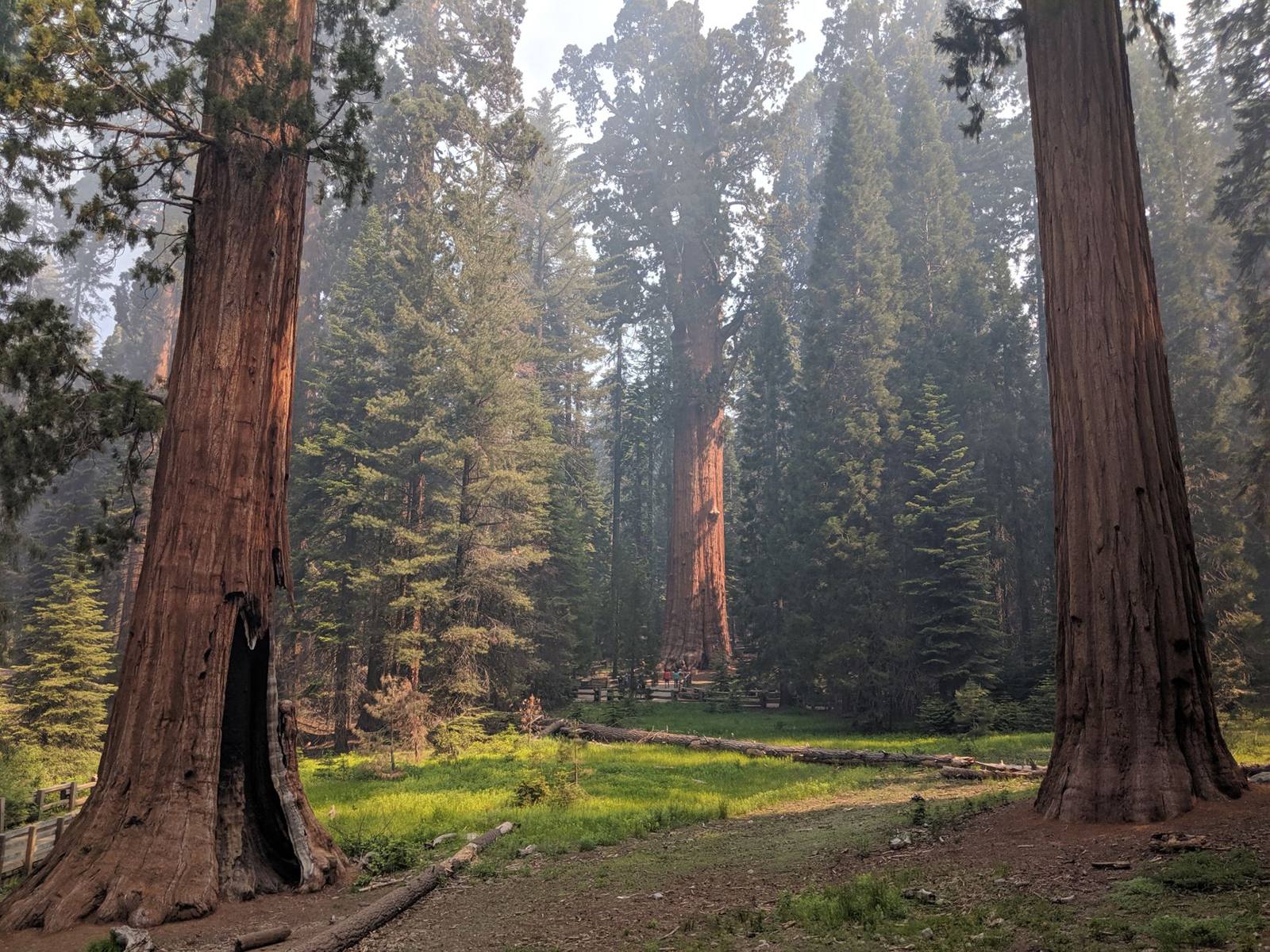
Sequoia National Park is worth visiting for anyone who wants to stand next to the largest trees on Earth by volume, starting with the General Sherman Tree at 274.9 feet tall and roughly 52,500 cubic feet of trunk wood1. It is a poor fit for a traveler with only a few hours to spare, since the park covers 865,964 acres with no interstate access and the drive up into the groves is slow, curving mountain road2. Sequoia is less developed than Yosemite: no timed-entry reservation, a single in-park hotel, and 97% of the land managed as wilderness32. July and August are the busiest months, and the small parking lots at marquee sights like Moro Rock fill early even outside peak season45. The honest version of this answer depends on what you are trying to see: sequoias, or something else the Sierra also offers.
- Worth it for: the only place to see the biggest trees on Earth in an unlogged, protected setting1
- Not worth a detour for: a traveler with under half a day and no interest in trees or mountain driving2
- Entrance fee: $35 per private vehicle, valid 1-7 days, covers both Sequoia and Kings Canyon3
- No reservation needed to enter, unlike some other California parks3
- Busiest months: July and August4
- Parking: small lots at Moro Rock and other marquee stops fill fast on weekdays5
- Wilderness: 97% of the combined 865,964 acres is managed as wilderness, most of it reachable only on foot2
The question is not whether Sequoia National Park is beautiful. It is whether the specific thing Sequoia offers, giant sequoia trees at scale, is worth the specific cost of getting there: a slow drive, a small footprint of paved sights, and a summer crowd squeezed into a handful of parking lots. For context on how this compares to other parks in the region, see the complete visitor guide.
Who it is worth it for
If the reason you are considering Sequoia is the trees themselves, it delivers something no other park does. The General Sherman Tree is the largest tree on Earth by volume, at 274.9 feet tall with a 102.6-foot ground circumference and roughly 52,500 cubic feet of trunk wood, about 1,400 tons, and it stands in Giant Forest, which holds the largest unlogged sequoia groves in California16. The General Grant Tree, the second-largest by volume, sits a short drive away in Kings Canyon and has been a National Shrine since 19567. Nothing else in the country puts trees this size this close to a paved trail.
It is also worth it for anyone who wants fewer crowds than Yosemite without giving up granite domes and big Sierra views. Moro Rock’s 300-foot climb ends at a viewpoint looking toward the Great Western Divide, the Kaweah River canyon, and on clear days California’s Coast Range, and Sequoia’s 865,964 combined acres are 97% wilderness, so the developed footprint is small and the backcountry is enormous25. For a detailed side-by-side, see Sequoia vs Yosemite.
It is worth it for a multi-day trip with time to see both Sequoia and Kings Canyon, since they are managed as one unit and share an entrance system2. A single day works too, if you plan carefully; see one day in Sequoia National Park for a realistic hour-by-hour plan built around exactly that constraint.
Who should choose Yosemite instead
If what you actually want is waterfalls, sheer granite walls, and a wider menu of day hikes reachable by shuttle, Yosemite is the better fit, and it is closer to San Francisco. Sequoia’s paved sightseeing is concentrated in a few small areas, Giant Forest and Grant Grove chief among them, connected by a two-lane mountain road rather than a valley loop2. The full comparison, including which park handles crowds better and which is cheaper for a family, is in Sequoia vs Yosemite.
Who should choose the coast redwoods instead
If your interest is redwoods generally rather than giant sequoias specifically, and you are starting from the Bay Area, Redwood National and State Parks or Muir Woods put you next to trees within a shorter drive, and add an ocean. Giant sequoias only grow naturally in about 40 groves scattered along the western slope of the Sierra Nevada, all of them a multi-hour drive from any major coastal city, so choosing them over the coast redwoods is a real trade of driving time for a different kind of tree8. For that comparison directly, see Redwood National Park vs Sequoia National Park.
What the drive actually costs you
There is no interstate to Sequoia. The park’s own materials describe the road up into Giant Forest as a mountain highway with continuous curves, and the entrance fee itself, $35 per private vehicle for 1-7 days, is the smallest part of the cost; the larger cost is time and attention behind the wheel32. Visitors driving up from the Central Valley gain thousands of feet of elevation on a two-lane road, which is slower than the mileage alone suggests. If you are coming from a specific city, check the dedicated drive-time pages for Los Angeles, San Francisco, or Fresno before you commit to a day trip, since a plan built on a straight-line distance will run long.
Elevation is also a real factor for some visitors. Giant Forest, Lodgepole, and Grant Grove sit at 5,000 to 7,000 feet, high enough that some people notice shortness of breath or mild headache, especially if arriving directly from sea level2. It is rarely serious, but it is worth planning for if you have a heart or lung condition.
What the crowds actually cost you
Sequoia does not use timed entry, unlike some nearby parks, so there is no reservation to plan around3. That is a genuine advantage over places like Yosemite in a comparable summer. But the flip side is that popularity concentrates at a few pinch points rather than spreading out. July and August are the parks’ busiest months4. The lot at Moro Rock is small and “fills fast” on weekdays, and on summer weekends the road is closed to private vehicles entirely, with the free shuttle from Giant Forest Museum as the only access5. If you arrive at a marquee sight at 11 a.m. in August expecting an empty parking lot, you will be disappointed regardless of how you feel about the trees. Arriving early, or visiting the shoulder seasons, avoids most of this; see how to avoid crowds in Sequoia National Park for specifics.
The honest answer
Sequoia is worth visiting on its own terms, not as a quick add-on to a Yosemite trip and not as a substitute for the coast redwoods if what you actually want is a coastal forest. It rewards travelers who want to see the largest trees on Earth, who don’t mind a slow mountain drive, and who plan around the crowded pinch points rather than expecting Yosemite-style infrastructure to spread visitors out. It is a poor fit for anyone with only a couple of hours, a fear of narrow mountain roads, or no particular interest in trees.
Frequently Asked Questions
Is Sequoia National Park worth visiting if I have already been to Yosemite?
Yes, for a different experience. Sequoia’s draw is the trees themselves, not granite walls or waterfalls, and Giant Forest holds the largest unlogged sequoia groves in California6. See Sequoia vs Yosemite for the full comparison.
Is Sequoia more crowded than Yosemite?
That comparison depends on which sight and which month; Sequoia’s own busiest months are July and August, and its small parking lots create bottlenecks at spots like Moro Rock even though the park overall covers a huge wilderness area452. See Sequoia vs Yosemite for specifics.
Can I see Sequoia and Kings Canyon in one day?
You can see the highlights of one district in a day. Sequoia and Kings Canyon are managed as a single 865,964-acre unit but are geographically separated, so covering both thoroughly in one day is unrealistic2. See one day in Sequoia National Park for a realistic plan.
Is Sequoia worth it if I only have a few hours?
Marginally. The park’s most famous sights are close together in Giant Forest, but the drive in from any gateway town already takes real time on a mountain road, so a stop of only an hour or two mostly gets you a photo at the General Sherman Tree and little else2.
Should I visit the redwoods instead of the sequoias?
Depends on what you want to see. Giant sequoias, the biggest trees by volume, grow only in about 40 Sierra Nevada groves; coast redwoods, the tallest trees, grow along the California and southern Oregon coast8. See Redwood National Park vs Sequoia National Park for a direct comparison.
Do I need a reservation to visit Sequoia National Park?
Is the drive to Sequoia difficult?
It involves sustained mountain driving with continuous curves and thousands of feet of elevation gain, which is slower and more demanding than the same distance on flat highway2. Anyone uneasy on mountain roads should plan extra time and consider the wider Highway 180 route through Grant Grove.
Related Articles
Sources
- General Sherman Tree — National Park Service. Accessed 2026-09-15.
- Basic Information — National Park Service. Accessed 2026-09-15.
- Entrance Fees — National Park Service. Accessed 2026-09-15.
- Ranger Programs — National Park Service. Accessed 2026-09-15.
- Moro Rock — National Park Service. Accessed 2026-09-15.
- Giant Forest and Lodgepole — National Park Service. Accessed 2026-09-15.
- General Grant Tree — National Park Service. Accessed 2026-09-15.
- Sequoia Groves — National Park Service. Accessed 2026-09-15.