
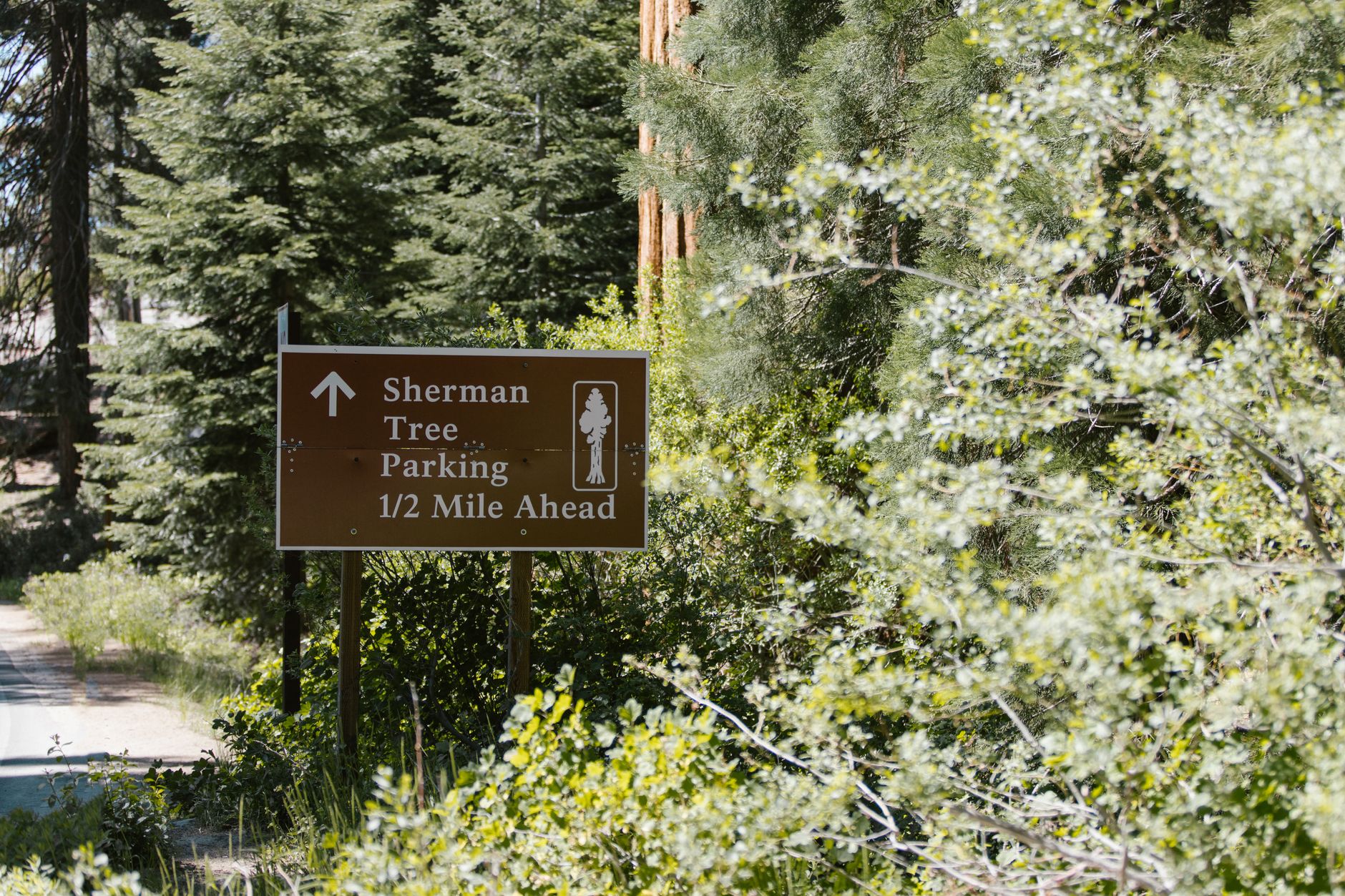
The General Sherman Tree in Sequoia National Park’s Giant Forest is the largest living tree on Earth by trunk volume, not by height or age. The National Park Service measures it at 274.9 feet tall, 102.6 feet around at the ground, 36.5 feet across at the base, and about 52,500 cubic feet of trunk wood weighing close to 1,400 tons12. It is roughly 2,200 years old, well short of the oldest known giant sequoias at over 3,200 years34. The tree stands beside a half-mile paved trail off Wolverton Road, two miles north of the Giant Forest Museum, with a shorter wheelchair-accessible path from the Generals Highway56.
- Height: 274.9 ft (83.8 m)1
- Trunk volume: about 52,500 cu ft (1,487 m³)1
- Circumference at ground: 102.6 ft (31.1 m)1
- Age: about 2,200 years3
- Rank: largest tree in the world by volume; General Grant is second2
- Trail: 0.5 mi each way, 200 ft of climb on the way back; 500 ft accessible trail from the highway lot5
- Named: August 7, 1879, by James Wolverton, after Civil War general William Tecumseh Sherman7
People arrive at the General Sherman Tree expecting to be impressed by its height, then find that it is the width that stops them. The trunk is still 17 feet across at 120 feet above the ground, higher than most trees ever grow8. This page collects every verified number about the tree, explains what “largest” actually means, tells the story of its name, and walks through how to reach it in summer and in winter.
What "largest tree in the world" means
General Sherman is not the tallest tree, not the widest, and not the oldest. It is the largest by volume of trunk wood, which is the measure the National Park Service uses to rank giant sequoias2. Coast redwoods grow taller. The tallest known, Hyperion in Redwood National Park, reaches about 380 feet9. A Montezuma cypress in Mexico has a greater diameter, and bristlecone pines live longer. The Forest Service’s own silvics manual puts it plainly: one species is thicker than giant sequoia, three grow taller, and one lives longer, but none packs more wood into a single trunk10.
Volume rankings can shift depending on what you count. If branches are included, the President Tree, a short walk away on the Congress Trail, edges into second place with more than 54,000 cubic feet of wood and bark211. By trunk alone, the order is General Sherman, then General Grant in Kings Canyon at 46,608 cubic feet212.
The numbers, with their sources
| Measurement | Value | Source |
|---|---|---|
| Height | 274.9 ft (83.8 m) | NPS1 |
| Ground circumference | 102.6 ft (31.1 m) | NPS1 |
| Maximum base diameter | 36.5 ft (11.1 m) | NPS1 |
| Diameter at 120 ft above ground | 17 ft (5.2 m) | NPS FAQ8 |
| Height of first large branch | 130 ft (39.6 m) | NPS1 |
| Largest branch diameter | 6.8 ft (2.1 m) | NPS1 |
| Trunk volume | 52,500 cu ft (1,487 m³) | NPS1 |
| Estimated trunk weight | ~1,400 tons | NPS1 |
| Estimated age | ~2,200 years | NPS3 |
Two small discrepancies exist within official sources. The NPS largest-trees list gives the volume as 52,508 cubic feet rather than the rounded 52,5002, and the park’s FAQ page quotes a base circumference of 109 feet against the 102.6 feet on the tree’s dedicated page8. The difference is where the tape is held on an irregular, buttressed base. The figures on the tree’s own NPS page are the ones used here.
How heavy is 1,400 tons?
The NPS offers its own comparisons: the trunk weighs about as much as 15 adult blue whales, 10 diesel-electric locomotives, or 25 battle tanks, and contains roughly 630,000 board feet of lumber, enough to frame about 120 average houses1. Nobody will ever check that last figure. Giant sequoia wood is brittle and shatters when a tree falls, one reason the 1890s logging boom in these mountains never turned a profit1013.
How old is General Sherman?
The best current estimate is about 2,200 years, the figure on the NPS place page3. Save the Redwoods League gives a range of 2,200 to 2,700 years4. A 1975 NPS history put it at 3,000 to 3,500 years, an estimate later research has treated as too high7.
Nobody has counted the rings. A living tree of this size cannot be cored to its center, so age is estimated from diameter, growth rates measured on logged stumps, and the tree’s fire-scar record. The relationship is loose. In the analysis of the 2020 Castle Fire, researchers noted that a sequoia 15 feet in diameter has a median age of about 2,000 years but can be anywhere from 800 to 3,10014. General Sherman is not the oldest sequoia. Ring counts on stumps in Converse Basin exceed 3,200 years10, and the Grizzly Giant in Yosemite is estimated at around 2,90015. For the full story, see how old giant sequoias get.
Is it still growing?
Yes, and faster in volume than almost any younger tree. At roughly 2,500 years, the Forest Service estimates General Sherman adds only about a millimeter of radius each year, but spread over such a huge trunk that works out to 40 to 51 cubic feet of new wood annually10. The NPS puts it another way: each year the tree adds enough wood to make a 60-foot oak with a 3-foot trunk1. Climbing measurements of the nearby President Tree showed the same pattern, with an old tree laying down more wood per year than vigorous young ones11. There is a separate page on whether General Sherman is still growing.
Height is a different matter. Giant sequoias grow upward quickly for their first century, slow after about 400 years, and level off near 250 feet between 800 and 1,500 years of age10. General Sherman’s crown has a dead top and it is not getting taller.
Why is it named after General Sherman?
James Wolverton, a cattleman and former Union soldier who had served under William Tecumseh Sherman in the Civil War, named the tree on August 7, 18797. The name did not stick right away. In the late 1880s the Kaweah Colony, a socialist cooperative that had filed timber claims on Giant Forest and was building a road toward it, renamed the tree the Karl Marx Tree. When the colony collapsed in 1891, a year after Sequoia National Park was created, the tree reverted to Wolverton’s name7. The colony’s story is told on the page about the Kaweah Colony.
The 2021 fire and the foil
In September 2021 the KNP Complex Fire, started by lightning, burned toward Giant Forest. Fire crews wrapped the base of General Sherman and other named trees in fire-resistant aluminum foil to a height of 10 to 15 feet1. The tree survived without significant damage. Giant Forest burned mostly at low intensity because the NPS had been conducting prescribed burns there since 1979, including a 245-acre burn around the Sherman Tree in 2019 that reduced the fuel on the ground1617. Redwood Mountain Grove, which had not had recent fire, burned far more severely in the same event18. That contrast is explained on the page about why giant sequoias need fire, and the foil story has its own page: why General Sherman was wrapped in foil.
How to get to the General Sherman Tree
The tree stands in Giant Forest at about 7,000 feet in elevation. From the Ash Mountain entrance on Highway 198, it is 18 miles and about 70 minutes of slow, winding driving on the Generals Highway to the Sherman Tree parking area19. From the Giant Forest Museum it is 2 miles and 10 minutes19. In summer, the drive from the entrance is a serious undertaking with a vehicle over 22 feet long; the NPS advises anything longer to enter from Highway 180 instead20.
The main trail (summer)
The main Sherman Tree parking lot is off Wolverton Road, about two miles north of the Giant Forest Museum. From there the paved trail descends about half a mile to the tree, with roughly 200 feet of climb on the way back5. Most visitors take 30 to 60 minutes round trip with time at the tree. The path has steps and benches. Pets are not allowed on this trail, as on every trail in the park21.
In peak season the lot fills by mid-morning. The free in-park shuttle, running late May through Labor Day, stops at the Sherman Tree trailhead every 15 to 20 minutes on its way between the Giant Forest Museum, Lodgepole, and Wolverton522. Parking once at the museum or at Lodgepole and riding the shuttle avoids the problem entirely. See the Sequoia shuttle guide.
The accessible trail
A second, much shorter route begins at a small lot directly on the Generals Highway, reserved in summer for vehicles with a disability placard. From it, a paved trail about 500 feet long with inclines under 5 percent and benches leads to the tree56. In summer anyone can walk down the main trail to the tree and then continue to this lower lot to catch the shuttle back up, skipping the climb5.
In winter
From roughly November to April, snow closes Wolverton Road and the main lot. Everyone parks at the lower accessible lot on the Generals Highway. The Sherman Tree Trail is the only trail in Giant Forest that the park keeps plowed, but it is often icy, and the NPS advises traction cleats for boots523. Tire chains may be required on the Generals Highway any time it snows, so carry them from late fall through spring24. The tree in snow is worth the effort. Details are on the page about Sequoia National Park in winter.
What to see nearby
- The Congress Trail starts beside General Sherman and loops 2.7 paved miles past the House and Senate groups and the President Tree, the second-largest tree when branches count252. Read the Congress Trail guide.
- The Giant Forest Museum, 2 miles south, is free and the best place to start, with exhibits on how sequoias grow and burn26.
- Moro Rock, Tunnel Log, and Crescent Meadow are along the Moro Rock and Crescent Meadow Road, which begins near the museum and is closed to private cars on summer weekends, when the shuttle serves it instead27.
For a full plan of the area, see the Giant Forest guide and the one-day Sequoia itinerary.
Frequently Asked Questions
How tall is the General Sherman Tree?
How old is the General Sherman Tree?
How much does the General Sherman Tree weigh?
The trunk alone weighs close to 1,400 tons (about 1,270 metric tons), comparable to 15 adult blue whales. That figure does not include branches, roots, or foliage1.
How long is the walk to the General Sherman Tree?
Is General Sherman the biggest tree in the world?
Can you touch or hug the General Sherman Tree?
No. A low fence surrounds the base to protect its shallow roots from compaction. Visitors stay on the paved viewing area a few feet away5.
Did the General Sherman Tree survive the 2021 fire?
Related Articles
Sources
- The General Sherman Tree — National Park Service, Sequoia & Kings Canyon. Accessed 2026-09-06.
- The Largest Trees in the World — National Park Service. Accessed 2026-09-06.
- General Sherman Tree (place page) — National Park Service. Accessed 2026-09-06.
- Giant Sequoias — Save the Redwoods League. Accessed 2026-09-06.
- The General Sherman Tree Trail — National Park Service. Accessed 2026-09-06.
- Congress Trail (accessibility notes) — National Park Service. Accessed 2026-09-06.
- Sequoia–Kings Canyon National Parks: A History of the Parks — A. Berle Clemensen, NPS, 1975. Accessed 2026-09-06.
- Frequently Asked Questions — National Park Service, Sequoia & Kings Canyon. Accessed 2026-09-06.
- Coast Redwoods — Save the Redwoods League. Accessed 2026-09-06.
- Sequoiadendron giganteum, Silvics of North America — U.S. Forest Service. Accessed 2026-09-06.
- Forest Giant — National Geographic, December 2012. Accessed 2026-09-06.
- The General Grant Tree — National Park Service. Accessed 2026-09-06.
- Discover History, Sequoia National Forest — U.S. Forest Service. Accessed 2026-09-06.
- Wildfires Kill Unprecedented Numbers of Large Sequoia Trees — National Park Service. Accessed 2026-09-06.
- Grizzly Giant Tour: Enduring Giant — National Park Service, Yosemite. Accessed 2026-09-06.
- KNP Complex Fire — National Park Service. Accessed 2026-09-06.
- Sherman Prescribed Burn Planned in Sequoia National Park — National Park Service. Accessed 2026-09-06.
- Giant Sequoias and Fire — National Park Service. Accessed 2026-09-06.
- Winter 2025–26 Trip Planner (PDF) — National Park Service. Accessed 2026-09-06.
- Directions & Transportation — National Park Service. Accessed 2026-09-06.
- Pets — National Park Service. Accessed 2026-09-06.
- Park Shuttles — National Park Service. Accessed 2026-09-06.
- Giant Forest and Lodgepole Winter Trails — National Park Service. Accessed 2026-09-06.
- Road Information — National Park Service. Accessed 2026-09-06.
- Congress Trail — National Park Service. Accessed 2026-09-06.
- Giant Forest and Lodgepole — National Park Service. Accessed 2026-09-06.
- Road Conditions — National Park Service, updated September 1, 2026. Accessed 2026-09-06.