
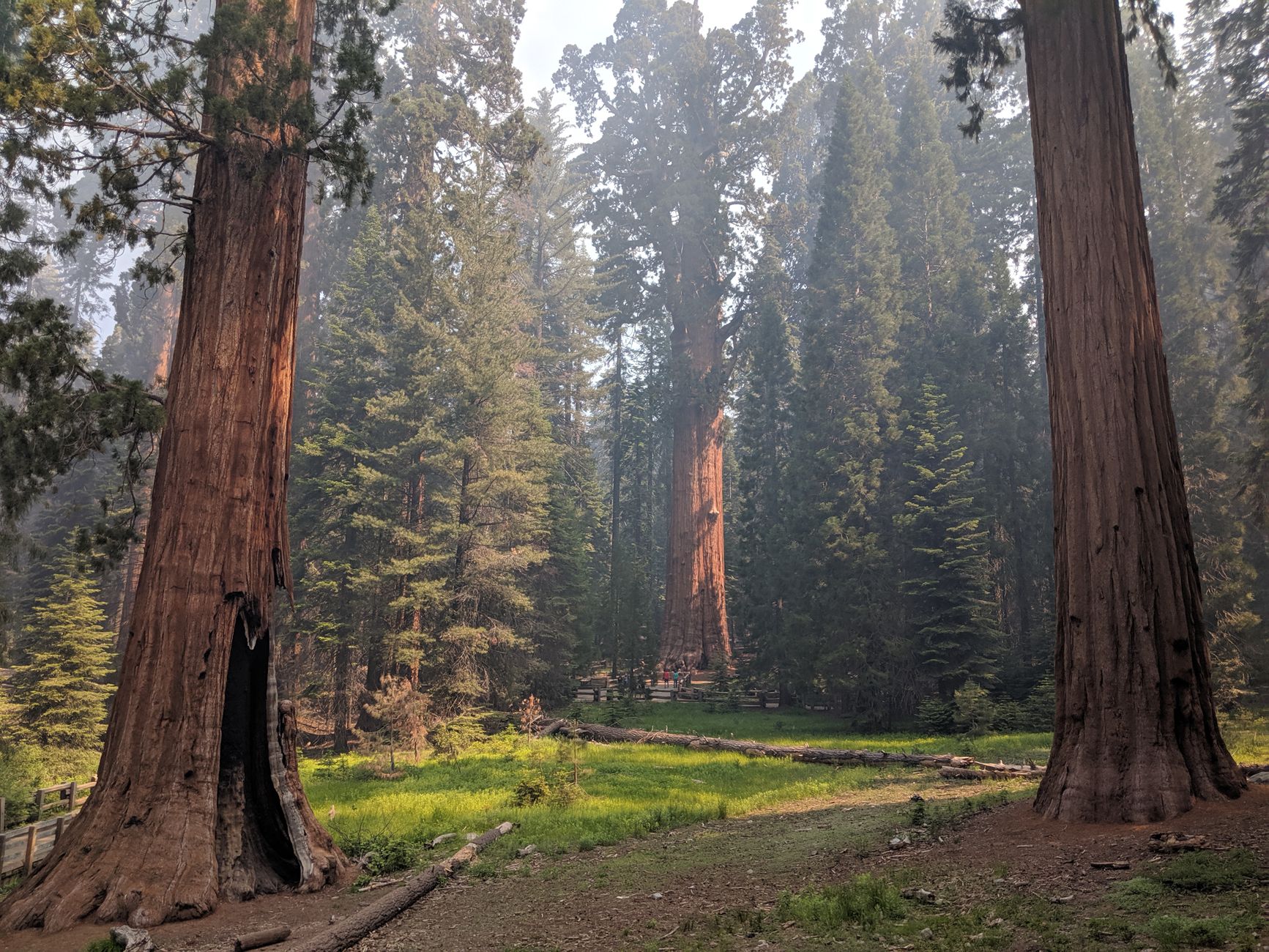
Giant sequoias (Sequoiadendron giganteum) depend on fire to reproduce. Their cones stay closed for 20 years or more until heat dries them, then release seed within one to two weeks onto ground that fire has cleared to bare mineral soil1. Fire-scar records show surface fires burned through Giant Forest every 6 to 35 years for 2,000 years until about 1860, when grazing, the loss of Native American burning, and suppression stopped them2. Sequoia and Kings Canyon National Parks began prescribed burning in 1968 to restore that cycle3. A century of accumulated fuel, combined with hotter drought, is why the Castle, KNP Complex, and Windy fires of 2020–21 burned at a severity the trees could not survive, killing an estimated 13 to 19 percent of all large sequoias45.
- Historic fire interval in Giant Forest: 6–35 years2; Forest Service range 5–25 years6
- Cones held closed: 20 years or more, opened by fire, squirrels, or beetles17
- Seed released by one fire: up to 8 million per acre8
- Seedling survival over 7–9 years: 27 percent on hot-burn patches, zero on undisturbed forest floor8
- Bark: up to 18 in to 2 ft thick, fibrous, non-resinous16
- Prescribed burning: since 1968 in the parks, since 1979 in Giant Forest39
- Grove acreage burned 2015–2021: over 85 percent, versus about 25 percent in the previous century4
The giant sequoia is a fire tree. Nearly every large one carries black scars at its base, its bark is built to take heat, and its seeds wait in sealed cones for a fire to let them out. Then, in 2020 and 2021, fire killed more sequoias than any event in the species’ recorded history. Both things are true, and the explanation is the difference between the fires sequoias evolved with and the fires we now have. This page covers the fire ecology, the historic fire record, what fire suppression did, the prescribed burning program that began in 1968, and why the recent fires were different. It belongs to the guide to giant sequoia trees.
How fire helps a giant sequoia
Cones that wait for heat
Giant sequoia cones are serotinous: they stay green and closed on the tree for 20 years or more8. A mature tree carries 10,000 to 30,000 of them and produces about 1,500 new cones a year, each holding roughly 200 seeds8. The NPS describes what happens when fire passes through: heat dries the cones, and within one to two weeks they begin to rain down their seed loads1. Ordinary seedfall averages about 400,000 seeds per acre per year; a fire can release 8 million seeds per acre in one event8.
Fire is not the only opener. A Douglas squirrel eats the fleshy scales of green cones and frees most of the seeds, and the larvae of a long-horned wood-boring beetle, Phymatodes nitidus, tunnel through cones 4 or more years old78. Between them the squirrel and the beetle keep some seed falling year-round. But only fire dumps the largest loads onto a freshly prepared seedbed8. See giant sequoia cones and seeds.
A seedbed only fire can make
Sequoia seeds are tiny, 91,000 to the pound, and they germinate best fully buried in disturbed mineral soil16. On an undisturbed forest floor, deep in needles and shade, they fail. The Forest Service reports that first-year seedlings are 30 to 150 times more numerous on disturbed ground than on undisturbed floor, and that survival over 7 to 9 years was 27 percent on patches burned hot, 3.5 percent on other treated ground, and zero on undisturbed forest floor8. After one high-severity prescribed fire, a study recorded 40,485 seedlings per acre6.
Gaps of sunlight
Sequoias are pioneers. The NPS states that they need fire “intense enough to kill the tree canopy in small areas” to open sunlit gaps where young trees can grow, and that without such fire the species suffered massive reproductive failure through the 1900s2. Shaded seedlings grow about 4 cm a year; open-grown seedlings can add 60 cm8. Prescribed burns now create those gaps deliberately2.
Bark that takes the heat
Mature sequoias survive the fires that feed their seedlings because of bark up to 18 inches thick by the NPS’s figure, up to 2 feet by the Forest Service’s, fibrous and non-resinous, which insulates the living tissue from heat16. The Forest Service credits it with fire resistance superior to any associated species, and notes that almost all large trees carry fire scars8. Frequent fire also keeps the fuel that would carry flames into the sequoia canopy from accumulating2. See giant sequoia bark.
The historic fire record
Sequoia rings hold a fire diary. Scars dating back 2,000 years show that widespread fires burned through Giant Forest at intervals of about 6 to 35 years, depending on the period, with the highest frequency during warm, drought-prone centuries between 800 and 1300 CE2. The Forest Service gives a presettlement interval of 5 to 25 years across the species and describes sequoia forest as a “fire climax community” kept stable by frequent fire6. Redwood Canyon burned about every 7 to 15 years; Giant Forest’s interval is given as 10 to 16 years in the park’s burn planning39.
Those were surface fires: low flames moving through grass, needles, and shrubs, scorching the bases of the giants and killing small trees, but seldom reaching the crowns. Many of them were set by people. The NPS lists the decline of fires set by Native Americans among the reasons fire frequency collapsed2; the site’s page on the Indigenous peoples of the sequoia groves covers cultural burning.
What fire suppression did
Around 1860, fire frequency in the groves dropped sharply. The NPS names three causes: intensive sheep grazing that stripped the grass that carried ground fire, the loss of Native American burning, and then government fire suppression2. For the next century the groves barely burned.
The consequences were slow and then sudden. Without fire, seedlings stopped establishing, and the species suffered reproductive failure through the twentieth century2. Fuel accumulated. The Forest Service calls fire exclusion the most significant human impact on the species, because it allows fuel to build toward crown fires, and adds that the damage caused by fire is outweighed by its benefits in perpetuating the species8.
Prescribed burning since 1968
Researchers from the NPS and the University of California first studied the sequoia’s need for fire in 1963 and 1964. Sequoia and Kings Canyon National Parks began prescribed burning in 1968, and Redwood Mountain Grove is called the birthplace of prescribed fire in the western United States3. Giant Forest has been burned since 19799.
The burns are deliberate, planned, and repeated. In June 2012 the Whitaker burn treated 504 acres of Redwood Mountain Grove, 429 of them on park land and 75 on University of California forestry land that had no recorded fire history3. In 2019 the Sherman burn covered 245 acres around the General Sherman Tree, to reduce dead and down fuel, maintain a mosaic of burned patches, and open the canopy and the cones for regeneration9. The NPS describes prescribed burning as one of the most important management tools for reducing fuels and increasing grove resilience4. The program has its own page: why rangers deliberately burn sequoia groves.
Why the fires of 2020 and 2021 were different
The numbers
| Fire | Year | Grove acres burned | Severity | Large sequoias killed |
|---|---|---|---|---|
| Castle | 2020 | 9,530, one-third of all grove area | about half moderate-to-high; nearly 30 percent high | 7,500–10,600 (10–14 percent of species)5 |
| KNP Complex | 2021 | 4,374 | 69 percent low; 31 percent moderate-to-high | 1,330–2,3805 |
| Windy | 2021 | — | — | 931–1,2572 |
| Total | 2020–21 | — | — | 8,431–11,897 (13–19 percent)4 |
Over 85 percent of all sequoia grove acreage burned between 2015 and 2021, against about 25 percent in the preceding century4. The worst mortality in the Castle Fire was on south-facing slopes without recent fire2.
The mechanism
The NPS explains the difference in two parts. First, high fuel accumulation from a century of suppression enabled higher-severity fire: flames climbed ladder fuels into the crowns instead of staying on the ground. Second, recent drought and a warming climate intensified the effect2. The park’s climate page states that human-caused climate change combined with fuel accumulation now produces wildfires that giant sequoias, despite their fire adaptations, cannot withstand10. Bark that stops a surface fire cannot save a tree whose entire crown has been scorched.
A crown fire also breaks the regeneration cycle. Fire that kills small patches of canopy makes gaps that seedlings fill from the seed rain of surviving neighbors. Fire that kills every tree across hundreds of acres leaves no parents; wind carries sequoia seed only about 600 feet7. NPS surveys in 2022 and 2023 found natural regeneration insufficient in the worst-burned parts of Redwood Mountain Grove, and in 2024 the park planted 65,000 seedlings there11.
The proof from Giant Forest
The KNP Complex, ignited by lightning on September 9, 2021, reached Giant Forest on September 18 and burned at low intensity, which the NPS attributes to significant preparation and many years of prescribed burn treatments12. Firefighters wrapped the lower 10 to 15 feet of General Sherman in fire-resistant material and raked fuel from around its base; the tree was not seriously harmed1312. Redwood Mountain Grove, in the same fire, without the same treatment history, burned 40 percent at moderate-to-high severity and lost many giants14. Same fire, same week, opposite outcomes. The story is told in full on the Castle, KNP Complex, and Windy fires and why General Sherman was wrapped in foil.
What the record says now
Giant sequoias are not adapted to fire in general. They are adapted to frequent, low-intensity fire, the kind that visited every decade or two for two thousand years. Remove it for a century and the same trait that made the species nearly immortal, an indifference to surface fire, leaves it standing in a fuel bed it cannot survive. The management answer is to put the old fire back before the new kind arrives, and the 2021 outcome in Giant Forest is the strongest evidence that it works. What is being done about the trees already lost is on are giant sequoias dying.
Frequently Asked Questions
Why do giant sequoias need fire?
Can a sequoia survive a wildfire?
How often did sequoia groves burn naturally?
Why do the parks deliberately set fires in sequoia groves?
Is sequoia bark fireproof?
Did fire suppression cause the 2020 sequoia deaths?
Do sequoia seeds only germinate after fire?
Related Articles
Sources
- Giant Sequoias — National Park Service, Sequoia & Kings Canyon. Accessed 2026-09-06.
- Giant Sequoias and Fire — National Park Service. Accessed 2026-09-06.
- Whitaker Prescribed Fire — National Park Service. Accessed 2026-09-06.
- Giant Sequoias Face New Threats — National Park Service. Accessed 2026-09-06.
- Wildfires Kill Unprecedented Numbers of Large Sequoia Trees — National Park Service. Accessed 2026-09-06.
- Sequoiadendron giganteum, Fire Effects Information System (fire ecology) — U.S. Forest Service. Accessed 2026-09-06.
- Fallen Green Cones of the Giant Sequoia — National Park Service, Yosemite. Accessed 2026-09-06.
- Sequoiadendron giganteum, Silvics of North America — U.S. Forest Service. Accessed 2026-09-06.
- Sherman Prescribed Burn Planned in Sequoia National Park — National Park Service. Accessed 2026-09-06.
- Climate Change — National Park Service, Sequoia & Kings Canyon. Accessed 2026-09-06.
- Restoring Giant Sequoia Groves Following High-Severity Wildfire — National Park Service. Accessed 2026-09-06.
- KNP Complex Fire — National Park Service. Accessed 2026-09-06.
- The General Sherman Tree — National Park Service. Accessed 2026-09-06.
- Exploring Giant Sequoia Groves — National Park Service. Accessed 2026-09-06.