
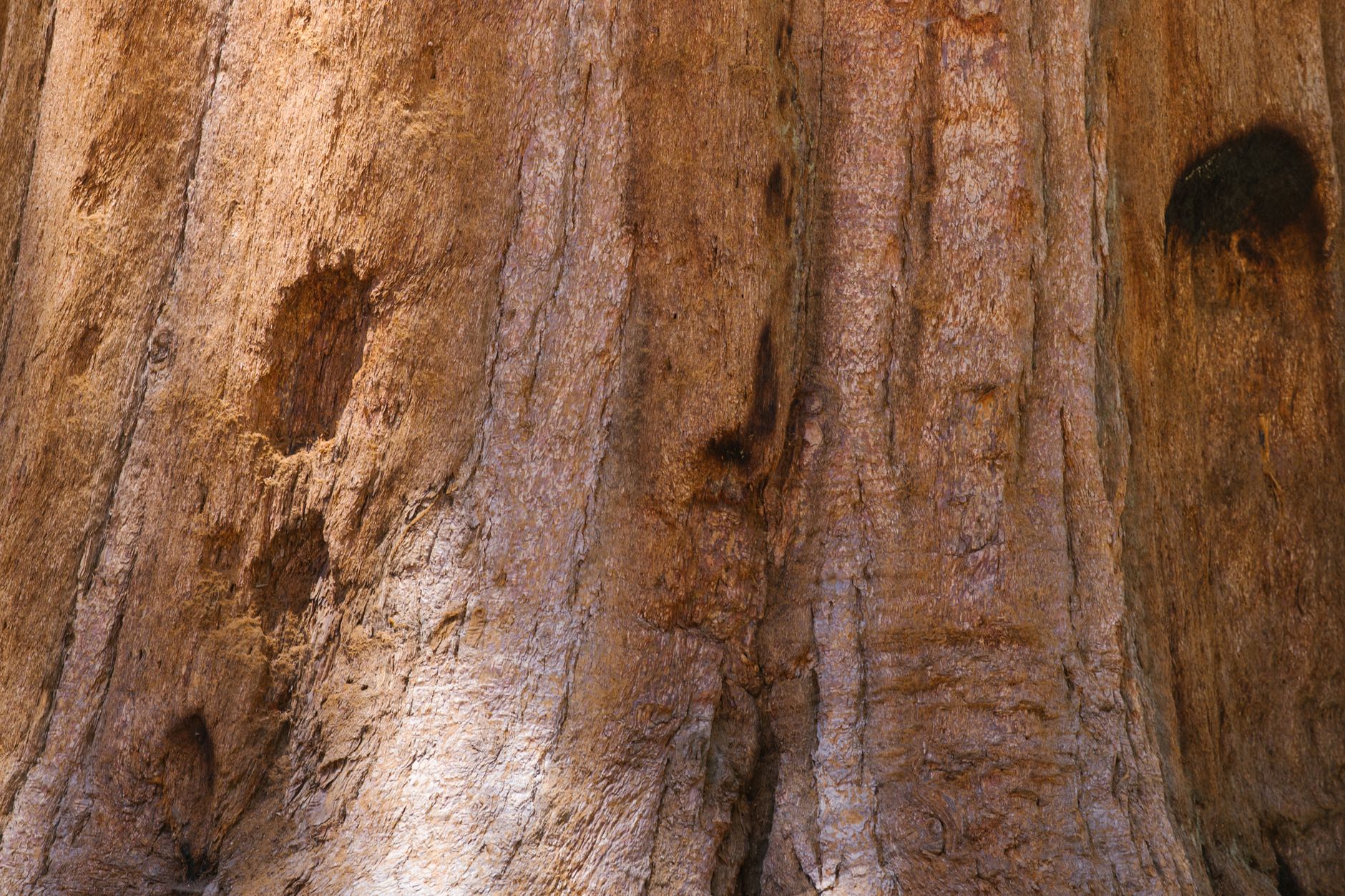
Giant sequoia bark reaches up to 18 inches (46 cm) thick on the National Park Service’s own measurements, and up to 2 feet (0.6 m) at the base of the largest trees according to the U.S. Forest Service12. The bark is fibrous, spongy to the touch, and largely free of the resin that makes most conifer bark burn readily, which is why the Forest Service ranks giant sequoia’s fire resistance above every species that grows alongside it15. That resistance has limits. Between 2020 and 2021, wildfire killed an estimated 13 to 19 percent of all large giant sequoias on Earth, somewhere around 8,431 to 11,897 trees, because modern fires burn hotter and higher into the canopy than the bark ever evolved to withstand7. This page covers what the bark is made of, why it resists flame, why it still failed at scale in 2020 and 2021, and why rangers wrapped the base of General Sherman in aluminum foil rather than trust the bark alone.
- Maximum thickness: up to 18 in (46 cm) per the National Park Service, up to 2 ft (0.6 m) per the U.S. Forest Service12
- Alternate figure: the Gymnosperm Database gives up to 60 cm (about 23.6 in)3
- Composition: thick, fibrous, and non-resinous, which the Forest Service says gives giant sequoia better fire resistance than any tree it grows beside5
- Texture: described by the NPS as “spongy” enough to press a finger into1
- Color: reddish-orange, distinct from the gray and brown bark of most conifers1
- Fire scars: nearly every large old-growth sequoia carries them5
- 2020-2021 toll: an estimated 13-19% of the world’s large sequoias killed by wildfire despite the bark7
- Case in point: crews wrapped the base of the General Sherman Tree in fire-resistant foil during the 2021 KNP Complex Fire rather than rely on bark alone9
Giant sequoia bark is the reason these trees carry char scars from fires that killed every neighboring pine and fir around them, and it is also the reason casual visitors are told they can press a fist into the trunk without hurting either the tree or their knuckles. Both things are true, and both come from the same fibrous, air-filled structure. This page is one piece of the giant sequoia trees guide to the species’ biology, records, and fire ecology; it focuses specifically on the bark, what it is made of, and where its protection stops.
How thick is giant sequoia bark
Sources disagree on the exact ceiling, which is normal for a tissue that varies across a tree’s own trunk and between individual trees. The National Park Service’s overview of giant sequoia biology puts maximum bark thickness at 18 inches (46 cm)1. The U.S. Forest Service’s fire-effects database describes bark up to 2 feet (0.6 m) thick at the base of the largest trees2. The Gymnosperm Database, a specialist conifer reference, gives a slightly lower figure of up to 60 cm (about 23.6 inches)3. Save the Redwoods League states more simply that bark thickness “often exceeds one foot”4. None of these numbers describes an average tree. A giant sequoia’s bark is thickest at the base of old, fire-scarred trunks and thins with height and with youth; a sapling’s bark is a fraction of an inch.
Why the bark barely burns
The mechanism is straightforward. The Forest Service’s silvics manual for the species states plainly that giant sequoia bark “is thick and non-resinous,” and that this combination gives the species fire resistance “superior to any associated species” in the Sierra Nevada mixed-conifer forest5. Most conifers, including the pines and firs that share sequoia groves, carry resin canals in their bark and wood. Resin is flammable; it is part of what lets a torching pine crown ignite so fast. Giant sequoia bark has comparatively little of it. What it has instead is fiber: long, loosely packed cellulose strands that trap air, much like the batting in insulation. That structure resists ignition on its own and, when a surface fire does scorch the outer layer, slows the transfer of heat to the living, water-conducting tissue just beneath the bark. A fire that would girdle and kill a thin-barked fir can pass across the base of a mature sequoia and leave the tree standing, blackened but alive.
The color and the spongy texture
The same fibrous structure gives giant sequoia bark its two most commented-on features. The NPS describes the bark’s reddish-orange color as “distinct among the grey and brown bark of other trees,” and it is soft enough that the Park Service’s own visitor materials invite people to “press your fingers against its spongy, thick bark”1. The give is real: unlike the hard, brittle bark plates on a pine or an oak, sequoia bark compresses slightly under a knuckle and springs back, the same fiber-and-air structure that resists fire also absorbing a punch. This is why leaning on or lightly touching the bark does no harm to the tree, while the shallow root systems a few feet away are a different matter entirely; see the guide to giant sequoia roots for why the Park Service still asks visitors to stay on paved trails.
Fire scars: the record on every mature tree
Bark resistance is not the same as immunity, and the record of that is visible on nearly every large old-growth sequoia in the Sierra. The silvics manual notes that almost all mature trees carry fire scars, black, hollowed-out sections where repeated fires burned through the outer bark and into the wood beneath5. The NPS describes these scars as blackened areas that can extend “from 1 to many feet up the height of older sequoias where fires scarred the tree many times”1. A sequoia does not heal a scar the way a smaller tree seals a wound; new wood grows around the edges of the burned area over centuries, but the tree cannot always outpace repeated fire, and old giants often carry open fire caves at their base big enough to walk into. Before 1860, fire returned to a given patch of Sierra forest roughly every 5 to 25 years, frequently enough that fuel never built up to dangerous levels and scars stayed shallow26. Grazing, the suppression of Native burning, and organized fire exclusion after 1860 changed that pattern, and by the mid-20th century the Park Service had stopped virtually all fire from reaching the groves for the better part of a century6.
The limits of fire resistance: what happened in 2020 and 2021
A century of excluded fire is the backdrop for what happened next. In 2020, the Castle Fire (part of the SQF Complex) burned through 12 sequoia groves and killed an estimated 7,500 to 10,600 large sequoias, trees with a trunk diameter of 4 feet or more68. That toll equaled 31 to 42 percent of all large sequoias inside the fire’s footprint and 10 to 14 percent of all large sequoias in the entire Sierra Nevada. Roughly half of the 9,530 acres of grove that burned did so at moderate-to-high severity, and nearly 30 percent burned at high severity8. In 2021, the KNP Complex Fire burned 16 groves across 88,307 acres and killed an estimated 1,330 to 2,380 large sequoias, while the separate Windy Fire killed 931 to 1,257 more, a combined 2021 toll of 2,261 to 3,637 trees, or roughly 3 to 5 percent of the Sierra’s sequoia population6. Together, the fires from 2020 through 2021 killed an estimated 13 to 19 percent of all large giant sequoias on Earth, somewhere between 8,431 and 11,897 trees7. More grove acreage burned between 2015 and 2021 than in the entire preceding century7.
Thick bark did not fail these trees so much as it was never built for what modern fires have become. Decades of accumulated fuel, drought-dried understory, and dense stands of small trees let fires climb into the canopy and burn with an intensity the historic surface-fire regime rarely produced. A fire that scorches bark at the base is survivable; a crown fire that burns for hours at the top of a 200-foot tree, or a surface fire hot enough to consume the accumulated duff at a tree’s base for days, is not. The Park Service’s detailed count of the 2021 damage found that 69 percent of the KNP Complex’s grove acreage still burned at low severity, evidence that the historic pattern of tolerable fire has not disappeared everywhere, but the minority that burned hot did a disproportionate share of the killing68. The full breakdown of what happened grove by grove is covered in the Castle, KNP Complex, and Windy fires guide, and the reasoning behind why the species depends on fire at all despite this toll is covered separately in why giant sequoias need fire.
Bark protects against fire specifically. It does little against bark beetles, and the 2012-2016 drought produced a phenomenon the Park Service had not documented before: 33 sequoias died standing, killed by native Phloeosinus bark beetles rather than by falling or by fire, almost all of them trees that already carried old basal fire scars7. A scar that lets a beetle in is a wound the thick bark around it cannot compensate for.
Wrapping General Sherman: an admission that bark is not enough
The clearest evidence that park managers do not fully trust bark alone came in September 2021, as the KNP Complex Fire advanced toward Giant Forest. Crews wrapped the lower 10 to 15 feet of the General Sherman Tree, along with other named trees, in fire-resistant aluminum foil9. The tree survived without significant damage, but Giant Forest’s survival owed at least as much to decades of prescribed burning, conducted there since 1979, including a 245-acre burn around General Sherman itself in 2019 that had already reduced the ground fuel nearby6. Bark bought time and reduced ignition risk; the foil and the fuel-reduction work did the rest. Full detail on that event is in the General Sherman foil story.
Frequently Asked Questions
How thick is giant sequoia bark?
Estimates range from about 18 inches (46 cm) on the NPS’s biology page to up to 2 feet (0.6 m) on the U.S. Forest Service’s fire-effects database, with a specialist conifer database giving a slightly lower ceiling of about 60 cm. The variation reflects where on the trunk and on which tree the bark is measured123.
Is giant sequoia bark actually fireproof?
No tree is fireproof, but the bark is genuinely fire-resistant. It is thick, fibrous, and largely free of the flammable resin found in most conifer bark, which the U.S. Forest Service says gives the species better fire resistance than any tree that grows alongside it5. Nearly every mature sequoia still carries fire scars from surface fires the bark did not fully stop5.
Why is sequoia bark red and spongy?
The reddish-orange color is distinctive among Sierra conifers, most of which have gray or brown bark, and the same loose, fibrous structure that resists flame also gives the bark a soft, compressible texture the National Park Service describes as spongy1.
If the bark resists fire, why did so many giant sequoias die in 2020 and 2021?
Bark resists surface fire of the kind that burned through the groves for centuries before 1860. A century of fire exclusion let fuel build up to levels that produce crown fires and prolonged, intense burns the bark was never adapted to survive, and the Castle, KNP Complex, and Windy fires killed an estimated 13 to 19 percent of the world’s large sequoias between 2020 and 2021 as a result678.
Can bark beetles get through the bark?
Bark alone deters most insects, but old basal fire scars create openings. During the 2012-2016 drought, 33 giant sequoias died standing from native Phloeosinus bark beetles, nearly all of them trees with existing fire scars, a pattern the Park Service had not documented before that drought7.
Why was the General Sherman Tree wrapped in foil if its bark resists fire?
Bark reduces risk but does not guarantee survival against an intense, fast-moving fire. As the 2021 KNP Complex Fire approached, crews wrapped General Sherman’s base in aluminum foil as an added precaution, and the tree survived without significant damage9.
Can you safely touch or press on giant sequoia bark?
Yes. The fibrous bark compresses under light pressure without harming the tree, which is why NPS materials invite visitors to press a hand against it. The tree’s shallow root system nearby is far more vulnerable to foot traffic than the bark is to touch1.
Related Articles
Sources
- Giant Sequoias — National Park Service, Sequoia & Kings Canyon. Accessed 2026-09-09.
- FEIS: Sequoiadendron giganteum — U.S. Forest Service, Fire Effects Information System. Accessed 2026-09-09.
- Sequoiadendron giganteum — The Gymnosperm Database. Accessed 2026-09-09.
- Giant Sequoias — Save the Redwoods League. Accessed 2026-09-09.
- Sequoiadendron giganteum, Silvics of North America — U.S. Forest Service. Accessed 2026-09-09.
- Giant Sequoias and Fire — National Park Service. Accessed 2026-09-09.
- Giant Sequoias Face New Threats — National Park Service. Accessed 2026-09-09.
- Wildfires Kill Unprecedented Numbers of Large Sequoia Trees — National Park Service. Accessed 2026-09-09.
- The General Sherman Tree — National Park Service, Sequoia & Kings Canyon. Accessed 2026-09-09.