
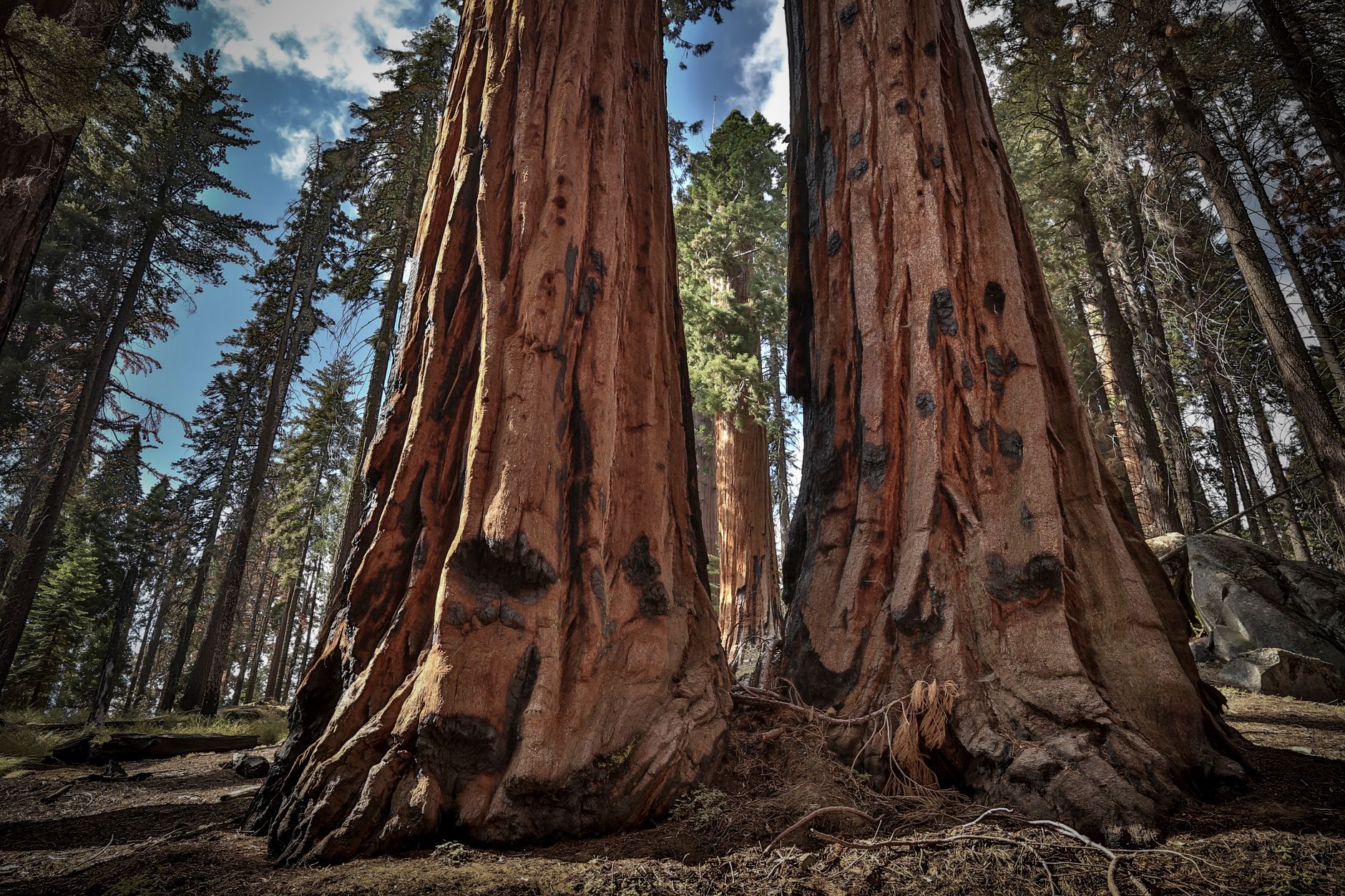
Giant sequoias (Sequoiadendron giganteum) are the largest trees on Earth by trunk volume. The General Sherman Tree holds about 52,500 cubic feet of wood and stands 274.9 feet tall1. The oldest ring-counted sequoia stump is just over 3,200 years old, and the National Park Service puts the species’ maximum age at up to 3,400 years37. The trees grow naturally only on the west slope of California’s Sierra Nevada, in a belt about 260 miles long and less than 15 miles wide23. Their seeds are so small that 91,000 weigh a pound, and their bark can be 18 inches to 2 feet thick74. Wildfires in 2020 and 2021 killed an estimated 13 to 19 percent of all large sequoias10.
- Largest tree by volume: General Sherman, 52,500 cu ft (1,487 m³)1
- Tallest known sequoia: 310 to 311 ft (94.5 to 94.9 m)35
- Oldest ring count: 3,266 years, from a Converse Basin stump5
- Natural range: about 75 to 94 groves totaling 35,607 acres346
- Seeds per pound: about 91,0007
- Bark thickness: up to 18 in (46 cm) per the NPS; up to 2 ft per the Forest Service74
- 2020–21 fire losses: 8,431 to 11,897 large trees, 13 to 19 percent of the population10
Most lists of sequoia facts repeat the same few numbers without saying where they came from, and some of the numbers are wrong. This page gives 30 facts about the giant sequoia, each with a citation to the National Park Service, the U.S. Forest Service, Save the Redwoods League, or a peer-reviewed or specialist source. Where official sources disagree, both figures are given. For the full picture of the species, start with the guide to giant sequoia trees.
Size
-
The General Sherman Tree is the largest tree on Earth by trunk volume. The NPS measures it at 274.9 feet tall, 102.6 feet around at the ground, 36.5 feet across at the base, and about 52,500 cubic feet of trunk1. At 120 feet above the ground the trunk is still 17 feet in diameter25.
-
It is not the tallest, thickest, or oldest tree. The Forest Service silvics manual states that one species has a greater diameter than giant sequoia, three grow taller, and one lives longer3. The tallest tree is a coast redwood, Hyperion, at 380 feet18.
-
The tallest known giant sequoia is about 310 feet. The Forest Service gives 94.5 m (310 ft) as the record3; the Gymnosperm Database lists a 94.9 m (311 ft) tree in Redwood Mountain Grove, measured in 19985; Save the Redwoods League says “more than 316 feet”6. Sources disagree by a few feet.
-
General Sherman’s trunk weighs close to 1,400 tons. The NPS compares that to 15 adult blue whales, 10 diesel-electric locomotives, or 25 battle tanks, and estimates 630,000 board feet of lumber, enough to frame about 120 average houses1.
-
A big sequoia adds about 40 cubic feet of wood a year. That is roughly the volume of a 50-foot tree one foot in diameter, according to the NPS2. The Forest Service estimates General Sherman adds 40 to 51 cubic feet annually despite laying down only about a millimeter of new radius3.
-
Old sequoias grow faster, not slower. Climbing measurements of the President Tree, about 3,200 years old, showed it producing more new wood each year than vigorous younger trees, contradicting the assumption that growth slows with age12.
-
Ten of the 30 largest sequoias stand in one grove. The NPS Top Thirty list places General Sherman, the President, Lincoln, Franklin, Monroe, Adams, Column, Pershing, Chief Sequoyah, and Hamilton all in Giant Forest2. See the largest giant sequoias.
Age
-
The oldest verified sequoia lived just over 3,200 years. The Forest Service records a ring count of 3,200 years from a stump34. A Converse Basin stump logged in the 1870s was later crossdated at 3,266 years5. The NPS Sequoia and Kings Canyon site says the species reaches “up to 3,400 years,” the highest figure in any official source7.
-
General Sherman is about 2,200 years old. That is the most recent NPS estimate26. Save the Redwoods League gives 2,200 to 2,700 years6. It is large because it grew fast on a good site, not because it is the oldest.
-
You cannot read a sequoia’s age from its size. In the NPS analysis of the 2020 Castle Fire, trees about 15 feet in diameter had a median age near 2,000 years but ranged from 800 to 3,100 years; 10-foot trunks ranged from 400 to 2,1009. The page on how old giant sequoias get explains the methods.
-
John Muir once counted 4,000 rings on a stump. Later work corrected that count to roughly 3,000 years5.
Where they grow
-
The entire natural range is a strip 260 miles long and less than 15 miles wide on the west slope of the Sierra Nevada23. Nowhere else on Earth has wild giant sequoias.
-
Official grove counts run from about 75 to about 94. The Forest Service counts about 75 groves totaling 35,607 acres34. Save the Redwoods League counts about 94 naturally occurring groves6. The difference is how historic grove names are split or lumped, not new discoveries. Sequoia and Kings Canyon National Parks alone distinguish about 40 groves11.
-
Groves sit between roughly 4,600 and 7,050 feet. The Forest Service gives 4,590 to 6,560 feet in the north and 5,580 to 7,050 feet in the south, with extremes of 2,720 and 8,860 feet3. The NPS rounds this to 4,000 to 8,000 feet11.
-
Sequoia country gets 12 to 16 feet of snow a year and almost no summer rain. Mean annual snowfall is 144 to 197 inches; of the 35 to 55 inches of annual precipitation, less than 30 millimeters (about an inch) falls from June through September3. That snowpack is the trees’ summer water supply.
-
The species once grew in Colorado, Wyoming, and Nevada. Fossils show a far wider range during wetter periods; the Sierra strip is what remains23. See where giant sequoias grow.
Bark, cones, seeds, and roots
-
The bark can be 18 inches to 2 feet thick. The NPS gives up to 18 inches (46 cm)7; the Forest Service’s Fire Effects Information System gives up to 2 feet at the base4. It is fibrous and non-resinous, which is why it insulates the tree from fire3.
-
Each cone holds about 200 seeds, and 91,000 seeds weigh one pound. Cones are only 2 to 3 inches long; each seed is about the size of a flake of oatmeal73.
-
A sequoia keeps its cones closed for 20 years or more. A mature tree carries 10,000 to 30,000 green cones at once and makes about 1,500 new ones a year; fire heat dries the cones and they release seed within one to two weeks37.
-
Only three things open a sequoia cone. Fire, the Douglas squirrel, and a long-horned wood-boring beetle (Phymatodes nitidus) are the seed-release agents; fire is the most important because it also prepares the seedbed233.
-
Sequoias have no taproot. Seedlings start with one, but by six to eight years lateral roots take over. Mature roots spread 100 feet or more from the trunk yet seldom go deeper than 3 feet36. See giant sequoia roots.
-
Seeds travel only about 600 feet from the parent, and a tree needs one surviving offspring in 3,000 years. Wind dispersal is short16; the NPS notes that over such a lifespan a single maturing seedling is enough to replace the parent7.
Fire and threats
-
Fires burned through Giant Forest every 6 to 35 years for 2,000 years. Fire-scar records show that pattern until about 1860, when sheep grazing, the end of Native American burning, and then suppression cut fire frequency sharply8.
-
Rangers have been deliberately burning sequoia groves since 1968. Sequoia and Kings Canyon National Parks began prescribed fire that year after studies in 1963 and 1964; Redwood Mountain Grove is called the birthplace of prescribed fire in the western United States17. Read why giant sequoias need fire.
-
The 2020 and 2021 fires killed 13 to 19 percent of all large sequoias. The Castle, KNP Complex, and Windy fires killed an estimated 8,431 to 11,897 trees with trunks 4 feet or more in diameter10.
-
More grove acreage burned in six years than in the previous century. Over 85 percent of all sequoia grove area burned between 2015 and 2021, against about 25 percent in the hundred years before10.
-
Bark beetles have killed sequoias for the first time on record. During the 2012–2016 hotter drought, 33 sequoias died standing with native Phloeosinus beetle activity, a newly reported phenomenon10. Details are on are giant sequoias dying.
-
The NPS planted 65,000 sequoia seedlings in one grove in 2024. Redwood Mountain Grove received 65,000 and Board Camp Grove about 3,800 after surveys found natural regeneration insufficient in the worst-burned patches22.
History and names
-
Sequoia National Park, created September 25, 1890, was the second U.S. national park and the first created to protect a living organism15. Mariposa Grove had been protected even earlier, by Abraham Lincoln’s 1864 Yosemite Grant21.
-
The tree was briefly named for the Duke of Wellington. When William Lobb rushed specimens to England in 1853, John Lindley named it Wellingtonia gigantea; an American botanist had planned Washingtonia, and the argument ran for years before the modern name settled it14. The genus name Sequoia was coined by Endlicher in 1847, “presumably” for the Cherokee scholar Sequoyah, though he never said so13. See why it is called sequoia.
Frequently Asked Questions
Are sequoia trees really the largest living things on Earth?
What is the difference between a sequoia and a redwood?
Giant sequoias grow inland in the Sierra Nevada and are the largest trees by volume; coast redwoods grow in a coastal fog belt and are the tallest618. The full comparison is on sequoia vs redwood.
How many giant sequoias are left?
A 2024 University College London study put the number in the native range at fewer than 80,00019, and the 2020–21 fires killed 13 to 19 percent of the large ones10. See how many giant sequoias are left.
Do giant sequoias grow outside California?
Only when planted. An estimated half a million giant sequoias and coast redwoods now grow in the UK alone, and the tallest UK specimen measured 54.87 m (about 180 ft) in 202419.
Is the giant sequoia California's state tree?
Yes, jointly. The giant sequoia shares the title of California state tree with the coast redwood5.
Can you still drive through a giant sequoia?
Only through Tunnel Log in Sequoia National Park, a tree that fell across the road in 1937 and was cut through by the Civilian Conservation Corps. Yosemite’s standing tunnel tree collapsed in 196920.
How were giant sequoias discovered?
Outsiders learned of them in 1852, when hunter Augustus T. Dowd publicized the Discovery Tree at what is now Calaveras Big Trees State Park24.
Related Articles
Sources
- The General Sherman Tree — National Park Service, Sequoia & Kings Canyon. Accessed 2026-09-06.
- The Largest Trees in the World — National Park Service. Accessed 2026-09-06.
- Sequoiadendron giganteum, Silvics of North America — U.S. Forest Service. Accessed 2026-09-06.
- Sequoiadendron giganteum, Fire Effects Information System — U.S. Forest Service. Accessed 2026-09-06.
- Sequoiadendron giganteum — The Gymnosperm Database. Accessed 2026-09-06.
- Giant Sequoias — Save the Redwoods League. Accessed 2026-09-06.
- Giant Sequoias — National Park Service, Sequoia & Kings Canyon. Accessed 2026-09-06.
- Giant Sequoias and Fire — National Park Service. Accessed 2026-09-06.
- Wildfires Kill Unprecedented Numbers of Large Sequoia Trees — National Park Service. Accessed 2026-09-06.
- Giant Sequoias Face New Threats — National Park Service. Accessed 2026-09-06.
- Exploring Giant Sequoia Groves — National Park Service. Accessed 2026-09-06.
- Forest Giant — National Geographic, December 2012. Accessed 2026-09-06.
- Discover History, Sequoia National Forest — U.S. Forest Service. Accessed 2026-09-06.
- How the giant sequoia came to England — National Trust. Accessed 2026-09-06.
- History & Culture — National Park Service, Sequoia & Kings Canyon. Accessed 2026-09-06.
- Fallen Green Cones of the Giant Sequoia — National Park Service, Yosemite. Accessed 2026-09-06.
- Whitaker Prescribed Fire — National Park Service. Accessed 2026-09-06.
- Coast Redwoods — Save the Redwoods League. Accessed 2026-09-06.
- Giant sequoias are a rapidly growing feature of the UK landscape — ScienceDaily / University College London, March 2024. Accessed 2026-09-06.
- Tunnel Log — National Park Service. Accessed 2026-09-06.
- Mariposa Grove of Giant Sequoias — National Park Service, Yosemite. Accessed 2026-09-06.
- Restoring Giant Sequoia Groves Following High-Severity Wildfire — National Park Service. Accessed 2026-09-06.
- Giant Sequoia (Sequoiadendron giganteum) — University of California Agriculture and Natural Resources. Accessed 2026-09-06.
- Calaveras Big Trees State Park Fact Sheet (PDF) — California State Parks. Accessed 2026-09-06.
- Frequently Asked Questions — National Park Service, Sequoia & Kings Canyon. Accessed 2026-09-06.
- General Sherman Tree (place page) — National Park Service. Accessed 2026-09-06.