
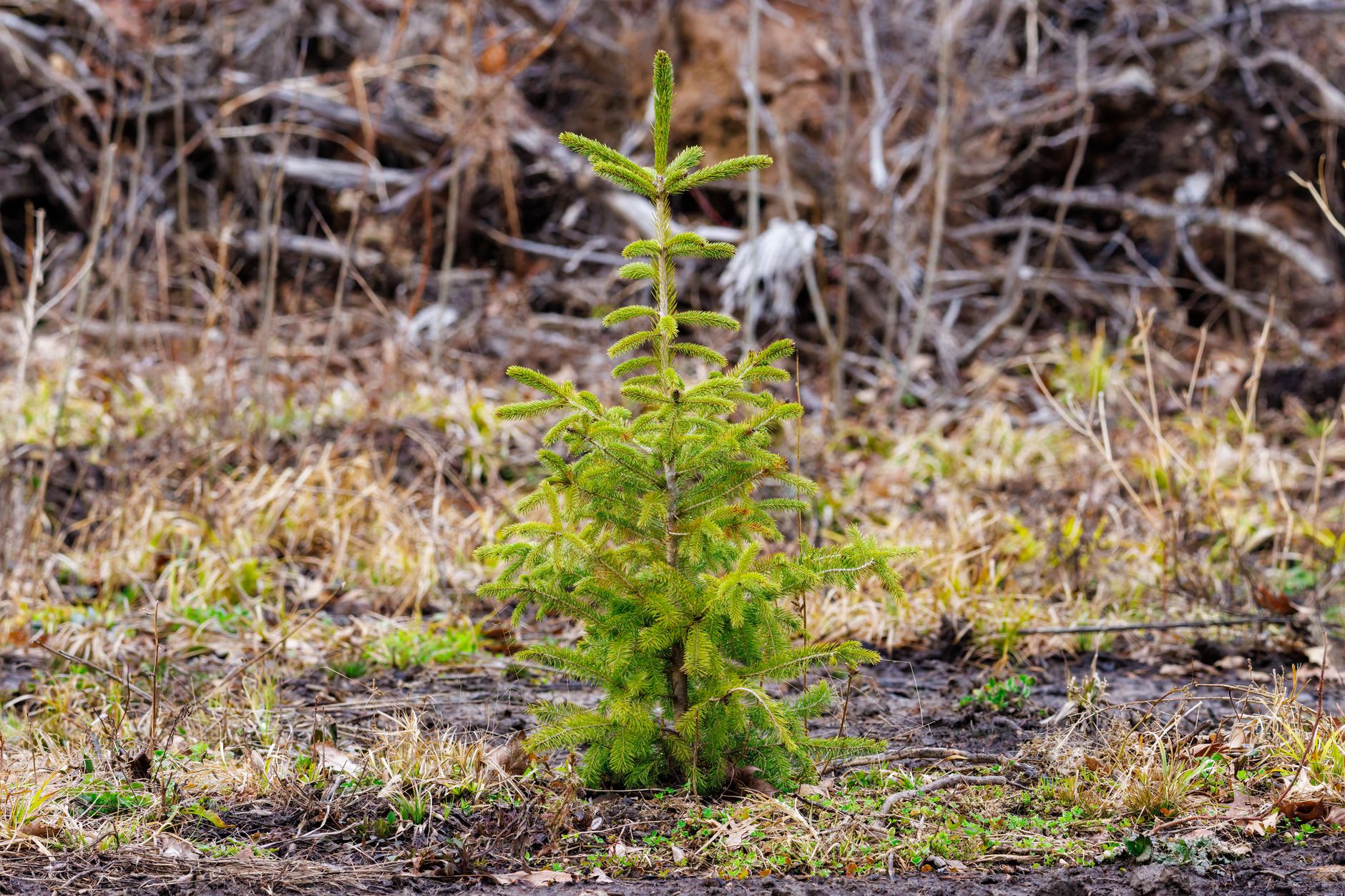
A giant sequoia grows 4 to 10 inches in its first year from seed, then about 1 to 2 feet a year for its first decade, reaching roughly 30 feet at year 10, 40 to 60 feet at year 20, and 100 feet or more at year 50 on a good site123. California State Parks gives about 2 feet of height and an inch of trunk diameter per year for the first 50 to 100 years under ideal conditions, and the Forest Service reports 1.6 to 2.3 feet a year in the best plantations45. Height growth stays rapid for at least a century, slows after 400 years, and levels off near 250 feet between 800 and 1,500 years5. Volume growth never stops: the General Sherman Tree adds 40 to 51 cubic feet of wood a year, and climbing measurements of the 3,200-year-old President Tree showed it laying down more new wood annually than vigorous younger trees56.
- Year 1: 4–8 in from seed in US gardens; 2–10 in (5–25 cm) in the UK; up to 24 in for an established, watered seedling127
- Years 1–10: about 1–2 ft per year3
- Year 10: about 30 ft; ‘Hazel Smith’ reaches 30 ft by 20 ft18
- Year 20: 40–60 ft1
- Year 50: over 100 ft1
- Year 100: trunk about 19 in (48 cm) in diameter in native stands; still growing fast in height5
- Old age: General Sherman adds about 1 mm of radius but 40–51 cu ft of volume a year5
The growth rate of Sequoiadendron giganteum answers two different questions. A gardener wants to know how many feet a year to expect, and how soon the tree will be taller than the house. A biologist wants to know how a tree that is 3,000 years old keeps getting bigger. This page has both: a year-by-year table from planting to a century, drawn from nursery records, extension data, and the Forest Service’s silvics manual; the difference between garden and native rates; and what the measurements of the President Tree revealed about growth in old age. For planting and care, start with the guide to how to grow a giant sequoia.
Growth by age: year 1 to year 100
Every figure in this table comes from a source that measured or reported a real tree or plantation. Garden figures assume full sun, deep drained soil, and water; native figures come from Sierra Nevada stands.
| Age | Height | Trunk | Where measured | Source |
|---|---|---|---|---|
| Year 1 (from seed) | 4–8 in; 2–10 in (5–25 cm) in the UK | — | US and UK nurseries | 12 |
| Year 1 (nursery seedling planted out) | 3 ft with a 2-in base | 2 in | Comstock Park, Michigan, planted July 2010 | 9 |
| Year 1 (open-grown, watered) | 24 in of growth “not uncommon” | — | UC forestry | 7 |
| Year 3 (large pot) | About 4 ft of upward growth that year | Rings of 1 in or more per year | Welker’s Grove Nursery, Sierra foothills | 10 |
| Year 6 | 6 ft, from a 6-in seedling | — | Berks County, Pennsylvania | 11 |
| Years 1–10 | 1–2 ft per year | — | National Sequoias, Michigan | 3 |
| Year 10 | About 30 ft; more than 12 ft by the conifer society’s size class | — | Trees for a Change; American Conifer Society | 112 |
| Year 10, ‘Hazel Smith’ | 30 ft tall by 20 ft wide | — | American Conifer Society | 8 |
| Year 15 | About 30 ft | — | Swoyersville, Pennsylvania, zone 6a, 650 ft elevation | 11 |
| Year 20 | 40–60 ft | — | Trees for a Change | 1 |
| Years 25–30 | 30–40 ft of growth reported | — | Victoria, British Columbia | 13 |
| Year 50 | Over 100 ft | — | Trees for a Change | 1 |
| Years 50–100 | About 2 ft per year | About 1 in of diameter per year | California State Parks | 4 |
| Year 72 | 116 ft | — | Manistee, Michigan, planted 1948–49, reported 2021 | 1415 |
| Year 70+ | 80 ft | — | Washington Park Arboretum, Seattle | 16 |
| Year 100 | Height growth still rapid | 19 in (48 cm) diameter | Native stands, Forest Service | 5 |
| Year 105 | About 98–100 ft; roughly 800,000 lb | — | Boise, Idaho, planted 1912 | 17 |
| Year 119 | About 80 ft | — | John Muir’s tree, Martinez, California, planted about 1885 | 18 |
Two things in that table deserve a second look. The Pennsylvania and Michigan garden trees are running below the nursery projections: 30 feet at 15 years in Swoyersville, not at 10, and 80 feet at 119 years in Martinez, not 100 feet at 50. And the biggest trees outside California, at 116 feet in Michigan and about 100 feet in Boise, are the product of 70 to 105 years, not a lifetime of a gardener. The projections describe a good site; the specimens describe real ones.
Garden rates versus native rates
In the Sierra Nevada, the Forest Service’s silvics manual reports that the best plantations gain 1.6 to 2.3 feet (0.5 to 0.7 m) of height and 0.5 to 0.8 inches (1.3 to 2.0 cm) of diameter per year5. Open-grown seedlings with water can add up to 24 inches (60 cm) a year, but seedlings under a grove canopy manage only about 1.5 inches (4 cm) a year at ages 7 to 105. Light is the variable. The species is shade-intolerant, and the difference between a seedling in sun and one in shade is a factor of 1557.
In California plantations up to 50 years old, giant sequoia outgrew most other conifers, and an 80-year-old plantation in Belgium yielded 36 to 49 cubic meters of wood per hectare5. A 2024 laser-scanning study of 97 trees in the United Kingdom found that giant sequoias at Wakehurst and Benmore grew at rates matching their native range, while trees at Havering Country Park near London grew more slowly for lack of rain; the tallest UK specimen measured 180 feet (54.87 m), from plantings that date to 18631920.
Outside the Pacific coast and northern Europe, the rate and the ceiling both drop. The Arnold Arboretum in Boston tells visitors that 60 feet at maturity is typical on the East Coast, against 300 feet in the Sierra21. The Manistee, Michigan tree, at 116 feet, is called the largest sequoia east of the Rockies, and its position near Lake Michigan is credited with moderating both winter cold and summer heat1415. The limiting factors are described on the page about giant sequoia hardiness zones.
Trunk diameter: the native progression
The silvics manual gives a typical diameter progression for native trees: 19 inches (48 cm) at 100 years, 52 inches (132 cm) at 400 years, 86 inches (219 cm) at 800 years, and 168 inches (427 cm) at 2,000 years5. The NPS analysis after the 2020 Castle Fire adds ranges: trunks 4 feet across are 200 to 500 years old, 10-foot trunks have a median age of 1,000 years (range 400 to 2,100), and 15-foot trunks a median of 2,000 years (range 800 to 3,100)22.
Those ranges are wide because site matters as much as age. A 10-foot tree can be 400 years old on a wet, sunny site or 2,100 years old on a dry one. The age-diameter relationship is discussed on the page about how old giant sequoias get.
Height versus volume
The species grows in two phases that people tend to confuse. For roughly the first century, it grows upward fast, at the 2-feet-a-year rates in the table. Height growth slows after about 400 years and levels off near 250 feet (76 m) at 800 to 1,500 years5. The tallest known giant sequoia is about 310 feet (94.5 m), and the General Sherman Tree is 274.9 feet with a dead top that is no longer rising523.
Volume growth does not level off. General Sherman, at more than 2,000 years, adds only about 1 mm of radius each year, but that millimeter is spread over a trunk 36.5 feet across at the base and 17 feet across at 120 feet up, so it amounts to 40 to 51 cubic feet (1.13 to 1.44 m³) of new wood annually523. The NPS translates that into a single comparison: each year the tree adds enough wood to make a 60-foot oak with a 3-foot trunk23. Whether the tree is still growing is a question with its own page: is the General Sherman Tree still growing?
The President Tree finding
The President, a 3,200-year-old tree on the Congress Trail a short walk from General Sherman, is the tree that changed how researchers think about growth in old age. When Stephen Sillett’s team climbed and measured it for a study reported by National Geographic in 2012, they found a tree 247 feet tall with a dead spire, at least 54,000 cubic feet of wood and bark, a base 27 feet across, and nearly two billion leaves. The measurements showed that the President lays down more new wood each year than vigorous younger trees, and that growth in giant sequoias can accelerate in old age rather than tapering off6.
The reason is scale. The President carries nearly two billion leaves, and a thin ring on a huge trunk contains more wood than a thick ring on a small one6. The finding also placed the President second among all trees when branch volume is counted, ahead of the General Grant Tree; by trunk volume alone, General Sherman and General Grant still rank first and second24.
For a gardener, the implication runs the other way. The tree planted this year will spend its first 50 years in the fast-height phase, adding a foot or two a year. It will not reach the volume phase in any owner’s lifetime, or their grandchildren’s. The page on whether a giant sequoia belongs in your backyard covers what 50 years of that growth means for a house.
What slows growth in a garden
The rates in the table need sun, water, and drained soil, and the deficit in any one of them shows up as slow growth before it shows up as a dead tree.
- Shade. The species is shade-intolerant; grove seedlings under a canopy grow at a fifteenth the rate of open-grown ones57.
- Water. Giant sequoia is the most moisture-demanding of the Sierra mixed conifers and needs at least 15 to 20 percent soil moisture year-round7. The UK study found the trees that grew slowest were the ones short of rain20.
- Soil. Trees and Shrubs Online reports slow growth on poor silty or sandy soil, and names compaction and poor drainage as the two main enemies in cultivation25. NC State calls the species intolerant of clay26.
- Heat. A West Virginia extension agent said the tree wants cool summers, with maximum temperatures around 75–84 °F, and does poorly in clay and heat27.
- Feeding. Welker’s Grove treats the species as a heavy feeder10, but UC IPM lists nutrient excess and salinity among its disorders, so fertilizer is not a substitute for water and light28.
The day-to-day version of this is on the giant sequoia care page.
Frequently Asked Questions
How many feet a year does a giant sequoia grow?
How big is a giant sequoia at 10 years?
How big is a giant sequoia at 20 years?
How big is a giant sequoia at 50 years?
Do giant sequoias ever stop growing?
How fast does a giant sequoia grow in its first year?
How fast does a giant sequoia's trunk grow?
Related Articles
Sources
- How to Grow Giant Sequoia — Trees for a Change. Accessed 2026-09-06.
- Growing Giant Sequoia from Seed — Superlative Trees. Accessed 2026-09-06.
- FAQs — National Sequoias. Accessed 2026-09-06.
- Giant Sequoia Growth — California State Parks. Accessed 2026-09-06.
- Sequoiadendron giganteum, Silvics of North America — USDA Forest Service. Accessed 2026-09-06.
- Forest Giant — National Geographic, December 2012. Accessed 2026-09-06.
- Giant Sequoia (Sequoiadendron giganteum) — UC Agriculture and Natural Resources, Forestry Research and Outreach. Accessed 2026-09-06.
- Sequoiadendron giganteum ‘Hazel Smith’ — American Conifer Society. Accessed 2026-09-06.
- Michigan Gallery — Welker’s Grove Nursery. Accessed 2026-09-06.
- Giant Sequoia Landscape Questions — Welker’s Grove Nursery. Accessed 2026-09-06.
- Pennsylvania Gallery — Welker’s Grove Nursery. Accessed 2026-09-06.
- Sequoiadendron giganteum — American Conifer Society. Accessed 2026-09-06.
- Mapping the Giant Sequoias of Victoria, BC — Vancouver Island Big Trees. Accessed 2026-09-06.
- Giant Sequoia in Manistee — Up North Michigan. Accessed 2026-09-06.
- A giant sequoia tree in northern Michigan? Yes, and it’s not only surviving but thriving — ClickOnDetroit, November 3, 2021. Accessed 2026-09-06.
- Core Collections, Washington Park Arboretum — University of Washington Botanic Gardens. Accessed 2026-09-06.
- Giant sequoia move on schedule in Idaho; tree doing well — The Spokesman-Review, June 24, 2017. Accessed 2026-09-06.
- John Muir’s Giant Sequoia — National Park Service, John Muir National Historic Site. Accessed 2026-09-06.
- Giant sequoia (Sequoiadendron giganteum) in the UK: carbon storage potential and growth rates (PDF) — Holland et al., Royal Society Open Science, 2024, via UCL Discovery. Accessed 2026-09-06.
- Giant sequoias in the UK are growing at rates similar to their native range — ScienceDaily, March 12, 2024. Accessed 2026-09-06.
- Conifer Tour (PDF) — Arnold Arboretum of Harvard University. Accessed 2026-09-06.
- Wildfires Kill Unprecedented Numbers of Large Sequoia Trees — National Park Service. Accessed 2026-09-06.
- The General Sherman Tree — National Park Service, Sequoia & Kings Canyon. Accessed 2026-09-06.
- The Largest Trees in the World — National Park Service. Accessed 2026-09-06.
- Sequoiadendron giganteum — Trees and Shrubs Online, International Dendrology Society. Accessed 2026-09-06.
- Sequoiadendron giganteum — NC State Extension Plant Toolbox. Accessed 2026-09-06.
- Giant sequoia browning, West Virginia — Ask Extension. Accessed 2026-09-06.
- Giant Sequoia — UC Statewide Integrated Pest Management Program. Accessed 2026-09-06.