
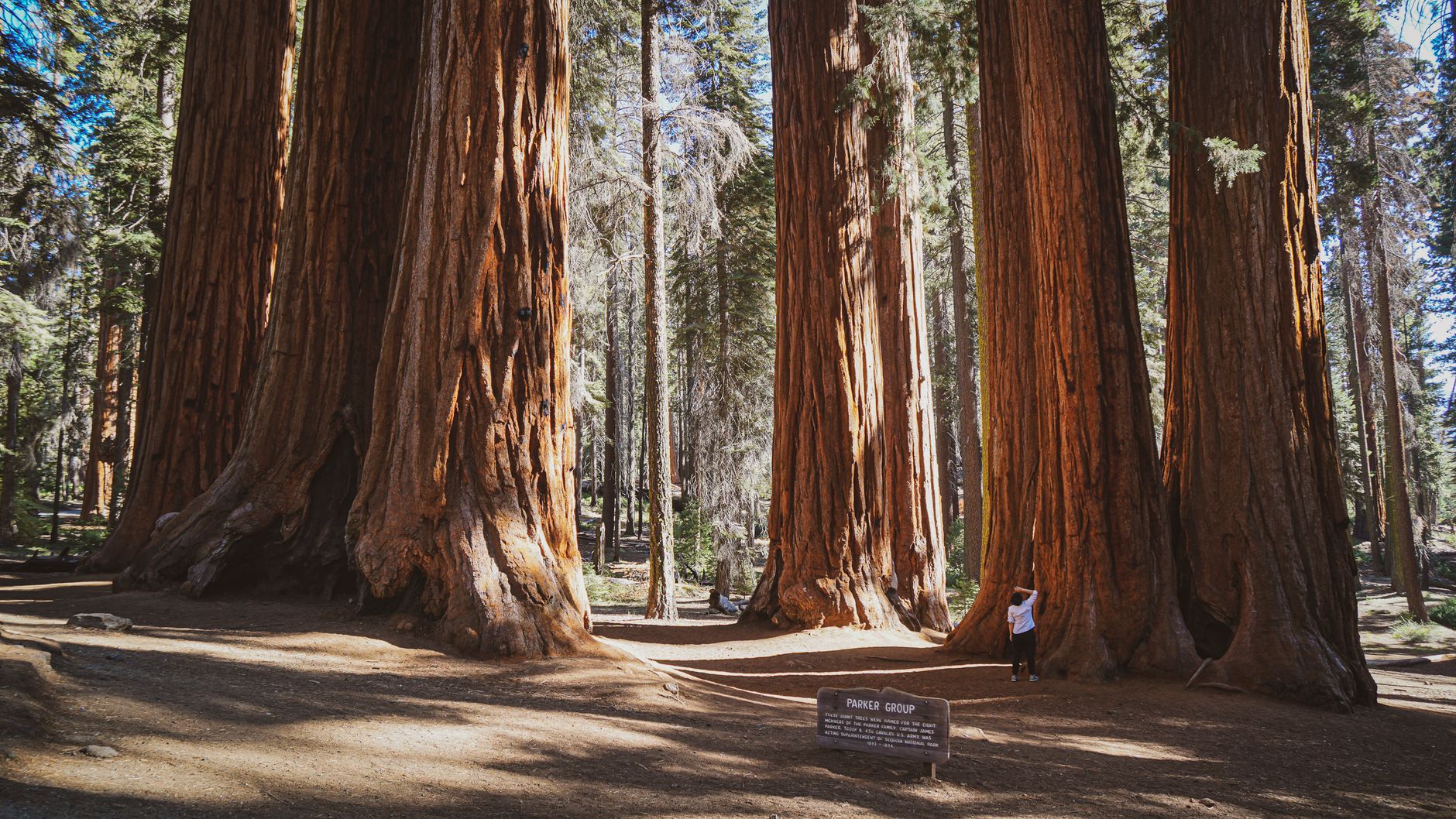
The giant sequoia (Sequoiadendron giganteum) is the largest tree on Earth by trunk volume. The General Sherman Tree in Sequoia National Park stands 274.9 feet tall and holds about 52,500 cubic feet of wood1. The species lives more than 3,000 years; the oldest ring-counted stump is just over 3,200 years old, and the National Park Service puts the maximum at up to 3,40023. Wild giant sequoias grow only on the west slope of California’s Sierra Nevada, in about 75 to 94 groves totaling 35,607 acres along a belt 260 miles long and less than 15 miles wide2456. They depend on fire to open their cones and clear seedbeds, and on deep winter snowpack for summer water32. Wildfires in 2020 and 2021, fueled by a century of fire suppression and hotter drought, killed an estimated 13 to 19 percent of all large sequoias7.
- Largest tree: General Sherman, 52,500 cu ft (1,487 m³), 274.9 ft tall, 36.5 ft across at the base1
- Tallest sequoia: 310–311 ft (94.5–94.9 m); coast redwoods grow taller, to 380 ft289
- Oldest: 3,266 years by crossdated ring count; NPS maximum “up to 3,400 years”83
- Range: Sierra Nevada west slope only, 4,590–7,050 ft, about 75–94 groves256
- Bark: up to 18 in to 2 ft thick, fibrous, non-resinous34
- Seeds: 91,000 per pound; cones sealed 20+ years until fire32
- Lost to fire, 2020–21: 8,431–11,897 large trees, 13–19 percent of the population7
A giant sequoia is a tree that has solved the problem of dying. It grows for three thousand years on a trunk that barely tapers, wears bark two feet thick that fire cannot get through, is ignored by the insects and fungi that fell other conifers, and ends only when its own weight pulls it over. It lives in one narrow strip of one mountain range, on the meltwater of one winter’s snow, and it needs the forest to burn every decade or two to make its seedlings. For a century we stopped the fires, and in 2020 and 2021 the consequences arrived.
This is the site’s complete guide to the species. Every number carries a citation to the National Park Service, the U.S. Forest Service, Save the Redwoods League, or a specialist source, and the detailed pages linked from each section go deeper.
Guides in this section
- 30 giant sequoia facts, verified with sources
- Sequoia vs redwood: every difference, side by side
- How to tell a giant sequoia from a coast redwood
- The three redwoods: dawn redwood vs giant sequoia vs coast redwood
- Hyperion vs General Sherman: the tallest tree vs the biggest tree
- How old do giant sequoias get?
- How tall do giant sequoias grow, and why are they so big?
- The 10 largest giant sequoias and where to see each one
- Where giant sequoias grow, and why only in the Sierra Nevada
- How many giant sequoias are left?
- Are giant sequoias dying? Fire, drought, beetles, and the science
- Why giant sequoias need fire, and why recent fires killed them anyway
- The Castle, KNP Complex, and Windy fires
- Why rangers deliberately burn sequoia groves
- Giant sequoia bark: how thick it is and why it does not burn
- The giant sequoia cone: tiny seeds, a 20-year wait, and three ways to open it
- Giant sequoia roots: shallow, wide, and how the trees stay up
- The life cycle of a giant sequoia, from seed to 3,000 years
- Why giant sequoia wood is nearly useless for lumber
- Why is it called sequoia? The Sequoyah story and how to pronounce it
- California’s state tree: why it is both the redwood and the giant sequoia
- Sequoiadendron giganteum: taxonomy explained
- What lives in a giant sequoia grove
- How much carbon does a giant sequoia store?
What a giant sequoia is
The giant sequoia is a conifer in the cypress family, Cupressaceae, and the only species in the genus Sequoiadendron, which the American botanist John Buchholz established in 193984. Its older name, Sequoia gigantea, placed it in the same genus as the coast redwood; other names are “big tree,” “Sierra redwood,” and, in Britain, “Wellingtonia”8. The taxonomy page untangles the history.
It is one of three living “redwoods.” The coast redwood (Sequoia sempervirens) grows in a foggy Pacific strip and is the tallest tree on Earth; the dawn redwood (Metasequoia glyptostroboides) is a deciduous conifer from central China, known from fossils before living trees were found in the 1940s910. All three descend from a lineage that flourished across the Northern Hemisphere millions of years ago and retreated as the climate cooled and dried510. The differences are laid out on sequoia vs redwood, the three redwoods compared, and the field-identification page, how to tell a sequoia from a redwood.
The name itself is a puzzle. Stephan Endlicher coined Sequoia in 1847 without explaining it. The Forest Service says he “presumably” honored Sequoyah, the Cherokee scholar who invented an 86-symbol syllabary; a rival argument derives it from the Latin sequor, “to follow”1112. In 1853 the English botanist John Lindley named the giant sequoia Wellingtonia gigantea for the Duke of Wellington, over American objections and a rival Washingtonia13. The whole story, and the pronunciation (suh-KWOY-uh), is on why it is called sequoia. The tree shares the title of California state tree with the coast redwood8; see California’s state tree.
How big giant sequoias get
Giant sequoias are the largest trees on Earth by trunk volume, not by height. The Forest Service silvics manual states that one species has a greater diameter, three grow taller, and one lives longer, but none holds more wood in a single trunk2. Mature trees typically stand 250 to 275 feet tall with trunks 15 to 20 feet in diameter; the record diameter is about 35 feet4. The tallest known reaches 94.5 to 94.9 m (310 to 311 ft), well short of the coast redwood Hyperion at 380 feet289.
The General Sherman Tree in Giant Forest is the champion: 274.9 feet tall, 102.6 feet around at the ground, 36.5 feet across at the base, about 52,500 cubic feet of trunk, and close to 1,400 tons1. At 120 feet above the ground the trunk is still 17 feet thick14. The NPS Top Thirty list ranks the rest: General Grant at 46,608 cubic feet, the President at 45,148, Lincoln at 44,471, Stagg at 42,557, and Boole at 42,47215. When branches are counted, the President, measured at 54,000 cubic feet of wood and bark, moves into second place1516. Ten of the thirty largest trees stand in Giant Forest15. The full ranking is on the largest giant sequoias, and the champion has its own page: the General Sherman Tree.
Height and volume follow different curves. Height growth is rapid for at least 100 years, slows after 400, and levels off near 250 feet between 800 and 1,500 years; the trunk keeps thickening for the rest of the tree’s life2. A big sequoia adds about 40 cubic feet of wood a year, the volume of a 50-foot tree one foot thick, and General Sherman adds an estimated 40 to 51152. Old trees do not slow down: climbing measurements of the 3,200-year-old President showed it producing more new wood each year than vigorous younger trees16. Why the species grows so large, and why not taller, is on how tall giant sequoias grow; the two record holders are compared on Hyperion vs General Sherman.
How old giant sequoias get
The oldest verified giant sequoias are stumps. The Forest Service records a ring count of 3,200 years; a Converse Basin stump logged in the 1870s was later crossdated at 3,266 years; and the NPS says the species reaches ages “up to 3,400 years”283. John Muir once counted 4,000 rings on a stump, a figure later corrected to about 3,0008.
Living trees are estimated, not counted. The President is put at about 3,200 years, the Grizzly Giant in Yosemite at about 2,900, and General Sherman at only about 2,200161718. Size is a poor guide: in the NPS analysis of the 2020 Castle Fire, trees 15 feet in diameter had a median age near 2,000 years but ranged from 800 to 3,10019. The methods, the disagreements, and the age-to-diameter table are on how old giant sequoias get, and the whole arc from seed to old age is on the life cycle of a giant sequoia.
Where giant sequoias grow
Wild giant sequoias grow only at middle elevations on the western slope of the Sierra Nevada3. The groves are strung along a belt about 260 miles long and less than 15 miles wide, from the American River in Placer County south to Deer Creek Grove in Tulare County64. The Forest Service counts about 75 groves totaling 35,607 acres; Save the Redwoods League counts about 94; the difference is how historic grove names are split or lumped, not new discoveries245. Sequoia and Kings Canyon National Parks alone distinguish about 40 groves20. The total occupied area is about 124 km², roughly 2 percent of the coast redwood’s range8.
The groves sit between 4,590 and 7,050 feet, lower in the north and higher in the south, with 35 to 55 inches of annual precipitation, most of it as 144 to 197 inches of snow, and less than about an inch of rain from June through September2. The trees live on snowmelt held in deep soils; the species needs year-round soil moisture of at least 15 to 20 percent, making it the most water-demanding conifer in the Sierra mixed forest6. Fossils show it once grew in Colorado, Wyoming, and Nevada during wetter times6. Why it survives only here is on where giant sequoias grow.
How a giant sequoia is built
Bark
The bark is the species’ defining feature: reddish-brown, fibrous, and up to 18 inches thick by the NPS’s figure or 2 feet at the base by the Forest Service’s34. It is non-resinous, which is why it chars without carrying flame, and the Forest Service credits it with fire resistance superior to any associated species; almost all large trees carry fire scars2. See giant sequoia bark.
Cones and seeds
The cones are small, egg-shaped, and woody, 2 to 3.5 inches long, and hold about 200 seeds each; the seeds are the size of a flake of oatmeal, 91,000 to the pound32. A mature tree carries 10,000 to 30,000 green cones and adds about 1,500 a year, dispersing 300,000 to 400,000 seeds annually24. The cones are serotinous: they stay sealed for 20 years or more until fire, a Douglas squirrel, or the larvae of the long-horned beetle Phymatodes nitidus opens them26. Wind carries the seed only about 600 feet21. See the giant sequoia cone.
Roots
There is no taproot. Seedlings start with one, but by six to eight years lateral roots dominate; mature roots spread 100 feet or more from the trunk and occupy 0.7 acre or more, yet few go deeper than 3 feet25. Toppling, when wind, wet soil, stream undercutting, or snow load acts on enormous weight over shallow roots, is how sequoias have traditionally died2. See giant sequoia roots.
Needles
The foliage is scale-like, bluish-green, and sharp-pointed, spiraling around the twig, more like a juniper’s than a coast redwood’s flat needles6.
Wood
Old-growth sequoia wood is brittle, with low tensile strength; commercial logging from the 1850s to the mid-1950s produced fence posts, grape stakes, shingles, and pencils, and the largest operation, at Converse Basin, never made a profit2411. The heartwood resists decay so well that fallen logs stay largely intact for thousands of years2. See giant sequoia wood and logging.
The life cycle
A giant sequoia begins as a seed that must land in bare mineral soil and sunlight. On undisturbed forest floor, seedlings fail; on ground disturbed by fire they are 30 to 150 times more numerous2. First-summer mortality averages 39 percent, and survival over 7 to 9 years was 27 percent on hot-burned patches and zero on undisturbed floor2. Open-grown seedlings can add 60 cm of height a year; shaded ones manage about 42.
Trees produce their first cones at about 20 years4. Typical trunk diameters run 19 inches at 100 years, 52 at 400, 86 at 800, and 168 (14 feet) at 2,0002. Over a 3,000-year life, the NPS notes, a tree needs only one seedling to reach maturity to replace itself3. The stages are on the life cycle of a giant sequoia.
Why giant sequoias need fire
Fire is the species’ reproductive partner. Heat dries the sealed cones, which begin to shed seed within one to two weeks, releasing up to 8 million seeds per acre in a single event32. Fire clears the litter to mineral soil, and fire “intense enough to kill the tree canopy in small areas” opens the sunlit gaps where seedlings grow; without it, the NPS says, the species suffered massive reproductive failure through the 1900s22.
Fire-scar records going back 2,000 years show surface fires burning through Giant Forest every 6 to 35 years22. The Forest Service gives 5 to 25 years across the species and calls sequoia forest a “fire climax community”4. Around 1860 the fires stopped, ended by sheep grazing, the loss of Native American burning, and then government suppression22. The Forest Service calls fire exclusion the most significant human impact on the species, because it lets fuel accumulate toward crown fires2.
The parks answered with deliberate fire. After studies in 1963 and 1964, Sequoia and Kings Canyon began prescribed burning in 1968, and Redwood Mountain Grove is called the birthplace of prescribed fire in the western United States23. Giant Forest has been burned since 1979, including a 245-acre burn around General Sherman in 201924. The ecology is on giant sequoias and fire; the program is on why rangers deliberately burn sequoia groves.
What is killing giant sequoias now
Managers long believed a sequoia died only by falling or by crown scorch3. Since 2014 three things have changed that.
Hotter drought. The drought of 2012 to 2016 combined low precipitation with high temperatures; 2014 was the most severe drought year in the park’s 122-year record, and foliage dieback on some sequoias exceeded 75 percent7. Annual tree mortality in Sequoia National Park had already nearly doubled between 1983 and 200425.
Bark beetles. During that drought, 33 sequoias died standing with native Phloeosinus bark beetle activity and fire damage at the base, the first documented beetle kill of the species73.
High-severity wildfire. The 2020 Castle Fire burned 9,530 acres of grove, one-third of all grove area, and killed an estimated 7,500 to 10,600 large sequoias, 10 to 14 percent of the species19. The 2021 KNP Complex and Windy fires killed 2,261 to 3,637 more19. Combined, 8,431 to 11,897 large trees died, 13 to 19 percent of all sequoias with trunks 4 feet or more in diameter7. Over 85 percent of grove acreage burned between 2015 and 2021, against about 25 percent in the previous century7.
The NPS attributes the severity to fuel built up by a century of suppression, intensified by drought and a warming climate2226. The proof came inside one fire: in 2021 Giant Forest, treated with prescribed burns for decades, burned at low intensity with General Sherman’s base wrapped in protective foil, while Redwood Mountain Grove burned 40 percent at moderate-to-high severity2720. The Sierra snowpack the trees depend on is also at risk, with the rain–snow line projected to rise 1,500 to 3,000 feet as temperatures climb 6 to 10 °F by the century’s end26. The full assessment is on are giant sequoias dying, and the fires have their own page: the Castle, KNP Complex, and Windy fires.
How many are left, and what is being done
Fewer than 80,000 giant sequoias remain in the native range, according to a 2024 University College London study, a figure best read as an order of magnitude since no agency counts every tree28. Save the Redwoods League estimates more than 17 percent of mature sequoias lost to wildfire since 20155.
Restoration has two tools. The first is prescribed fire, which the NPS calls one of the most important management tools for grove resilience7. The second is planting. Surveys in 2022 and 2023 found natural regeneration insufficient in the worst-burned parts of Redwood Mountain Grove, so in 2024 the NPS planted 65,000 sequoia seedlings there and about 3,800 in Board Camp Grove, with more groves slated for 202529. The stock is 110,000 seedlings grown from cones collected in September 2022, funded by $2.6 million in Bipartisan Infrastructure Law money30. Save the Redwoods League planted more than 20,000 seedlings at Alder Creek in 2023 and coordinates with agencies and tribes through the Giant Sequoia Lands Coalition315. See how many giant sequoias are left.
What lives in a sequoia grove
The Douglas squirrel, or chickaree, is the grove’s most important animal. About 14 inches long including its tail, it eats the fleshy scales of green sequoia cones rather than the seeds, freeing them to fall, and one squirrel can go through 3,000 to 3,500 cones a year32214. The Forest Service counts over 30 bird species using the tree, along with 151 insect and 37 arachnid species4. The Pacific fisher, listed as endangered in the southern Sierra in June 2020, lost habitat in the 2020–21 fires, and the NPS is replanting mixed conifers to reconnect it3330. The California spotted owl needs the old, dense forest that high-severity fire removes34; black bears range through every grove35. See what lives in a giant sequoia grove.
Carbon
A 2024 laser-scanning study of 97 trees planted in the UK found them taking up an average of about 85 kg of carbon per tree per year, with the fastest growers exceeding that2836. Ancient coast redwood forests store more carbon per acre than any other forest type9. The numbers for native groves are on how much carbon a giant sequoia stores.
A short history
Outsiders learned of the trees in 1852, when the hunter Augustus T. Dowd publicized the Discovery Tree at what is now Calaveras Big Trees State Park; it was felled the next year with pump augers over three weeks, and its stump hosted dances3738. The Mark Twain Tree was cut in 1891 so slabs could be shown in New York and London39. Converse Basin, once the largest grove in the world, was logged of most of its giants between the 1890s and 191840.
Protection came early by American standards. Abraham Lincoln’s 1864 Yosemite Grant protected Mariposa Grove, the first federal set-aside of scenic land41. Sequoia National Park was created on September 25, 1890, the second national park and the first established to protect a living organism; General Grant National Park followed a week later and became part of Kings Canyon in 194042. Giant Sequoia National Monument, proclaimed April 15, 2000, brought the remaining groves on national forest land under protection8. John Muir began writing about the “big trees” in 187643. The story is told on the history of Sequoia National Park.
Growing a giant sequoia
William Lobb carried seed to England in 1853, and an estimated half a million giant sequoias and coast redwoods now grow in the UK, where the tallest measured 54.87 m (about 180 ft)1328. It is hardy to USDA Zone 7 and has naturalized in Ireland, the UK, and Turkey; a planted tree near Eagle Point, Oregon, stands 64.95 m (213 ft)8. Outside the native range, though, it is highly susceptible to pests and pathogens at every stage of life2. The site’s guide to growing a giant sequoia covers seed, seedlings, and zones.
Where to see giant sequoias
The most accessible groves are Giant Forest in Sequoia National Park, home of General Sherman and the largest unlogged grove; Grant Grove in Kings Canyon, with numerous giants in about 90 acres; Mariposa Grove in Yosemite, with more than 500 mature trees; and Calaveras Big Trees, the only California state park with giant sequoias204138. Converse Basin and its Boole Tree are in Giant Sequoia National Monument40. Plan a visit with the Sequoia National Park guide, the Kings Canyon guide, the ranked list on where to see giant sequoias, the best hikes in Sequoia and Kings Canyon, and where to stay for Sequoia National Park.
Frequently Asked Questions
What is special about giant sequoia trees?
Are giant sequoias the biggest trees in the world?
How old is the oldest giant sequoia?
Where do giant sequoias grow?
Why do giant sequoias need fire?
Are giant sequoias endangered?
What is the difference between a sequoia and a redwood?
Can I grow a giant sequoia at home?
Related Articles
Sources
- The General Sherman Tree — National Park Service, Sequoia & Kings Canyon. Accessed 2026-09-06.
- Sequoiadendron giganteum, Silvics of North America (age) — U.S. Forest Service. Accessed 2026-09-06.
- Giant Sequoias — National Park Service, Sequoia & Kings Canyon. Accessed 2026-09-06.
- Sequoiadendron giganteum, Fire Effects Information System — U.S. Forest Service. Accessed 2026-09-06.
- Giant Sequoias — Save the Redwoods League. Accessed 2026-09-06.
- Giant Sequoia (Sequoiadendron giganteum) — University of California Agriculture and Natural Resources. Accessed 2026-09-06.
- Giant Sequoias Face New Threats — National Park Service. Accessed 2026-09-06.
- Sequoiadendron giganteum — The Gymnosperm Database. Accessed 2026-09-06.
- Coast Redwoods — Save the Redwoods League. Accessed 2026-09-06.
- Dawn Redwoods — Save the Redwoods League. Accessed 2026-09-06.
- Discover History, Sequoia National Forest — U.S. Forest Service. Accessed 2026-09-06.
- Naming Sequoia — Yore Sequoia. Accessed 2026-09-06.
- How the giant sequoia came to England — National Trust. Accessed 2026-09-06.
- Frequently Asked Questions — National Park Service, Sequoia & Kings Canyon. Accessed 2026-09-06.
- The Largest Trees in the World — National Park Service. Accessed 2026-09-06.
- Forest Giant — National Geographic, December 2012. Accessed 2026-09-06.
- Grizzly Giant Tour: Enduring Giant — National Park Service, Yosemite. Accessed 2026-09-06.
- General Sherman Tree (place page) — National Park Service. Accessed 2026-09-06.
- Wildfires Kill Unprecedented Numbers of Large Sequoia Trees — National Park Service. Accessed 2026-09-06.
- Exploring Giant Sequoia Groves — National Park Service. Accessed 2026-09-06.
- Fallen Green Cones of the Giant Sequoia — National Park Service, Yosemite. Accessed 2026-09-06.
- Giant Sequoias and Fire — National Park Service. Accessed 2026-09-06.
- Whitaker Prescribed Fire — National Park Service. Accessed 2026-09-06.
- Sherman Prescribed Burn Planned in Sequoia National Park — National Park Service. Accessed 2026-09-06.
- Forest Health and Climate Change — National Park Service. Accessed 2026-09-06.
- Climate Change — National Park Service, Sequoia & Kings Canyon. Accessed 2026-09-06.
- KNP Complex Fire — National Park Service. Accessed 2026-09-06.
- Giant sequoias are a rapidly growing feature of the UK landscape — ScienceDaily / University College London, March 2024. Accessed 2026-09-06.
- Restoring Giant Sequoia Groves Following High-Severity Wildfire — National Park Service. Accessed 2026-09-06.
- Sequoia and Kings Canyon Post-Fire Sequoia Restoration — National Park Service. Accessed 2026-09-06.
- Alder Creek — Save the Redwoods League. Accessed 2026-09-06.
- Douglas’s Squirrel — National Park Service. Accessed 2026-09-06.
- The Pacific Fisher — Sequoia Parks Conservancy. Accessed 2026-09-06.
- California Spotted Owl — National Park Service. Accessed 2026-09-06.
- Black Bears — National Park Service, Sequoia & Kings Canyon. Accessed 2026-09-06.
- Giant sequoia (Sequoiadendron giganteum) in the UK: carbon storage potential and growth rates — Holland et al., Royal Society Open Science, 2024. Accessed 2026-09-06.
- Big Trees, Early Years — Calaveras Heritage Council. Accessed 2026-09-06.
- Calaveras Big Trees State Park Fact Sheet (PDF) — California State Parks. Accessed 2026-09-06.
- Big Stump — National Park Service. Accessed 2026-09-06.
- Converse Basin Grove — U.S. Forest Service, Sequoia National Forest. Accessed 2026-09-06.
- Mariposa Grove of Giant Sequoias — National Park Service, Yosemite. Accessed 2026-09-06.
- History & Culture — National Park Service, Sequoia & Kings Canyon. Accessed 2026-09-06.
- Preserving a “Big Tree” — National Park Service, John Muir National Historic Site. Accessed 2026-09-06.