
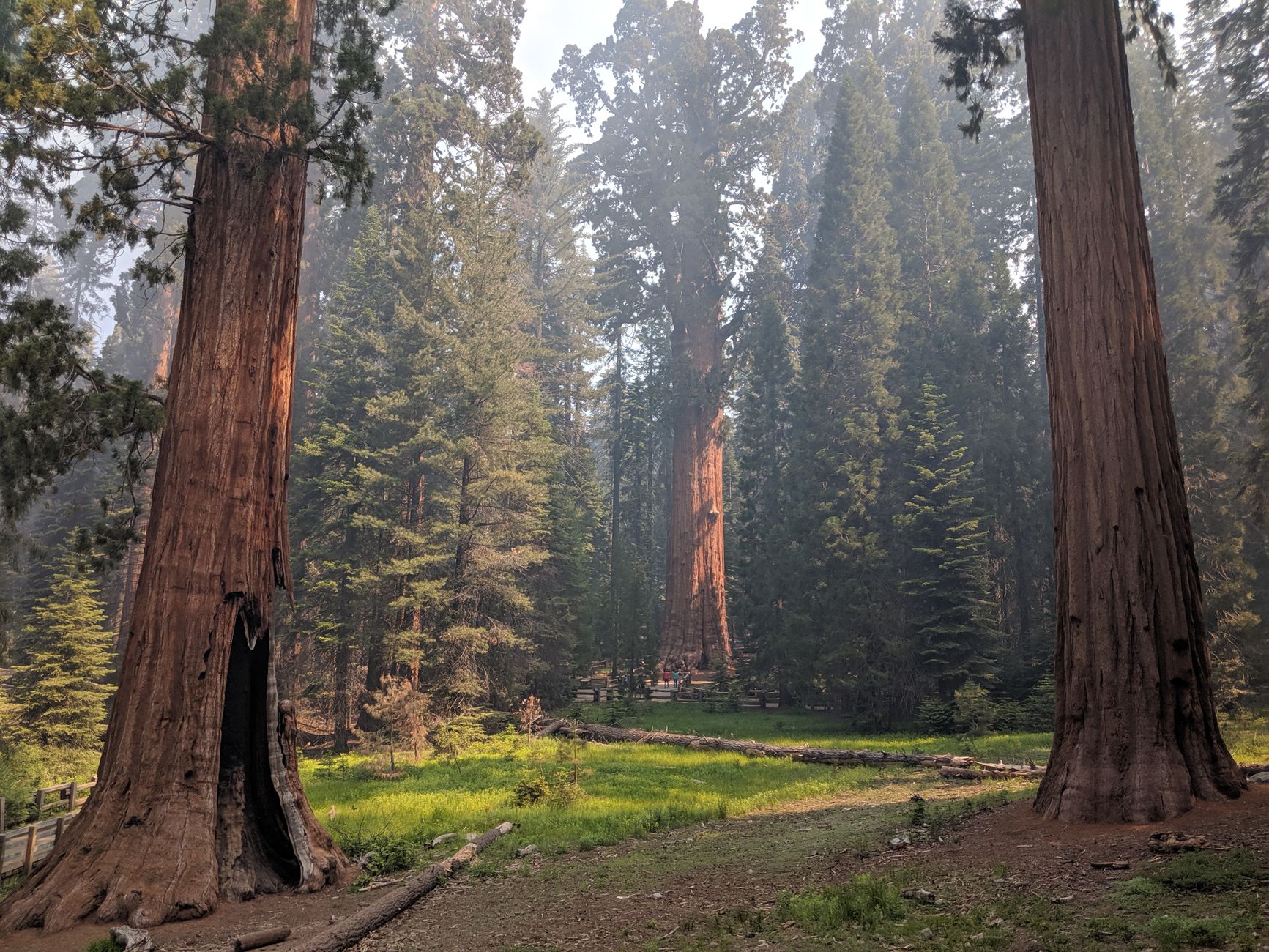
The largest giant sequoias (Sequoiadendron giganteum) are ranked by trunk volume, not height, on the National Park Service’s Top Thirty list. General Sherman in Sequoia National Park’s Giant Forest leads at 52,508 cubic feet, followed by General Grant in Kings Canyon at 46,608, the President at 45,148, and Lincoln at 44,471, both in Giant Forest1. The Stagg Tree in Alder Creek Grove (42,557) and the Boole Tree in Converse Basin (42,472) are the largest outside the national parks1. If branches are counted, the President moves into second place1. Ten of the thirty largest stand in Giant Forest, and seven of the top ten are in Sequoia and Kings Canyon National Parks1.
- 1. General Sherman: 52,508 cu ft, 274.9 ft tall, Giant Forest1
- 2. General Grant: 46,608 cu ft, 268.1 ft, Grant Grove1
- 3. The President: 45,148 cu ft by trunk; second if branches count1
- 4. Lincoln: 44,471 cu ft, Giant Forest1
- 5. Stagg: 42,557 cu ft, Alder Creek Grove, Save the Redwoods League land16
- 6. Boole: 42,472 cu ft, the largest tree in any national forest17
- Grizzly Giant: 34,005 cu ft, 26th on the list, the largest in Yosemite’s Mariposa Grove1
The one official ranking of the world’s largest trees is kept by Sequoia and Kings Canyon National Parks. It measures trunk volume only, leaving out branches, foliage, and roots, and draws on Wendell Flint’s 2002 book To Find the Biggest Tree plus NPS and U.S. Geological Survey measurements from 2001 and 20121. This page reproduces the top ten, adds the Grizzly Giant because so many people ask about it, and says where each tree stands. It is part of the guide to giant sequoia trees.
The top ten by trunk volume
| Rank | Tree | Grove | Manager | Height (ft) | Ground circumference (ft) | Trunk volume (cu ft) |
|---|---|---|---|---|---|---|
| 1 | General Sherman | Giant Forest | Sequoia National Park | 274.9 | 102.6 | 52,508 |
| 2 | General Grant | Grant Grove | Kings Canyon National Park | 268.1 | 107.5 | 46,608 |
| 3 | President | Giant Forest | Sequoia National Park | 240.9 | 93 | 45,148 |
| 4 | Lincoln | Giant Forest | Sequoia National Park | 255.8 | 98.3 | 44,471 |
| 5 | Stagg | Alder Creek | Private land in 2002; Save the Redwoods League since 2019 | 243 | 109 | 42,557 |
| 6 | Boole | Converse Basin | Giant Sequoia National Monument | 268.8 | 113 | 42,472 |
| 7 | Genesis | Mountain Home | Mountain Home State Forest | 253 | 85.3 | 41,897 |
| 8 | Franklin | Giant Forest | Sequoia National Park | 223.8 | 94.8 | 41,280 |
| 9 | King Arthur | Garfield | Sequoia National Park | 270.3 | 104.2 | 40,656 |
| 10 | Monroe | Giant Forest | Sequoia National Park | 247.8 | 91.3 | 40,104 |
Source: NPS Top Thirty Largest Sequoias1; Alder Creek ownership from Save the Redwoods League6. Robert E. Lee in Grant Grove is 11th at 40,102 cubic feet, two cubic feet behind Monroe1.
The NPS cautions that tree dimensions may have changed since the measurements were collated1. The Washington Tree in Giant Forest was second on the list until 2003, when fire reduced it, and it no longer ranks in the top thirty1.
1. General Sherman Tree, Giant Forest
General Sherman is the largest living single-trunked tree on Earth. The NPS gives 274.9 feet of height, 102.6 feet of ground circumference, a base diameter of 36.5 feet, and about 52,500 cubic feet of trunk, rounded from the list’s 52,50821. The trunk weighs close to 1,400 tons, and at 120 feet above the ground it is still 17 feet across23. Two NPS pages disagree on the ground circumference, 102.6 feet on the tree’s page versus 109 feet in the park FAQ; the difference is where a tape is held on a buttressed base23. Its age is about 2,200 years by the latest NPS estimate, with Save the Redwoods League giving 2,200 to 2,70045.
Where: Giant Forest, Sequoia National Park. The main trail drops half a mile from the Wolverton Road parking lot; a 500-foot accessible path leads from a small lot on the Generals Highway, 2 miles north of the Giant Forest Museum12. Full details on the General Sherman Tree.
2. General Grant Tree, Grant Grove
General Grant is the second-largest tree by trunk volume at 46,608 cubic feet, 268.1 feet tall, with a ground circumference of 107.5 feet, wider around than General Sherman18. President Coolidge designated it the Nation’s Christmas Tree on April 28, 1926, and President Eisenhower declared it a National Shrine in 1956 in memory of Americans who died in the armed forces, the only living shrine in the country9.
Where: Grant Grove, Kings Canyon National Park, on the paved Grant Tree Trail near Grant Grove Village. Grant Grove packs an unusual number of trees 10 to 20 feet in diameter into about 90 acres10. See the General Grant Tree.
3. The President, Giant Forest
The President is third by trunk volume at 45,148 cubic feet, but when Steve Sillett’s team measured it branch by branch in 2011–12 they found at least 54,000 cubic feet of wood and bark, which moves it to second place overall and pushes General Grant to third111. It is about 3,200 years old, roughly a thousand years older than General Sherman, with a base 27 feet across and a dead spire that the NPS list puts at 240.9 feet and National Geographic at 247111. The same measurements showed the tree adding more new wood each year than younger trees11.
Where: On the Congress Trail, a 2.7-mile paved loop that begins beside General Sherman12. See the Congress Trail guide.
4. Lincoln Tree, Giant Forest
Lincoln is fourth at 44,471 cubic feet, 255.8 feet tall, with a ground circumference of 98.3 feet1. It stands in Giant Forest, Sequoia National Park1. A different Lincoln Tree grows on the Grant Tree Trail in Kings Canyon; the ranked tree is the Giant Forest one1.
5. Stagg Tree, Alder Creek Grove
The Stagg Tree is fifth at 42,557 cubic feet and 243 feet tall, with the second-widest ground circumference on the list at 109 feet1. Save the Redwoods League describes it as the fifth-largest tree on Earth, 250 feet tall and “wider than a two-lane street,” and larger than any tree in the adjacent Giant Sequoia National Monument6. The NPS list still records the land as private, which it was in 2002; the League bought the 530-acre Alder Creek property in 2019 for $15.65 million with gifts from more than 8,500 donors in 30 countries16. The 2020 Castle Fire burned 38 percent of the property at high severity and killed at least 108 old-growth sequoias; the League planted more than 20,000 seedlings there in 20236.
Where: Alder Creek Grove, in the southern Sierra near the Giant Sequoia National Monument. Access is at the League’s discretion; check its Alder Creek page before planning a visit. See Alder Creek Grove.
6. Boole Tree, Converse Basin
The Boole Tree is sixth at 42,472 cubic feet, 268.8 feet tall, and has the largest ground circumference on the entire list at 113 feet1. The Gymnosperm Database records the largest diameter at breast height of any sequoia, 898 cm (29.5 ft), and the largest footprint13. Forest Service pages disagree on its rank, calling it sixth on one page and eighth on another; the NPS list says sixth7141. It is the largest tree in any national forest, named around 1895 by Fresno physician A. H. Sweeny for Franklin A. Boole, the logging supervisor who spared it, and was considered the world’s largest tree until 1931710. It is the last big sequoia standing in Converse Basin, once the largest grove in the world and logged of nearly all its giants7.
Where: Converse Basin, Giant Sequoia National Monument, about 5 miles from Grant Grove. Forest Route 13S55 runs 2.5 miles to the trailhead; the Forest Service recommends high-clearance vehicles and advises against low-clearance cars7. See the Boole Tree and Converse Basin.
7. Genesis Tree, Mountain Home State Forest
Genesis is seventh at 41,897 cubic feet and 253 feet tall, with a ground circumference of 85.3 feet, the slimmest base in the top ten1. It stands in Mountain Home State Forest in Tulare County, which holds five of the thirty largest sequoias: Genesis, Summit Road, Euclid, Methuselah, and a second Adams Tree1. See Mountain Home State Forest and Balch Park.
8. Franklin Tree, Giant Forest
Franklin is eighth at 41,280 cubic feet. At 223.8 feet it is the shortest tree in the top ten, which says something about how little height matters in this ranking1. It stands in Giant Forest, Sequoia National Park1.
9. King Arthur, Garfield Grove
King Arthur is ninth at 40,656 cubic feet, 270.3 feet tall, with a ground circumference of 104.2 feet1. It grows in Garfield Grove in Sequoia National Park; an unnamed tree found and measured in the same grove in 2001 ranks 12th1.
10. Monroe Tree, Giant Forest
Monroe is tenth at 40,104 cubic feet and 247.8 feet tall, in Giant Forest1. With General Sherman, the President, Lincoln, Franklin, Adams, Column, Pershing, Chief Sequoyah, and Hamilton, it makes Giant Forest home to ten of the thirty largest trees on Earth110.
The Grizzly Giant, Mariposa Grove
The Grizzly Giant is not in the top ten. It ranks 26th at 34,005 cubic feet, 209 feet tall, with a ground circumference of 92.5 feet1. It earns a place here because it is the largest tree in Yosemite’s Mariposa Grove and one of the oldest living sequoias, estimated at 2,900 years by the NPS tour page and rounded to 3,000 on the grove’s visitor page1516. The Washington Tree, also in Mariposa Grove, is slightly larger at 35,901 cubic feet and ranks 18th1.
Where: Mariposa Grove, Yosemite National Park, on the 2-mile Grizzly Giant Loop Trail from the grove arrival area16. See the Grizzly Giant and the Mariposa Grove guide.
What "largest" means, and why lists differ
The NPS ranks by trunk volume because it is the fairest single measure of how much tree there is. Height favors slim trees; circumference favors buttressed bases. Even trunk volume depends on method: General Sherman is 52,508 cubic feet on the NPS list and 1,473.4 m³ (about 52,000 cu ft) in the Gymnosperm Database113. Including branches reorders the top three, and fire reorders it too, as the Washington Tree showed in 20031. Treat the rankings as accurate to the measurement date.
For how these giants compare to the tallest trees, see how tall giant sequoias grow and Hyperion vs General Sherman.
Frequently Asked Questions
What is the largest sequoia tree in the world?
Is General Sherman the biggest tree by every measure?
What is the second-largest tree in the world?
General Grant in Kings Canyon at 46,608 cubic feet of trunk. If branch volume is included, the President in Giant Forest is second and General Grant third1.
Where are the largest sequoias?
How big is the Boole Tree?
Is the Grizzly Giant one of the biggest trees?
How many of the largest trees are in Giant Forest?
Ten of the thirty largest, including four of the top ten: General Sherman, the President, Lincoln, and Franklin, plus Monroe at tenth1.
Related Articles
Sources
- The Largest Trees in the World (Top Thirty Largest Sequoias) — National Park Service, Sequoia & Kings Canyon. Accessed 2026-09-06.
- The General Sherman Tree — National Park Service. Accessed 2026-09-06.
- Frequently Asked Questions — National Park Service, Sequoia & Kings Canyon. Accessed 2026-09-06.
- General Sherman Tree (place page) — National Park Service. Accessed 2026-09-06.
- Giant Sequoias — Save the Redwoods League. Accessed 2026-09-06.
- Alder Creek — Save the Redwoods League. Accessed 2026-09-06.
- Boole Tree — U.S. Forest Service, Sequoia National Forest. Accessed 2026-09-06.
- The General Grant Tree — National Park Service. Accessed 2026-09-06.
- General Grant Tree — National Park Service, Sequoia & Kings Canyon. Accessed 2026-09-06.
- Exploring Giant Sequoia Groves — National Park Service. Accessed 2026-09-06.
- Forest Giant — National Geographic, December 2012. Accessed 2026-09-06.
- Congress Trail — National Park Service. Accessed 2026-09-06.
- Sequoiadendron giganteum — The Gymnosperm Database. Accessed 2026-09-06.
- Converse Basin Grove — U.S. Forest Service, Sequoia National Forest. Accessed 2026-09-06.
- Grizzly Giant Tour: Enduring Giant — National Park Service, Yosemite. Accessed 2026-09-06.
- Mariposa Grove of Giant Sequoias — National Park Service, Yosemite. Accessed 2026-09-06.