
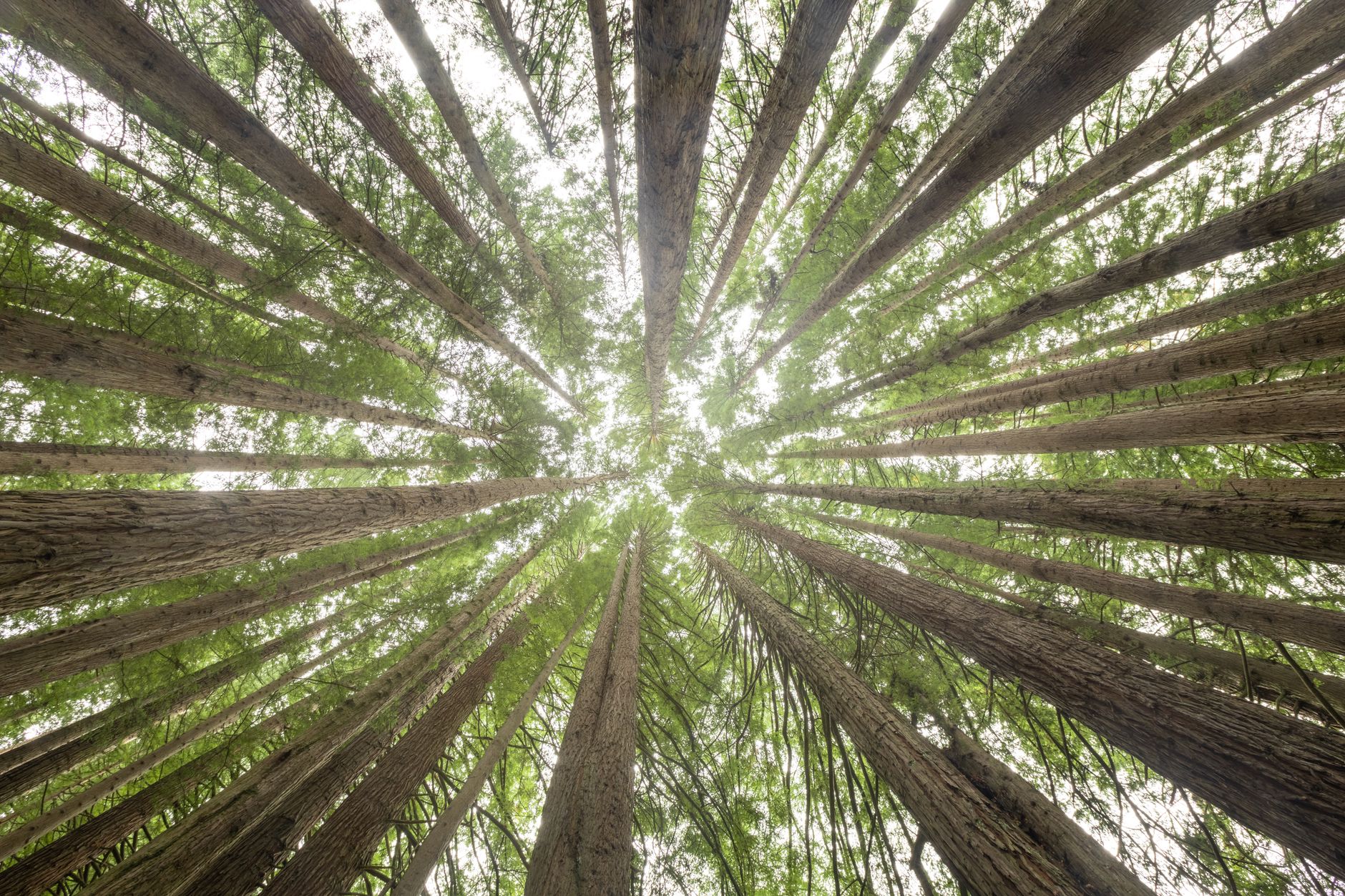
Hyperion, a coast redwood in Redwood National Park, is the tallest known tree on Earth at about 380 feet; the Gymnosperm Database records the tallest coast redwood at 115.9 meters12. General Sherman, a giant sequoia in Sequoia National Park, is the largest known tree by trunk volume at about 52,500 cubic feet, standing 274.9 feet tall with a base 36.5 feet across and a trunk weighing close to 1,400 tons3. They are different species answering different questions: height versus volume of wood. The practical difference is bigger still. General Sherman stands at the end of a paved half-mile trail with a shuttle stop4, while Hyperion sits off-trail inside a designated area closure where hiking “could result in a fine or jail,” a restriction the National Park Service still lists as of September 20265.
- Hyperion height: about 380 ft; tallest coast redwood on record 115.9 m12
- General Sherman height: 274.9 ft (83.8 m)3
- General Sherman volume: about 52,500 cu ft (1,487 m³), roughly 1,400 tons of trunk3
- Height difference: Hyperion is roughly 105 ft taller13
- Species: Hyperion is Sequoia sempervirens; General Sherman is Sequoiadendron giganteum67
- Hyperion confirmed tallest: 2006, by a team including Humboldt State’s Stephen Sillett8
- Access: Sherman, paved 0.5-mi trail; Hyperion, closed area, penalties up to $5,000 and six months in jail48
Two trees hold the two headline records, and they are not competing for the same title. Hyperion wins on height by about 105 feet. General Sherman wins on volume by a margin nobody has seriously challenged. This page sets out the measured figures for each, explains why “biggest” and “tallest” produce different champions, and covers the awkward fact that only one of them can legally be visited. Background on the Sierra species is on the giant sequoia trees pillar page.
The two trees, side by side
| Hyperion | General Sherman | |
|---|---|---|
| Species | Coast redwood, Sequoia sempervirens6 | Giant sequoia, Sequoiadendron giganteum7 |
| Record held | Tallest known tree15 | Largest known tree by trunk volume9 |
| Height | About 380 ft; tallest coast redwood recorded at 115.9 m12 | 274.9 ft (83.8 m)3 |
| Trunk volume | Not the species’ strength; NPS calls its trunk “small in comparison to many other old-growth redwood trees”5 | About 52,500 cu ft (1,487 m³); 52,508 cu ft on the NPS ranking list39 |
| Base measurement | Not published by NPS | 102.6 ft ground circumference, 36.5 ft maximum base diameter3 |
| Trunk weight | Not published | Close to 1,400 tons3 |
| Age | Not published; coast redwoods exceed 2,200 years6 | About 2,200 years, with estimates up to 2,7001011 |
| Location | Redwood National Park, off-trail near Redwood Creek5 | Giant Forest, Sequoia National Park3 |
| Can you visit? | No. Designated closure as of September 20265 | Yes, paved 0.5-mi trail plus a 500-ft accessible route4 |
| Confirmed | 20068 | Measured repeatedly by NPS; the standing record holder9 |
Why "tallest" and "biggest" are different records
Height and volume measure different things, and the two species are built to win different contests.
A coast redwood is a spire. It tapers steadily from a base that FEIS records at up to 20 feet in diameter, and it carries that taper to extraordinary heights, up to a measured 364 feet in the FEIS record and about 380 feet for Hyperion61. The NPS Redwood page cites the tallest at 367 feet with a 22-foot base12. Fog supplies roughly 40 percent of the trees’ moisture, which is part of how they sustain water transport at that height12.
A giant sequoia is a column. It refuses to narrow. General Sherman is 36.5 feet across at the base and, according to the NPS FAQ, still 17 feet across at 120 feet above the ground, higher than most trees ever grow313. Its first large branch is 130 feet up and 6.8 feet thick on its own3. All that width, carried far up the trunk, is where the volume comes from.
The Forest Service silvics manual states the ranking plainly: one species has a greater diameter than giant sequoia, three grow taller, and one lives longer, but none packs more wood into a single trunk7.
So the honest comparison is not “which is bigger” but “bigger by what measure”:
- Tallest tree on Earth: Hyperion, a coast redwood15
- Largest tree by trunk volume: General Sherman, a giant sequoia9
- Tallest giant sequoia: about 310 feet by the Forest Service, 94.9 meters in the Gymnosperm Database’s record72
- Oldest of the two species: giant sequoia, with ring counts above 3,200 years against more than 2,200 for coast redwood76
If you want the volume ranking below Sherman, that is on the 10 largest giant sequoias. For the species-level comparison, see sequoia vs redwood and how to tell a giant sequoia from a coast redwood.
General Sherman: the measured figures
The National Park Service publishes a full set of dimensions for General Sherman, which is why it is the best-documented big tree in the world.
| Measurement | Value |
|---|---|
| Height | 274.9 ft (83.8 m)3 |
| Trunk volume | About 52,500 cu ft (1,487 m³)3 |
| Ground circumference | 102.6 ft (31.1 m)3 |
| Maximum base diameter | 36.5 ft (11.1 m)3 |
| Diameter at 120 ft above ground | 17 ft (5.2 m)13 |
| Height of first large branch | 130 ft (39.6 m)3 |
| Largest branch diameter | 6.8 ft (2.1 m)3 |
| Estimated trunk weight | About 1,400 tons3 |
| Estimated age | About 2,200 years10 |
Small discrepancies exist between official pages. The NPS largest-trees list gives 52,508 cubic feet rather than the rounded 52,5009, and the park FAQ quotes a base circumference of 109 feet against 102.6 on the tree’s own page13. The Gymnosperm Database, measuring independently, gives 83.6 meters of height and a stem volume of 1,473.4 cubic meters14. The differences come from where a tape is held on an irregular buttressed base, not from disagreement about which tree is largest.
The tree is also still growing in volume, adding 40 to 51 cubic feet a year at roughly 2,500 years of age7. That is covered on is the General Sherman Tree still growing, and the full visitor page is the General Sherman Tree.
Hyperion: what is actually known, and what is not
Hyperion was confirmed as the world’s tallest tree in 2006, measured by a team that included Stephen Sillett of Humboldt State University8. Its height is commonly given as about 380 feet, and the Gymnosperm Database lists the tallest recorded coast redwood at 115.9 meters, which is 380.2 feet12.
Beyond height, the public record is thin. The NPS does not publish a volume, circumference, or age for Hyperion, and it makes a point of saying the trunk is small compared with many other old-growth redwoods, and that the top cannot be seen from the ground5. There is no viewing angle. There is no clearing. There is nothing to photograph.
The park also notes that the tallest-tree title is inherently temporary, because crowns break5. Hyperion holds the record until it does not.
Why you cannot visit Hyperion
The tree stands off-trail through dense vegetation, reachable only by heavy bushwhacking5. Enough people tried that the ground around it failed. According to the NPS, visitors trampled and in some cases killed the surrounding native vegetation, compacted soil over the shallow roots redwoods depend on, and left trash and human waste; the area around the tree no longer has ferns5.
Redwood National Park responded with a designated area closure covering Tom McDonald Creek and the surrounding area upstream from its confluence with Redwood Creek. The NPS states that hiking within the closure “could result in a fine or jail”5. Local reporting at the time put the closure’s effective date at March 2022, publicized that August, with maximum penalties of a $5,000 fine and six months in jail, though officials said typical enforcement was a citation and removal8. As of September 2026 the closure is still described on the park’s Hyperion page5. Climbing trees requires a research permit, and drones are prohibited5.
The park’s own recommendation is to go and look at accessible trees instead, and it says outright that hundreds of trees on designated trails are more impressive from the base5. The Grove of Titans is the sanctioned alternative: a $3.5-million project by California State Parks, Save the Redwoods League, the Redwood Parks Conservancy and the NPS built a 1,300-foot elevated boardwalk that opened with limited access in September 2021, reached by the 3-mile Mill Creek Trail off Howland Hill Road15.
Which one should you go see?
General Sherman, if you want to stand at the base of a record holder. The tree is at the end of a paved half-mile trail off Wolverton Road with about 200 feet of climb on the way back, and a 500-foot accessible path leads to it from a lot on the Generals Highway4.
For Hyperion, the honest answer is that there is nothing to see even if you got there, which is the park’s point. A tall redwood you can actually appreciate is a better use of a day. The park-level comparison is on Redwood National Park vs Sequoia National Park.
Frequently Asked Questions
Is Hyperion taller than General Sherman?
Is General Sherman the biggest tree in the world?
Can you visit Hyperion?
No. The tree sits inside a designated closure in Redwood National Park, and the NPS states that hiking within it could result in a fine or jail. That closure was still listed as of September 20265.
Why is Hyperion closed to visitors?
Visitors reaching the tree trampled and killed native vegetation, compacted the soil over its shallow roots, and left trash and human waste. The ground around the tree no longer has ferns5.
How tall is the tallest giant sequoia?
Which tree is older, Hyperion or General Sherman?
What is the second tallest tree?
The NPS notes that the tallest-tree title changes as crowns break, and it does not publish a running ranking. What the agency says clearly is that many accessible trees are more impressive from the ground than Hyperion is5.
Related Articles
Sources
- Coast Redwoods — Save the Redwoods League. Accessed 2026-09-09.
- The Tallest Trees — The Gymnosperm Database. Accessed 2026-09-09.
- The General Sherman Tree — National Park Service, Sequoia & Kings Canyon. Accessed 2026-09-09.
- The General Sherman Tree Trail — National Park Service. Accessed 2026-09-09.
- Should I Hike to Hyperion? — National Park Service, Redwood National and State Parks. Accessed 2026-09-09.
- FEIS: Sequoia sempervirens — U.S. Forest Service, Fire Effects Information System. Accessed 2026-09-09.
- Sequoiadendron giganteum, Silvics of North America — U.S. Forest Service. Accessed 2026-09-09.
- Redwood National Park Closes Hyperion, World’s Tallest Tree, to Visitors — Lost Coast Outpost, August 1, 2022. Accessed 2026-09-09.
- The Largest Trees in the World — National Park Service. Accessed 2026-09-09.
- General Sherman Tree (place page) — National Park Service. Accessed 2026-09-09.
- Giant Sequoias — Save the Redwoods League. Accessed 2026-09-09.
- About the Trees — National Park Service, Redwood National and State Parks. Accessed 2026-09-09.
- Frequently Asked Questions — National Park Service, Sequoia & Kings Canyon. Accessed 2026-09-09.
- Sequoiadendron giganteum — The Gymnosperm Database. Accessed 2026-09-09.
- Grove of Titans Boardwalk Opens — National Park Service, Redwood National and State Parks. Accessed 2026-09-09.