
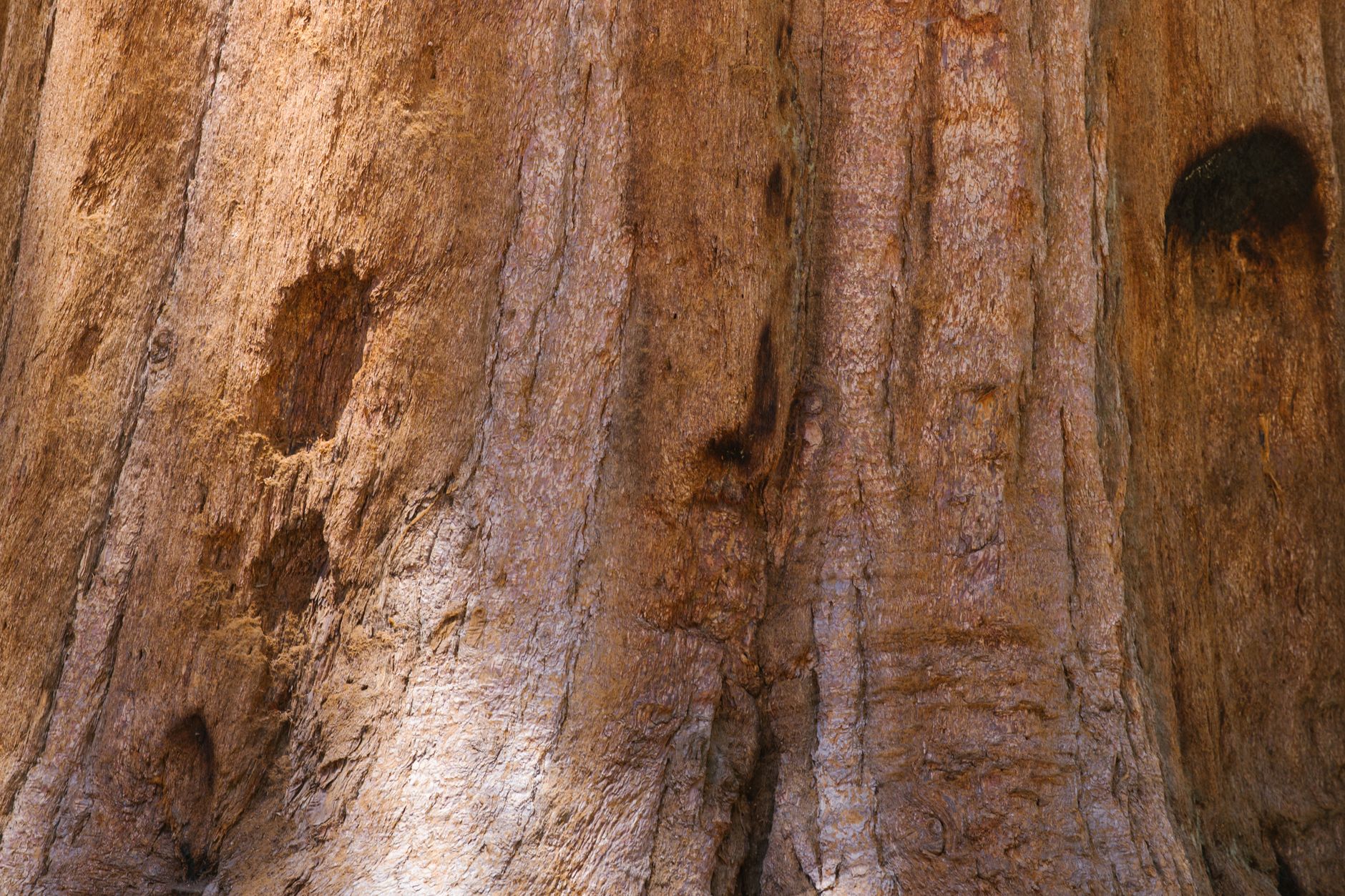
The fastest way to tell a giant sequoia from a coast redwood is where you are standing. Giant sequoias grow naturally only on the western slope of California’s Sierra Nevada, between roughly 4,000 and 8,000 feet, in about 75 to 94 scattered groves123. Coast redwoods grow in a fog belt about 450 miles long and 5 to 35 miles wide, from central California into southern Oregon, from sea level to 3,000 feet4. Up close, the giveaways are the needles and the cones: giant sequoia foliage is scale-like and awl-shaped, clasping the twig, with cones the size of a chicken egg, while coast redwood foliage is flat and feather-like, with rounded cones under an inch long5. Sequoia bark runs cinnamon-orange and up to 18 to 24 inches thick; redwood bark is reddish-brown to gray and up to about 12 inches thick674.
- Location: sequoia = Sierra Nevada, 4,000-8,000 ft; redwood = coastal fog belt, sea level to 3,000 ft24
- Needles: sequoia = pointed, scale-like, wrapped around the twig; redwood = flat, feathery sprays58
- Cones: sequoia = 2 to 3.5 in, egg-shaped; redwood = under 1 in, rounded95
- Bark: sequoia = cinnamon-orange, up to 18-24 in thick; redwood = reddish-brown to gray, up to 12 in674
- Shape: sequoia = massive columnar trunk that stays wide; redwood = tall, tapering spire1011
- Records: tallest tree is a coast redwood at about 380 ft; largest by volume is a giant sequoia at about 52,500 cu ft1110
- Sprouting: redwood stumps and burls resprout; giant sequoia essentially does not85
Two different trees get called “redwood,” and the confusion is old enough to be baked into the names. Both belong to the cypress family, both have thick red bark, and both are among the largest organisms alive. This page gives you a field-usable set of checks, starting with the one that works from a car window and ending with the details you need a hand lens for. For the wider context on the species itself, start with the guide to giant sequoia trees.
If you want a broader head-to-head on records, ecology, and where to see each, the companion page is sequoia vs redwood, every difference side by side. This page is narrower: it is about identification.
Side-by-side identification table
| Feature | Giant sequoia (Sequoiadendron giganteum) | Coast redwood (Sequoia sempervirens) |
|---|---|---|
| Natural range | Western Sierra Nevada only, a belt about 260 miles long and under 15 miles wide12 | Coastal strip about 450 miles long, 5-35 miles wide, central California to southern Oregon4 |
| Elevation | About 4,000-8,000 ft2 | Sea level to 3,000 ft; most stands 100-2,320 ft4 |
| Number of natural groves | About 75 groves totaling 35,607 acres3; Save the Redwoods League counts about 941 | Continuous forest rather than groves; about 5% of the old growth remains11 |
| Needles | Bluish-green, scale-like and awl-shaped with short sharp points, clasping the twig; triangular in cross-section, free portion to 15 mm129 | Flat, feather-like sprays that gather fog moisture5 |
| Cones | Egg-shaped, 2-3.5 in (5-9 cm), roughly 200 seeds each, can stay closed 20+ years7 | Small and rounded, under 1 in long5 |
| Bark | Cinnamon-orange, fibrous, non-resinous, 18 in6 to 2 ft thick3 | Reddish-brown weathering to charcoal or gray, fibrous, up to 12 in thick54 |
| Trunk form | Stays enormous with height; General Sherman is still 17 ft across at 120 ft up13 | Tapers to a spire; base diameter to 20 ft d.b.h.4 |
| Maximum height | About 310-316 ft71 | About 380 ft (Hyperion); FEIS records 364 ft114 |
| Maximum age | Over 3,200 years, ring-counted73 | Greater than 2,200 years4 |
| Water source | Sierra snowmelt5 | Coastal fog, roughly 40% of the tree’s moisture8 |
| Resprouting | Does not typically resprout5 | Sprouts as clones from stumps and basal burls8 |
| Record for | Largest tree by trunk volume, about 52,500 cu ft10 | Tallest tree on Earth11 |
Check 1: Where are you?
This is the only test that never fails, and it takes no botany at all. The two species do not overlap in the wild.
Giant sequoias grow on the western slope of the Sierra Nevada and nowhere else naturally. The Forest Service counts about 75 groves scattered along a 260-mile belt, totaling 35,607 acres, with the largest concentration between the Kings River and Deer Creek Grove3. Save the Redwoods League counts about 94 groves, a difference that reflects how historic grove names are split or lumped rather than any new discoveries1. The elevation band is roughly 4,000 to 8,000 feet2, or more precisely 1,400 to 2,000 meters in the north and 1,700 to 2,150 meters in the south3.
Coast redwoods occupy a very different strip of California: about 450 miles long and 5 to 35 miles wide, from sea level up to 3,000 feet, with most stands between 100 and 2,320 feet4. That band tracks summer fog, which supplies roughly 40 percent of the trees’ moisture8.
So: Sequoia National Park, Kings Canyon, Yosemite’s Mariposa Grove, Calaveras Big Trees, Giant Sequoia National Monument are all giant sequoia. Muir Woods, Redwood National and State Parks, Humboldt Redwoods, Big Basin, Henry Cowell, Armstrong Redwoods are all coast redwood. Details on the Sierra side are on where giant sequoias grow.
The one place this test breaks down is a park, campus, or European estate where both are planted. Then you need the next three checks.
Check 2: The needles
Pick up a fallen twig. This is the most reliable close-range test, and it works on planted trees.
Giant sequoia foliage is scale-like: short, awl-shaped, bluish-green needles with thick sharp points that wrap the twig on all sides12. Save the Redwoods League compares the resulting twig to a pipe cleaner, because the foliage is round in cross-section rather than flat5. Individual needles are triangular in section with a free portion up to about 15 millimeters and stomata on both surfaces9. Running a sequoia twig through your fingers feels prickly.
Coast redwood foliage is flat. The needles are arranged in two rows along the twig, making a spray that Save the Redwoods League describes as resembling a green feather, and their broad flat surfaces are shaped to capture fog5. A redwood twig lies flat on your palm. A sequoia twig does not.
Color helps as a secondary cue. Giant sequoia foliage reads bluish-green or gray-green12, while coast redwood foliage is a darker, glossier green.
Check 3: The cones
Cones settle any remaining doubt, and both species drop them where you can find them.
A giant sequoia cone is egg-shaped and 2 to 3.5 inches long, about the size of a chicken egg, holding roughly 200 seeds75. The seeds are tiny, about 91,000 to the pound, each like a flake of oatmeal6. Most striking is what the cones do not do: they can hang on the tree green and sealed for 20 years or more, waiting for fire, a wood-boring beetle, or a Douglas squirrel to open them67. Green cones on the ground in a sequoia grove are usually squirrel work. That story is on the giant sequoia cone.
A coast redwood cone is small and round, less than an inch long5. Next to a sequoia cone the difference is not subtle. If the cones under a big red-barked tree look like olives, you are under a coast redwood.
Check 4: The bark and the shape of the trunk
Both species have thick, fibrous, red bark, which is why the check has to be about degree rather than kind.
Giant sequoia bark is described by the NPS as up to 18 inches thick, extremely fibrous, and effective at insulating the tree from fire’s heat6. FEIS puts it at up to 2 feet at the base3. It is non-resinous, which is why it resists burning better than any species growing alongside it7. Save the Redwoods League describes the color as shades of cinnamon-orange5. Almost every large sequoia carries black fire scars near the base6. More on this in giant sequoia bark.
Coast redwood bark is up to about 12 inches thick and equally fibrous4, reddish-brown but often weathered to charcoal or gray on old-growth trees5. Its high tannin content, rather than sheer thickness, is what the NPS credits for the species’ resistance to insects and disease8.
Trunk form is the cue photographers notice. A giant sequoia is a column that refuses to narrow: General Sherman is 36.5 feet across at the base and still 17 feet across at 120 feet above the ground, higher than most trees ever get1013. A coast redwood tapers steadily into a spire, which is part of how it can carry 380 feet of height on a base 20 feet wide114.
Check 5: What is growing around the base
Look at the ground at the foot of the tree.
Coast redwoods sprout clones from stumps and from basal burls, producing the rings of trunks known as fairy rings8. A circle of redwoods around a stump or a mound of new shoots on a fallen trunk is diagnostic.
Giant sequoias essentially do not do this. The species relies on seed, and stump sprouting is limited to trees younger than about 20 years3. A ring of trunks in the Sierra is not a sequoia fairy ring.
Which is bigger, taller, older
These three questions get asked as if they have one answer, and they do not.
- Tallest: coast redwood. Hyperion, in Redwood National Park, is commonly given at about 380 feet11. The tallest known giant sequoia is roughly 310 to 316 feet71. The head-to-head is on Hyperion vs General Sherman.
- Largest by volume: giant sequoia. General Sherman holds about 52,500 cubic feet of trunk wood weighing close to 1,400 tons10.
- Oldest: giant sequoia. Ring counts on Converse Basin stumps exceed 3,200 years73, against more than 2,200 years for coast redwood4.
The Forest Service silvics manual states the sequoia’s position plainly: one species has a greater diameter, three grow taller, and one lives longer, but none packs more wood into a single trunk7.
Frequently Asked Questions
Are sequoias and redwoods the same thing?
What is the easiest way to tell a giant sequoia from a coast redwood?
Which has bigger cones, sequoia or redwood?
Which tree has thicker bark?
Which is taller, a sequoia or a redwood?
Do giant sequoias grow near the coast?
Can you tell them apart by the needles alone?
Related Articles
Sources
- Giant Sequoias — Save the Redwoods League. Accessed 2026-09-09.
- Exploring Giant Sequoia Groves — National Park Service, Sequoia & Kings Canyon. Accessed 2026-09-09.
- FEIS: Sequoiadendron giganteum — U.S. Forest Service, Fire Effects Information System. Accessed 2026-09-09.
- FEIS: Sequoia sempervirens — U.S. Forest Service, Fire Effects Information System. Accessed 2026-09-09.
- What’s the Difference? Coast Redwoods vs. Giant Sequoias — Save the Redwoods League. Accessed 2026-09-09.
- Giant Sequoias — National Park Service, Sequoia & Kings Canyon. Accessed 2026-09-09.
- Sequoiadendron giganteum, Silvics of North America — U.S. Forest Service. Accessed 2026-09-09.
- About the Trees — National Park Service, Redwood National and State Parks. Accessed 2026-09-09.
- Sequoiadendron giganteum — The Gymnosperm Database. Accessed 2026-09-09.
- The General Sherman Tree — National Park Service. Accessed 2026-09-09.
- Coast Redwoods — Save the Redwoods League. Accessed 2026-09-09.
- Giant Sequoia (Sequoiadendron giganteum) — University of California Agriculture and Natural Resources. Accessed 2026-09-09.
- Frequently Asked Questions — National Park Service, Sequoia & Kings Canyon. Accessed 2026-09-09.