
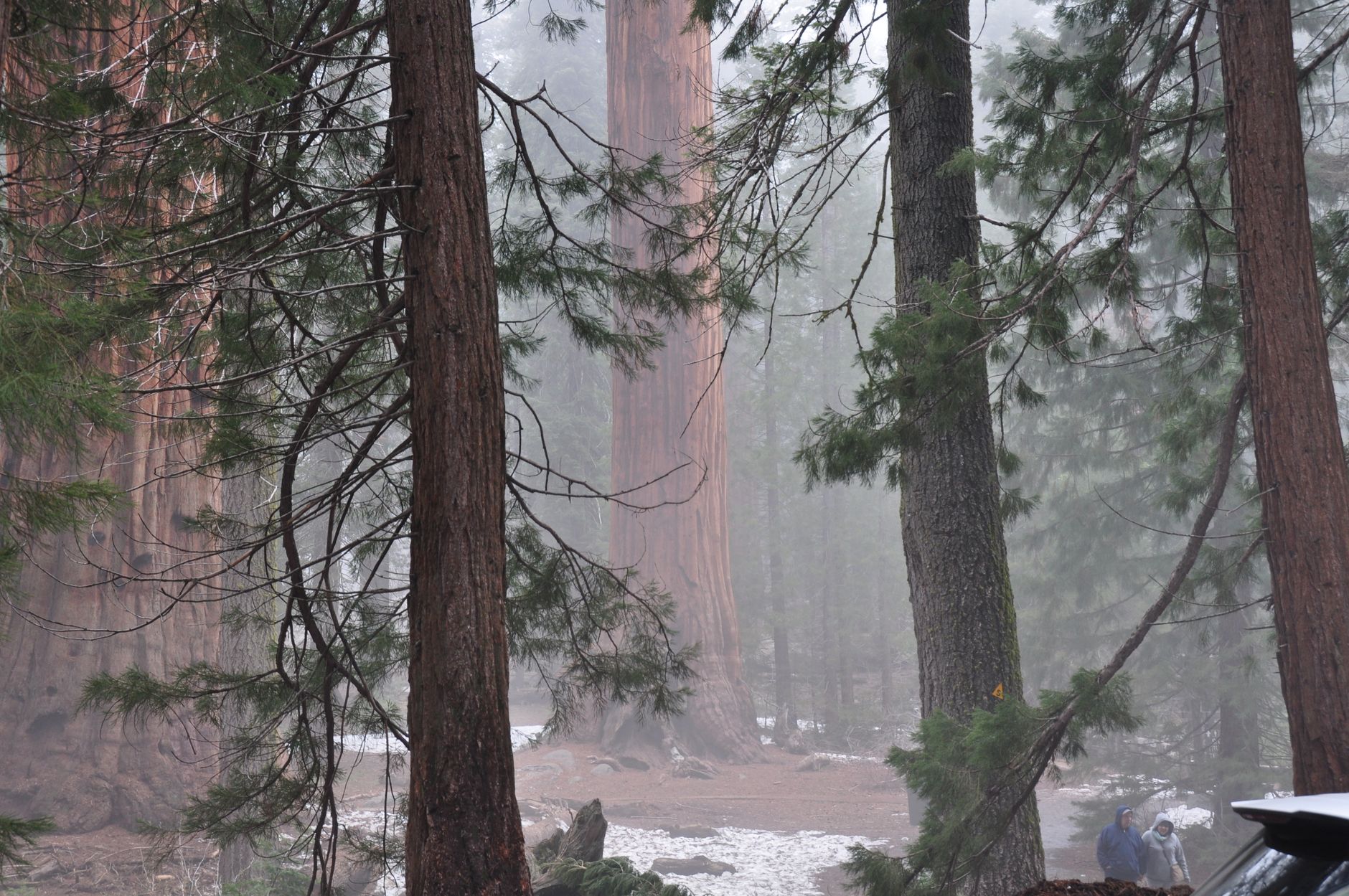
Giant sequoias (Sequoiadendron giganteum) grow naturally in one place: the west slope of California’s Sierra Nevada1. The groves are strung along a belt about 260 miles long and less than 15 miles wide, from the American River in Placer County south to Deer Creek Grove in Tulare County23. The U.S. Forest Service counts about 75 groves totaling 35,607 acres; Save the Redwoods League counts about 94435. Most groves sit between 4,590 and 7,050 feet, where 144 to 197 inches of snow falls each winter and almost no rain falls in summer4. The species once ranged across Colorado, Wyoming, and Nevada, and today’s strip is what a drying climate left behind2.
- Natural range: west slope of the Sierra Nevada, California only1
- Belt: about 260 mi long, under 15 mi wide2
- Grove count: about 75 (Forest Service) or about 94 (Save the Redwoods League)45
- Total grove area: 35,607 acres (14,416 ha)3
- Elevation: 4,590–6,560 ft in the north, 5,580–7,050 ft in the south; extremes 2,720 and 8,860 ft4
- Snowfall: 144–197 in a year; less than about an inch of rain June through September4
- Groves in Sequoia and Kings Canyon National Parks: about 406
A species that can live 3,000 years and grow larger than any other tree on Earth occupies a wild range smaller than many single cities. This page maps where giant sequoias grow, lists the grove counts and explains why they differ, sets out the elevation and climate the trees require, and explains why the species survives only in the Sierra Nevada. It is part of the guide to giant sequoia trees.
The range in one paragraph
Giant sequoias grow only at middle elevations on the western slope of the Sierra Nevada in California1. The Forest Service describes about 75 groves scattered over a 420-km (260-mile) belt, from the American River in Placer County in the north to Deer Creek Grove in southern Tulare County43. The belt is less than 15 miles wide2. The Gymnosperm Database puts the total occupied area at 124 km² (about 48 square miles), roughly 2 percent of the coast redwood’s range7.
The distribution is lopsided. The northern two-thirds of the belt holds only eight widely separated groves; the big groves lie in the southern third, between the Kings River and Deer Creek4. The Gymnosperm Database describes the main concentration as spanning 111 km (69 miles) from Kings River Canyon to California Hot Springs, with the eight outliers scattered to the north7.
How many groves there are, and why the count varies
| Source | Groves | Area |
|---|---|---|
| U.S. Forest Service, silvics manual | about 75 | 14,410 ha (35,607 acres)4 |
| U.S. Forest Service, Fire Effects Information System | about 75 | 35,607 acres (14,416 ha)3 |
| Save the Redwoods League | about 94 | not stated5 |
| Sequoia and Kings Canyon National Parks | about 40 within the two parks | not stated6 |
The difference between 75 and 94 is not new discoveries. It is how historic grove names are split or lumped: two patches of trees on either side of a ridge can be one grove or two, depending on who drew the map. Groves also vary enormously in size, from under one hectare to 1,619 hectares, and from six living trees to a grove of 2,470 acres with 20,000 trees43. This site follows the NPS habit of giving both counts. The complete list with access notes is on every giant sequoia grove in California.
Within Sequoia and Kings Canyon National Parks, staff distinguish about 40 groves ranging from a single tree to tens of thousands6. Giant Forest is the largest unlogged grove and has more exceptionally large sequoias than any other; Grant Grove packs numerous giants into about 90 acres; Redwood Mountain Grove is very large and burned hard in 20216. Yosemite’s Mariposa Grove holds more than 500 mature sequoias8, and Calaveras Big Trees is the only California state park with giant sequoias9. Giant Sequoia National Monument, proclaimed on April 15, 2000, protects the groves on national forest land7.
The elevation band
Sequoias grow in a narrow vertical band as well as a narrow horizontal one. The Forest Service gives 1,400 to 2,000 m (4,590 to 6,560 ft) in the north and 1,700 to 2,150 m (5,580 to 7,050 ft) in the south, with extremes of 830 m (2,720 ft) and 2,700 m (8,860 ft)4. The NPS rounds this to 4,000 to 8,000 feet6, and describes the 5,000-to-8,000-foot mid-Sierra zone as the place where mild temperatures, deep winter snowpack, and a rich fire history let the species reach its greatest size10.
The band rises as you go south because the climate warms. In the north, the belt sits lower to catch enough moisture; in the south, it climbs to escape the heat. Giant Forest, home of the General Sherman Tree, is at about 7,000 feet.
The climate sequoias need
The silvics manual describes the grove climate as humid with dry summers. Mean annual precipitation is 900 to 1,400 mm (35 to 55 in), of which less than 30 mm (about an inch) falls from June through September. Mean annual snowfall is 366 to 500 cm (144 to 197 in), and midwinter snow depths commonly exceed 2 m (6.5 ft). July highs average 24 to 29 °C (75 to 84 °F); January lows average 1 to −6 °C (34 to 21 °F)4.
That combination, deep snow and dry summers, is the key. The trees live all summer on snowmelt stored in the soil. The University of California notes that giant sequoia needs year-round soil moisture of at least 15 to 20 percent, making it the most moisture-demanding species in the Sierra mixed-conifer forest2. The Forest Service reports the best growth on deep, well-drained sandy loams with a pH of 5.5 to 7.5, and higher tree density on moist sites such as drainage bottoms and meadow edges4. Walk through Giant Forest and the biggest trees line the meadows.
Why only the Sierra Nevada
Three things explain the narrow range.
The climate moved, and the trees could not
Giant sequoias are the remnant of a lineage that flourished across the Northern Hemisphere millions of years ago5. Fossils show the species itself once grew in Colorado, Wyoming, and Nevada during wetter periods2. As the climate cooled and dried, the redwoods retreated: the coast redwood to the foggy Pacific strip, the giant sequoia to the Sierra west slope, and the dawn redwood to moist river valleys in central China511. The Sierra’s west slope is one of the few places left with the required mix of heavy winter snow, summer soil moisture, and mild temperatures.
Seeds do not travel far
Wind carries sequoia seed only about 600 feet from the parent12. Seedlings need bare mineral soil and sunlight, which historically only fire provided, and first-summer mortality averages 39 percent even on good ground4. A species with those rules colonizes new ground slowly. The Forest Service also notes distinctly low genetic variability compared with other Sierra conifers, consistent with a population that has been small and isolated for a long time4.
The Sierra is where the water is
The Sierra snowpack supplies about 60 percent of California’s fresh water, and it is also the sequoia’s13. That dependence is now the main worry. Warming could push the rain–snow line up by about 1,500 to 3,000 feet by the end of the century, and Sierra temperatures are projected to rise 6 to 10 °F; mid-elevation stations already warmed between 1940 and 2019 while precipitation showed no trend13. Save the Redwoods League lists changing snowpack among the species’ main threats5. See are giant sequoias dying.
Where sequoias grow when people plant them
The natural range is small; the planted range is not. Giant sequoias have been planted across Europe since 1853 and are hardy to USDA Zone 7 (minimum −17.7 to −12.2 °C). Naturalized populations, meaning trees reproducing on their own, exist in Ireland, the UK, Turkey, and the San Jacinto, San Gabriel, and San Bernardino mountains of southern California7. A planted sequoia near Eagle Point, Oregon, measured 64.95 m (213 ft) in 2020, and the UK holds an estimated half a million giant sequoias and coast redwoods714. Outside the native range, though, the species is highly susceptible to pests and pathogens at all life stages4. See giant sequoias outside California and the guide to growing a giant sequoia.
Where to see wild giant sequoias
The accessible groves, north to south: Calaveras Big Trees State Park; Yosemite’s Tuolumne, Merced, and Mariposa groves; Nelder Grove in Sierra National Forest; Grant Grove, Redwood Mountain, and Big Stump in Kings Canyon National Park; Converse Basin and the Boole Tree in Giant Sequoia National Monument; Giant Forest in Sequoia National Park; Mountain Home State Forest; and the Trail of 100 Giants and Freeman Creek in the southern monument6789. The ranked list is on where to see giant sequoias.
Frequently Asked Questions
Where do giant sequoias grow naturally?
Why do sequoias only grow in California?
The species needs deep winter snowpack, summer soil moisture of at least 15 to 20 percent, and mild temperatures, a combination now found only on the Sierra west slope. Its ancestors ranged across the Northern Hemisphere and the species once grew in Colorado, Wyoming, and Nevada before the climate dried254.
How many sequoia groves are there?
What elevation do giant sequoias grow at?
Do giant sequoias grow in Yosemite?
Yes. Mariposa Grove holds more than 500 mature giant sequoias, and Yosemite has two smaller groves, Tuolumne and Merced8.
Can giant sequoias grow outside California?
Only when planted, but they grow well in many temperate climates. They are hardy to Zone 7 and have naturalized in Ireland, the UK, and Turkey; a planted tree in Oregon stands 213 feet7.
What is the largest sequoia grove?
Related Articles
Sources
- Giant Sequoias — National Park Service, Sequoia & Kings Canyon. Accessed 2026-09-06.
- Giant Sequoia (Sequoiadendron giganteum) — University of California Agriculture and Natural Resources. Accessed 2026-09-06.
- Sequoiadendron giganteum, Fire Effects Information System — U.S. Forest Service. Accessed 2026-09-06.
- Sequoiadendron giganteum, Silvics of North America — U.S. Forest Service. Accessed 2026-09-06.
- Giant Sequoias — Save the Redwoods League. Accessed 2026-09-06.
- Exploring Giant Sequoia Groves — National Park Service. Accessed 2026-09-06.
- Sequoiadendron giganteum — The Gymnosperm Database. Accessed 2026-09-06.
- Mariposa Grove of Giant Sequoias — National Park Service, Yosemite. Accessed 2026-09-06.
- Calaveras Big Trees State Park — California State Parks. Accessed 2026-09-06.
- The Largest Trees in the World — National Park Service. Accessed 2026-09-06.
- Dawn Redwoods — Save the Redwoods League. Accessed 2026-09-06.
- Fallen Green Cones of the Giant Sequoia — National Park Service, Yosemite. Accessed 2026-09-06.
- Climate Change — National Park Service, Sequoia & Kings Canyon. Accessed 2026-09-06.
- Giant sequoias are a rapidly growing feature of the UK landscape — ScienceDaily / University College London, March 2024. Accessed 2026-09-06.