
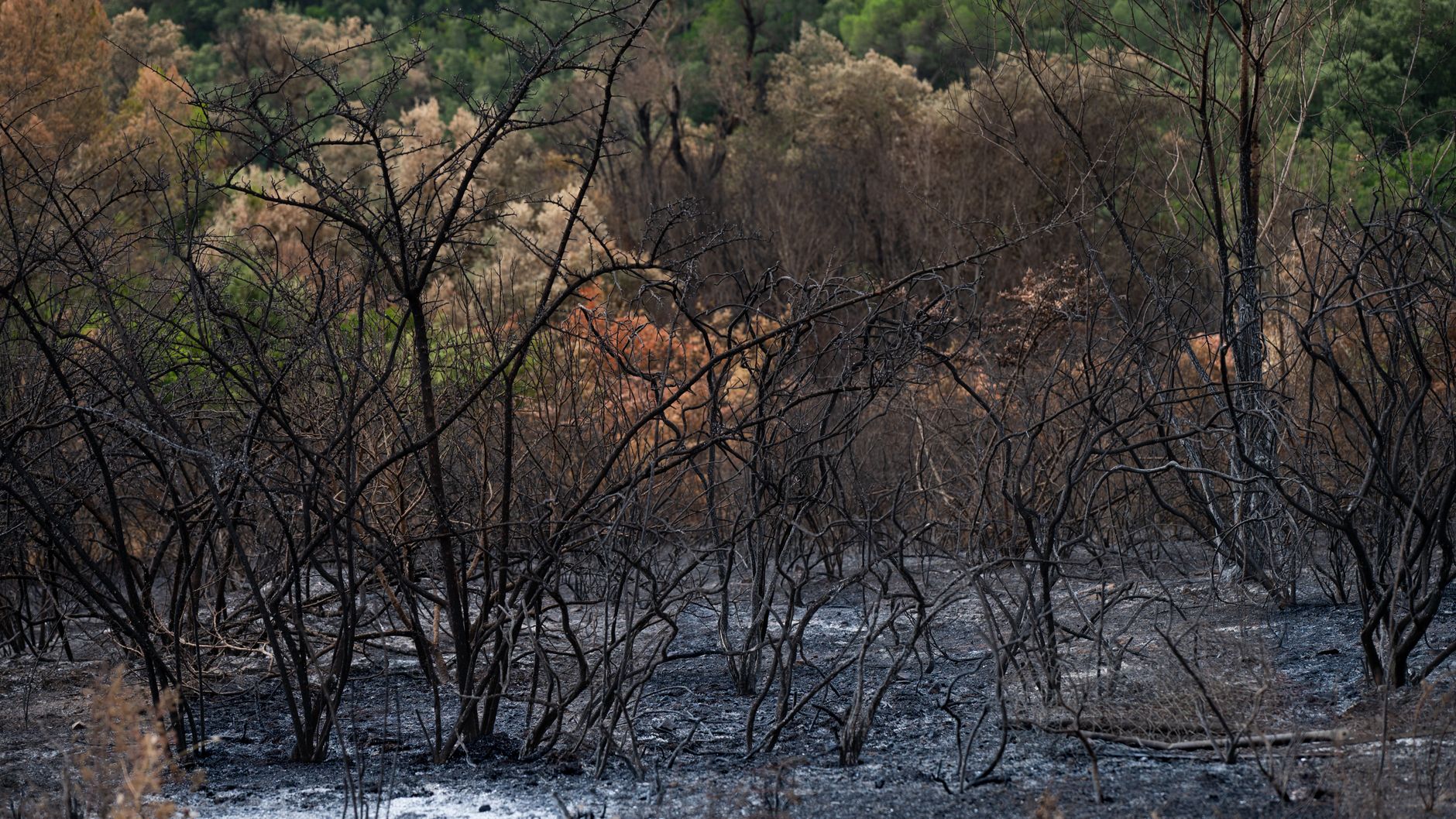
Fewer than 80,000 giant sequoias (Sequoiadendron giganteum) remain in their native California range, according to a 2024 University College London study1. Nobody has counted every tree, and that figure is best read as an order of magnitude. What is well counted is the loss: the Castle Fire of 2020 and the KNP Complex and Windy fires of 2021 killed an estimated 8,431 to 11,897 large sequoias, 13 to 19 percent of all trees with trunks 4 feet or more in diameter2. Save the Redwoods League puts it at more than 17 percent of mature sequoias lost to wildfire since 20153. The survivors grow in about 75 to 94 groves covering 35,607 acres, and the National Park Service planted 65,000 seedlings in Redwood Mountain Grove in 2024 to help the worst-burned patches recover4536.
- Trees remaining in the wild: fewer than 80,0001
- Large sequoias killed in 2020–21: 8,431–11,897, or 13–19 percent2
- Castle Fire alone: 7,500–10,600 large trees, 10–14 percent of the species7
- KNP Complex and Windy fires: 2,261–3,637 large trees, 3–5 percent7
- Groves: about 75 (Forest Service) or 94 (Save the Redwoods League)43
- Grove area burned 2015–2021: over 85 percent, versus about 25 percent in the previous century2
- Seedlings planted by the NPS in 2024: 65,000 at Redwood Mountain, about 3,800 at Board Camp6
The question has two honest answers. The first is that the number of wild giant sequoias has never been counted precisely, so any total is an estimate. The second is that the losses of 2020 and 2021 were counted with great care, because they were unlike anything in the species’ recorded history. This page gives the population figure and its source, the fire losses grove by grove, the grove counts, and what replanting is under way. It belongs to the guide to giant sequoia trees.
The "fewer than 80,000" figure
The number most often quoted comes from a March 2024 press release for a Royal Society Open Science study led by University College London. Its subject was giant sequoias planted in the UK, and it noted for contrast that fewer than 80,000 remain in their native California range1. The same release reported an estimated half a million giant sequoias and coast redwoods growing in the UK, which means there may be more planted sequoias in Britain than wild ones in California1.
Two cautions apply. The 80,000 figure is for all sequoias, not just large ones, and it was cited in passing rather than derived in the study. Official U.S. agencies do not publish a total tree count; they publish grove counts, grove acreage, and, since 2020, careful estimates of large trees killed. The NPS defines a large sequoia as one with a trunk 4 feet (1.2 m) or more in diameter, a size that takes at least 200 years to reach7. Those large trees are the ones that matter for the species’ future, since a sequoia does not produce cones until about 20 years old and the biggest trees carry the biggest seed loads4.
What the 2020 and 2021 fires killed
| Fire | Year | Groves burned | Large sequoias killed | Share of all large sequoias |
|---|---|---|---|---|
| Castle (SQF Complex) | 2020 | 12 in the parks; 9,530 grove acres overall | 7,500–10,600 | 10–14 percent7 |
| KNP Complex | 2021 | 16 groves, 88,307 acres total, 4,374 grove acres | 1,330–2,380 | —87 |
| Windy | 2021 | — | 931–1,257 | —8 |
| KNP and Windy combined | 2021 | — | 2,261–3,637 | 3–5 percent7 |
| All three | 2020–21 | — | 8,431–11,897 | 13–19 percent2 |
Source: NPS278. The estimates are ranges because trees that are scorched but standing may die over the following three to five years7.
The Castle Fire was the worst single event. It burned 9,530 acres of grove, one-third of all sequoia grove area in existence, with roughly half of that at moderate-to-high severity and nearly 30 percent at high severity; inside the fire perimeter, 31 to 42 percent of the large sequoias died7. The KNP Complex, started by lightning in September 2021, burned 4,374 grove acres, 69 percent at low severity, and would have done far worse if Giant Forest had not been treated with prescribed fire for decades79. Redwood Mountain Grove, which had less recent fire, burned 40 percent at moderate-to-high severity10. At Alder Creek, 38 percent burned at high severity in the Castle Fire and at least 108 old-growth sequoias died11.
Six fires did the damage between 2015 and 2021: Rough (2015), Railroad and Pier (2017), Castle (2020), and KNP Complex and Windy (2021). Together they burned over 85 percent of all sequoia grove acreage in the Sierra, against about 25 percent in the preceding century2. The full story is on the Castle, KNP Complex, and Windy fires.
How the three official loss figures relate
- 13 to 19 percent is the NPS estimate for large sequoias killed in the Castle, KNP Complex, and Windy fires2.
- “As much as 19 percent” is how NPS restoration planning phrases the same figure, using the upper bound12.
- “More than 17 percent” is Save the Redwoods League’s figure for mature sequoias lost to extreme wildfire since 2015, which folds in the 2015 and 2017 fires3.
They describe the same event from slightly different baselines. Roughly one in six of the world’s big sequoias died in two fire seasons.
How many groves are left
The grove count has not changed; the trees inside the groves have. The Forest Service counts about 75 groves totaling 35,607 acres, from the American River in Placer County south to Deer Creek Grove in Tulare County45. Save the Redwoods League counts about 94 naturally occurring groves3. The difference is how historic grove names are split or lumped. Sequoia and Kings Canyon National Parks distinguish about 40 groves within their boundaries10. No grove was erased by the fires, but several burned so severely that the NPS says they are unlikely to recover as sequoia forest without replanting6. See where giant sequoias grow.
Are giant sequoias endangered?
“Endangered” has a legal meaning and a plain one, and the sources this page relies on speak only to the plain one. The NPS describes the 2020–21 losses as unprecedented and the species as facing new threats, and the hotter drought of 2012–2016 produced the first documented sequoia deaths from bark beetles, 33 trees that died standing213. Whether the species is in decline is taken up on are giant sequoias dying.
What is being planted
Sequoias regenerate from seed only, and seedlings need bare mineral soil and sunlight, which is why moderate fire helps them and total canopy loss over large areas does not: with every parent tree dead, no seed rain arrives48. Surveys in 2022 and 2023 found natural regeneration insufficient in the worst-burned parts of Redwood Mountain Grove, so in 2024 the NPS planted 65,000 giant sequoia seedlings there and about 3,800 in Board Camp Grove, alongside sugar and ponderosa pines. Homer’s Nose, Dillonwood, and New Oriole Lake groves were slated for planting in 2025, while Suwanee Grove was set aside for monitoring only6.
The seedlings come from 110,000 grown from cones collected at Redwood Mountain, Big Stump, Board Camp, and Cedar Flat in September 2022, funded by $2.6 million from the Bipartisan Infrastructure Law; another 150,000 mixed-conifer seedlings are being raised to reconnect Pacific fisher habitat, of which 480 acres may need planting12. Save the Redwoods League planted more than 20,000 sequoia seedlings at Alder Creek in 202311. Restoration across ownerships is coordinated through the Giant Sequoia Lands Coalition, a partnership of federal and state agencies, tribes, scientists, and conservation groups3.
Replanting is one tool. The other is fire itself, applied deliberately. The NPS calls prescribed burning one of the most important management tools for reducing fuels and increasing grove resilience, and Giant Forest’s survival in 2021 is the evidence29. See why rangers deliberately burn sequoia groves.
Frequently Asked Questions
How many giant sequoias are left in the world?
Fewer than 80,000 in the native range, according to a 2024 UCL study; no agency publishes an exact count. Planted sequoias abroad may outnumber wild ones, with an estimated half a million sequoias and redwoods in the UK alone1.
How many sequoias died in the 2020–2021 fires?
An estimated 8,431 to 11,897 large sequoias, 13 to 19 percent of all trees 4 feet or more in diameter, in the Castle, KNP Complex, and Windy fires2.
Are giant sequoias endangered?
How many sequoia groves are there?
Are giant sequoias being replanted?
Did the General Sherman Tree survive the fires?
Will the burned groves grow back?
Some will on their own; others will not. NPS research found several groves that burned at high severity are unlikely to recover as sequoia forest without replanting, which is why the 2024 and 2025 plantings target those groves6.
Related Articles
Sources
- Giant sequoias are a rapidly growing feature of the UK landscape — ScienceDaily / University College London, March 2024. Accessed 2026-09-06.
- Giant Sequoias Face New Threats — National Park Service. Accessed 2026-09-06.
- Giant Sequoias — Save the Redwoods League. Accessed 2026-09-06.
- Sequoiadendron giganteum, Silvics of North America — U.S. Forest Service. Accessed 2026-09-06.
- Sequoiadendron giganteum, Fire Effects Information System — U.S. Forest Service. Accessed 2026-09-06.
- Restoring Giant Sequoia Groves Following High-Severity Wildfire — National Park Service. Accessed 2026-09-06.
- Wildfires Kill Unprecedented Numbers of Large Sequoia Trees — National Park Service. Accessed 2026-09-06.
- Giant Sequoias and Fire — National Park Service. Accessed 2026-09-06.
- KNP Complex Fire — National Park Service. Accessed 2026-09-06.
- Exploring Giant Sequoia Groves — National Park Service. Accessed 2026-09-06.
- Alder Creek — Save the Redwoods League. Accessed 2026-09-06.
- Sequoia and Kings Canyon Post-Fire Sequoia Restoration — National Park Service. Accessed 2026-09-06.
- Giant Sequoias — National Park Service, Sequoia & Kings Canyon. Accessed 2026-09-06.
- The General Sherman Tree — National Park Service. Accessed 2026-09-06.