
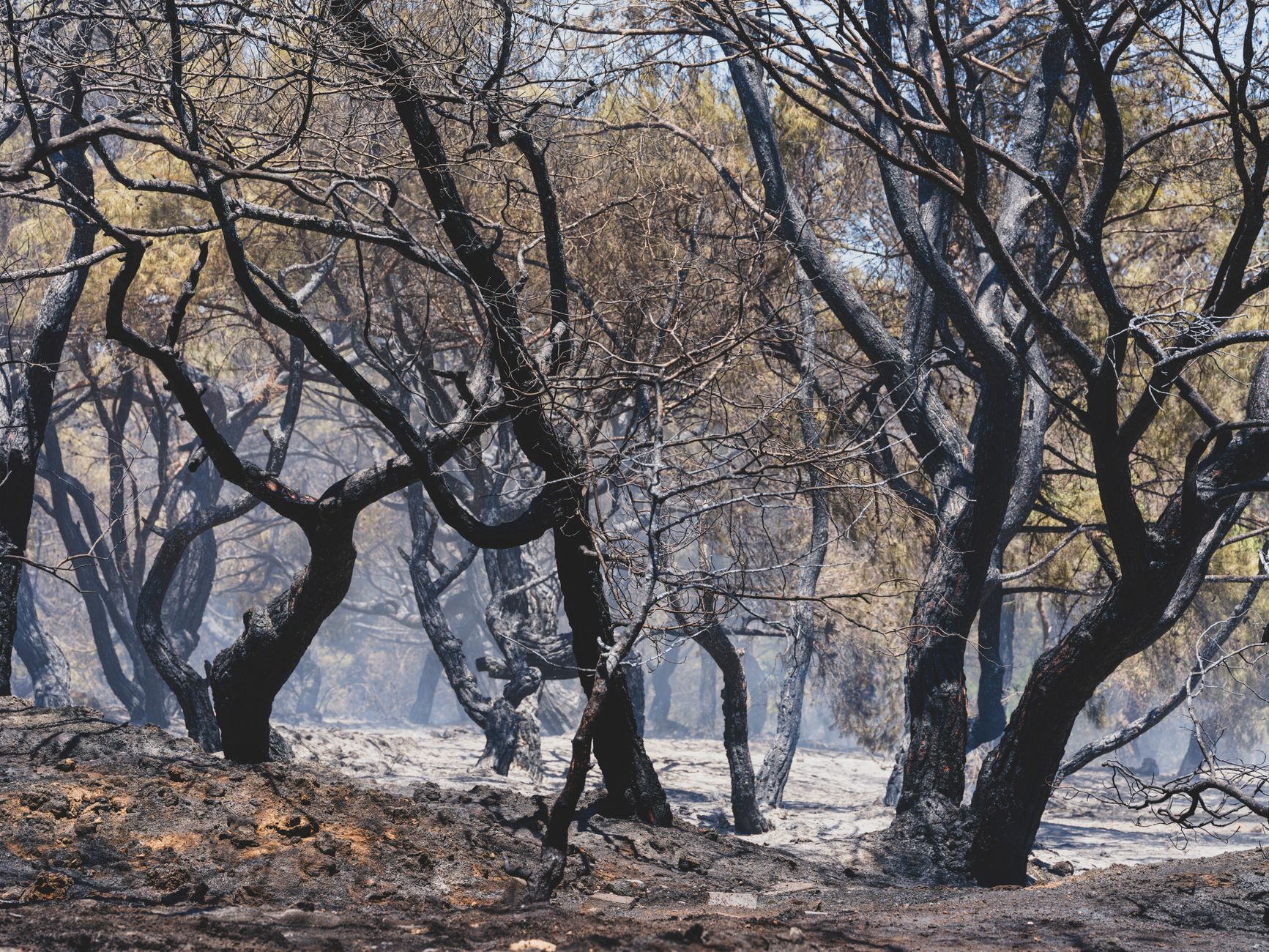
Giant sequoias (Sequoiadendron giganteum) are dying in numbers with no precedent in their recorded history, though the species is not close to extinction. Between 2020 and 2021, the Castle, KNP Complex, and Windy fires killed an estimated 8,431 to 11,897 large sequoias, 13 to 19 percent of all trees with trunks 4 feet or more in diameter1. During the 2012–2016 hotter drought, 33 sequoias died standing from native bark beetles, something never before documented in a species that historically died only by falling12. The National Park Service attributes the new severity to a century of fuel buildup from fire suppression combined with hotter droughts and a warming climate34. Its response is prescribed fire, which it calls one of the most important tools for grove resilience, and replanting: 65,000 seedlings went into Redwood Mountain Grove in 202415.
- Killed by fire, 2020–21: 8,431–11,897 large trees, 13–19 percent of the population1
- Grove acreage burned 2015–2021: over 85 percent, versus about 25 percent in the previous century1
- Standing deaths from drought and beetles, 2012–2016: 33 trees, a first12
- Worst drought year: 2014, the most severe in the park’s 122-year record1
- Tree mortality in Sequoia National Park: nearly doubled between 1983 and 20046
- Projected Sierra warming by 2100: 6–10 °F, with the rain–snow line rising 1,500–3,000 ft4
- Replanted in 2024: 65,000 seedlings at Redwood Mountain, about 3,800 at Board Camp5
For most of the twentieth century, the giant sequoia was the tree that did not die. Bark up to 2 feet thick shrugged off fire, insects left the trees alone, and a sequoia’s life ended when it fell over, usually after 2,000 or 3,000 years. Since 2014 that picture has changed. This page sets out what has killed sequoias in the past decade, why the fires of 2020 and 2021 were different from the fires the species evolved with, what researchers at the National Park Service say about the cause, and what is being done. It is part of the guide to giant sequoia trees.
How giant sequoias used to die
The U.S. Forest Service silvics manual describes a species with almost no natural enemies. Within the native range, insects do no serious harm to trees older than about two years. Decay fungi contribute to root or stem failure but rarely kill a tree. Fire alone kills few veterans. Death comes by toppling, when wind, water-softened soil, stream undercutting, or heavy snow acts on enormous weight over shallow roots, especially where a basal fire scar has weakened one side7. The NPS summarizes the old understanding: for years managers believed sequoias died only by falling or by crown scorch2.
What changed: three new causes of death
Hotter drought
The drought of 2012 to 2016 was not just dry but hot, which the NPS describes as a “hotter drought” and a tipping point for the species. In 2014, the most severe drought year in the park’s 122-year record, foliage dieback on individual sequoias ranged from none to over 75 percent; most trees recovered by the summer of 20151. Across the Sierra, the worst tree mortality was at 5,000 to 6,000 feet, the lower edge of the sequoia belt, and annual tree-mortality rates in Sequoia National Park had already nearly doubled between 1983 and 2004 in step with regional warming6.
Bark beetles
During that drought, scientists documented 33 giant sequoias that died standing, associated with native bark beetles of the genus Phloeosinus and fire-caused damage at the base. All had recent fire history and many had basal fire scars. The NPS calls it a newly reported phenomenon: beetle kill of giant sequoias had never been documented before the hotter drought126. Thirty-three trees is a small number against a population in the tens of thousands, but it marks the end of the rule that nothing kills a standing sequoia.
High-severity wildfire
The largest killer by far. The 2020 Castle Fire burned 9,530 acres of sequoia grove, one-third of all grove area in existence, roughly half of it at moderate-to-high severity, and killed an estimated 7,500 to 10,600 large sequoias, 10 to 14 percent of the species3. The 2021 KNP Complex and Windy fires killed another 2,261 to 3,637, or 3 to 5 percent3. Combined, the three fires killed 13 to 19 percent of the world’s large sequoias, 8,431 to 11,897 trees1. Save the Redwoods League puts the loss at more than 17 percent of mature sequoias since 20158. See how many giant sequoias are left.
Why the recent fires were different
Giant sequoias need fire. Fire-scar records show surface fires burned through Giant Forest every 6 to 35 years for 2,000 years, opening cones and clearing the ground for seedlings9. Those fires stopped around 1860 with sheep grazing, the loss of Native American burning, and then organized suppression9. The Forest Service calls fire exclusion the most significant human impact on the species, because it lets fuel build toward crown fires7.
By 2020, a century of accumulated fuel met a drying, warming climate. The NPS states that high fuel loads from long fire suppression enabled higher-severity fire, and that recent drought and a warming climate intensified the impacts9. Its climate page is blunter: human-caused climate change combined with fuel accumulation creates conditions for increasingly severe wildfires that giant sequoias, despite their fire adaptations, cannot withstand4. Over 85 percent of all grove acreage burned between 2015 and 2021, against about 25 percent in the preceding century1. Six fires did the damage: Rough (2015), Railroad and Pier (2017), Castle (2020), KNP Complex and Windy (2021)1.
The contrast within the 2021 KNP Complex is the clearest evidence of cause. Giant Forest, where the NPS has run prescribed burns since 1979, burned at low intensity and the General Sherman Tree came through with its base wrapped in foil as a precaution1011. Redwood Mountain Grove, without that treatment history, burned 40 percent at moderate-to-high severity and lost many giants12. The mechanics are explained on why giant sequoias need fire.
What warming means for the snowpack
Sequoias grow only where deep winter snow feeds soil moisture through a rainless summer, in a band between roughly 4,600 and 7,050 feet7. The Sierra snowpack supplies about 60 percent of California’s fresh water, and 2015 brought the lowest snowpack on record. By the end of the century, Sierra temperatures are projected to rise 6 to 10 °F, pushing the rain–snow line up 1,500 to 3,000 feet; mid-elevation stations warmed from 1940 to 2019 while precipitation showed no trend, and Sierra glaciers shrank 55 percent between the early 1900s and 20044. Save the Redwoods League lists changing snowpack patterns among the species’ main threats8. Beginning in 2021–22, scientists also observed increased tree death at higher elevations, reaching foxtail and whitebark pine at the treeline6.
What researchers say
The NPS’s published position, in its own words and figures:
- The 2012–2016 hotter drought was a tipping point, and beetle-caused death of sequoias is “a newly reported phenomenon”1.
- The 2020–21 mortality is “unprecedented” and represents a loss of 13 to 19 percent of the world’s large sequoias31.
- Several groves that burned at high severity in the Castle and KNP Complex fires “are unlikely to recover as giant sequoia forests without active restoration by replanting”5.
- “Prescribed burning remains one of the most important management tools” for reducing fuels and increasing grove resilience1.
None of the official sources describes the species as headed for extinction. What they describe is a tree whose defenses evolved for a fire regime that no longer exists, and a management problem that can be reduced but not solved from inside the parks.
What is being done
Prescribed fire. Sequoia and Kings Canyon began burning in 1968, and Redwood Mountain Grove is called the birthplace of prescribed fire in the western United States13. Giant Forest has been treated since 1979, including a 245-acre burn around General Sherman in 201910. The NPS treats the practice as the first line of defense1. See why rangers deliberately burn sequoia groves.
Replanting. Surveys in 2022 and 2023 found natural regeneration insufficient in the worst-burned parts of Redwood Mountain Grove. In 2024 the NPS planted 65,000 giant sequoia seedlings there and about 3,800 in Board Camp Grove, with sugar and ponderosa pines; Homer’s Nose, Dillonwood, and New Oriole Lake groves were slated for 2025, and Suwanee Grove is being monitored rather than planted5. The stock is 110,000 seedlings grown from cones collected in September 2022, funded by $2.6 million in Bipartisan Infrastructure Law money14. Save the Redwoods League planted more than 20,000 seedlings at Alder Creek in 2023, where the Castle Fire had killed at least 108 old-growth trees15.
Coordination. The Giant Sequoia Lands Coalition brings federal and state agencies, tribes, scientists, and conservation groups together to plan restoration and expand prescribed fire across ownerships8.
Monitoring. After the fires, NPS researchers built the age-to-diameter table used to estimate how old the dead trees were, and they continue to track scorched trees for three to five years, since many die slowly3.
The honest summary
Giant sequoias are not dying out. Fewer than 80,000 remain in the wild, by a 2024 estimate, and roughly one in six of the big ones died in two fire seasons161. The trees that survived can live for centuries more, and prescribed fire has shown it can protect a grove. What the science says is that the species’ future depends on whether fuel is reduced and groves are replanted faster than the climate removes the snow they live on. That is a management question, and the answers so far are measured in acres burned on purpose and seedlings in the ground.
Frequently Asked Questions
Are giant sequoias endangered?
How many sequoias died in the 2020–2021 fires?
Can bark beetles kill a giant sequoia?
Why did fires kill sequoias if they are adapted to fire?
Did climate change cause the sequoia deaths?
Are giant sequoias being replanted?
Did the General Sherman Tree survive?
Related Articles
Sources
- Giant Sequoias Face New Threats — National Park Service. Accessed 2026-09-06.
- Giant Sequoias — National Park Service, Sequoia & Kings Canyon. Accessed 2026-09-06.
- Wildfires Kill Unprecedented Numbers of Large Sequoia Trees — National Park Service. Accessed 2026-09-06.
- Climate Change — National Park Service, Sequoia & Kings Canyon. Accessed 2026-09-06.
- Restoring Giant Sequoia Groves Following High-Severity Wildfire — National Park Service. Accessed 2026-09-06.
- Forest Health and Climate Change — National Park Service, Sequoia & Kings Canyon. Accessed 2026-09-06.
- Sequoiadendron giganteum, Silvics of North America — U.S. Forest Service. Accessed 2026-09-06.
- Giant Sequoias — Save the Redwoods League. Accessed 2026-09-06.
- Giant Sequoias and Fire — National Park Service. Accessed 2026-09-06.
- Sherman Prescribed Burn Planned in Sequoia National Park — National Park Service. Accessed 2026-09-06.
- KNP Complex Fire — National Park Service. Accessed 2026-09-06.
- Exploring Giant Sequoia Groves — National Park Service. Accessed 2026-09-06.
- Whitaker Prescribed Fire — National Park Service. Accessed 2026-09-06.
- Sequoia and Kings Canyon Post-Fire Sequoia Restoration — National Park Service. Accessed 2026-09-06.
- Alder Creek — Save the Redwoods League. Accessed 2026-09-06.
- Giant sequoias are a rapidly growing feature of the UK landscape — ScienceDaily / University College London, March 2024. Accessed 2026-09-06.