
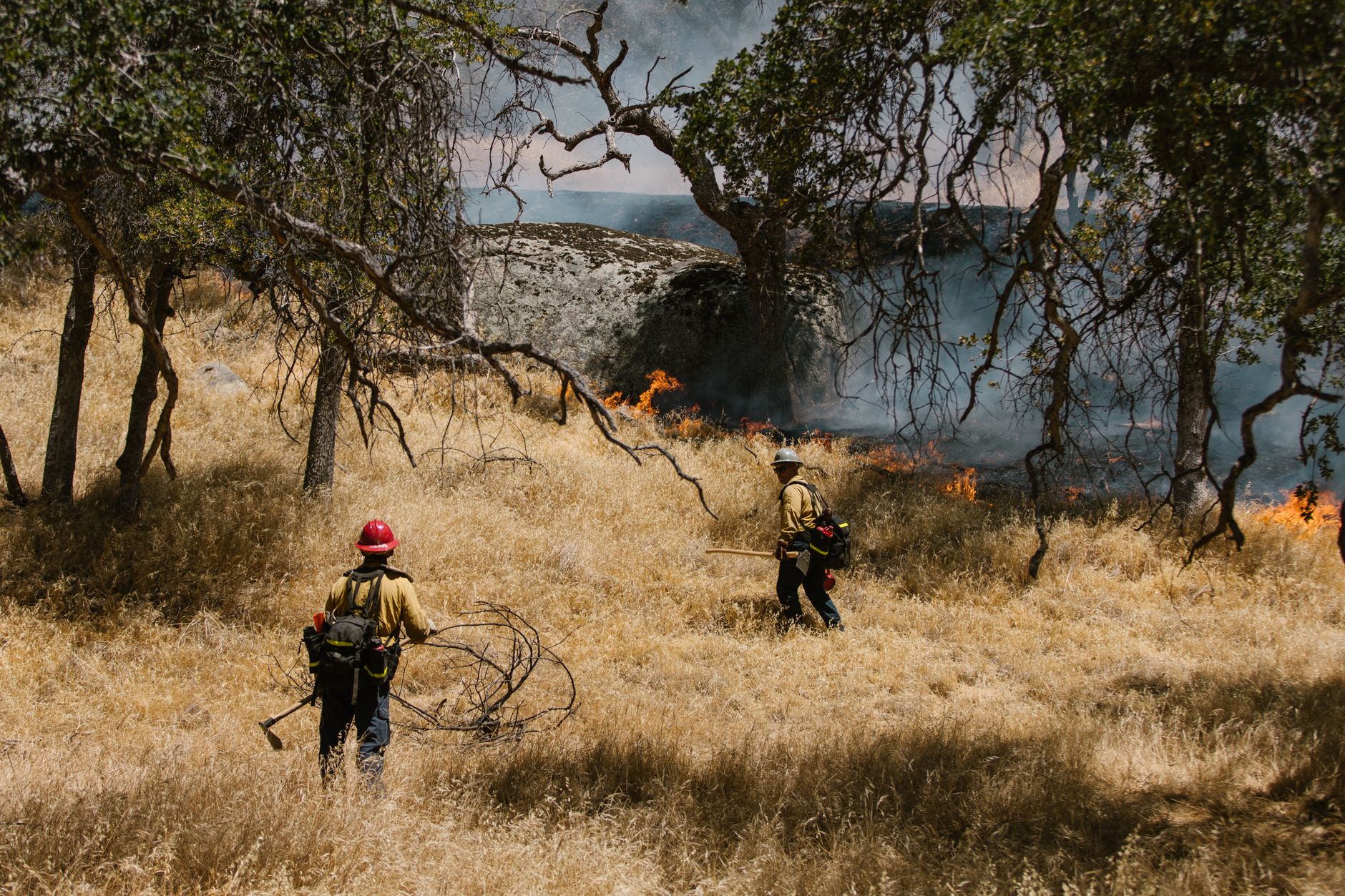
On September 17, 2021, fire crews wrapped the lower 10 to 15 feet of the General Sherman Tree in fire-resistant aluminum structure-protection wrap as the KNP Complex Fire moved toward Giant Forest12. The fire, started by lightning on September 9, reached Giant Forest the next day, September 18, and burned there at low to moderate intensity because the National Park Service had been conducting prescribed burns in the grove since 1979, including a 245-acre burn around the Sherman Tree in 201913. General Sherman survived undamaged. The same fire burned 40 percent of Redwood Mountain Grove, which had no comparable recent fire, at moderate to high severity and killed many of its sequoias4. Across all 16 groves it touched, the KNP Complex killed an estimated 1,330 to 2,380 large sequoias5.
- Ignition: September 9, 2021, by lightning; the Cabin, Colony, and Paradise fires merged into the KNP Complex1
- Foil applied: September 17, 2021, to the lower 10–15 ft of the trunk12
- Fire reached Giant Forest: September 18, 2021, at low to moderate intensity1
- Contained: December 16, 2021, after burning 88,307 acres15
- Giant Forest reopened: December 11, 20211
- Sequoias killed by the KNP Complex: 1,330–2,380 large trees, defined as over 4 ft in diameter5
- Why Giant Forest survived: prescribed burns since 1979, with a 10-to-16-year historic fire interval restored around the Sherman Tree3
The photographs went around the world in September 2021: the base of the largest tree on Earth wrapped in silver foil, like a giant baked potato, while smoke filled the Giant Forest. This page explains what the foil was, why crews used it, day by day what the fire did, and the more important story underneath: why the trees around General Sherman came through while a grove in the neighboring park lost thousands. The tree itself is described on the main General Sherman Tree page; the park’s logistics are in the Sequoia National Park guide.
The KNP Complex Fire, day by day
| Date (2021) | Event | Source |
|---|---|---|
| September 9 | Lightning ignites the Cabin, Colony, and Paradise fires in Sequoia National Park; they become the KNP Complex | NPS1 |
| September 11 | The Generals Highway from the Sequoia entrance to Giant Forest is closed | NPS1 |
| September 17 | Crews prepare the General Sherman Tree, wrapping the base in fire-resistant protection wrap | NPS1 |
| September 18 | Fire arrives in Giant Forest and nearby developed areas at low to moderate intensity | NPS1 |
| October 18 | Most of Kings Canyon National Park reopens | NPS1 |
| December 11 | Giant Forest reopens to the public | NPS1 |
| December 16 | Fire declared 100 percent contained | NPS1 |
The lightning storm of September 9 produced more than 200 strikes across the parks1. The fires that resulted grew in steep, remote terrain on the western slope of the park, in the Kaweah River canyons below Giant Forest, and by mid-September they were burning uphill toward the grove that holds the General Sherman Tree, the Giant Forest Museum, and the park’s road network. By the end, the complex had burned 88,307 acres and passed through 16 sequoia groves5.
What the foil was and why crews used it
The material was not household foil. The NPS describes it as fire-resistant structure protection wrap, the same aluminum-faced material wildland crews use to shield cabins, historic buildings, and bridges when a fire is expected to pass through1. The park’s own page on the tree says crews wrapped the lower 10 to 15 feet of the trunk in the protective aluminum material2. It reflects radiant heat and keeps embers from lodging against whatever it covers.
The wrapping was one part of a larger preparation. The base of a sequoia is its most vulnerable point. Giant sequoia bark is up to 18 inches thick and resists burning, and almost every large tree carries old fire scars as proof65. But a fire scar is also a gap in the armor. Flames that reach exposed wood inside an old scar can burn into the trunk, and a tree weakened at the base can fall. The NPS timeline describes significant preparation work in Giant Forest and the developed areas in the days before the fire arrived; the wrap went where a tree or building faced the highest risk1.
Wrapping General Sherman was, in part, insurance against the worst case. The reason the worst case did not happen lay in work done decades earlier.
Why Giant Forest survived
The NPS timeline is direct about the cause: when fire arrived in Giant Forest on September 18, its intensity was low to moderate “due to significant prep work and many years of prescribed burn treatments”1.
Giant sequoia groves evolved with frequent fire. Tree-ring records of fire scars show that widespread surface fires burned through Giant Forest at intervals of about 6 to 35 years for at least two thousand years, then dropped sharply after 1860 as sheep grazing, the end of Native American burning, and later fire suppression removed fire from the system5. Without regular fire, a century of dead wood, needles, and dense young firs accumulated on the forest floor. When fire finally returns to such a grove, it burns hot enough to climb into the crowns and kill trees that had survived hundreds of earlier fires.
Sequoia and Kings Canyon began prescribed burning in 1968, and Redwood Mountain Grove is called the birthplace of prescribed fire in the western United States7. The parks have burned inside Giant Forest since 19793. In July 2019, two years before the KNP Complex, park fire crews carried out a 245-acre prescribed burn around the General Sherman Tree specifically to reduce dead and down vegetation, with the goal of restoring the grove’s historic fire interval of ten to sixteen years3. That burn consumed the fuel the wildfire would otherwise have found.
The result was visible in the numbers. Across the sequoia grove acreage the KNP Complex burned, 69 percent showed no detected change or low-severity fire, and 31 percent burned at moderate to high severity8. Giant Forest, with four decades of treatment behind it, was on the low-severity side of that line.
Why Redwood Mountain Grove did not
Redwood Mountain Grove, reached by a rough dirt road that leaves the Generals Highway 6 miles south of Grant Grove Village in Kings Canyon National Park, is one of the largest sequoia groves in existence18. Despite its history as an early site of prescribed fire research, large parts of it had not burned in recent decades. When the KNP Complex reached it, 40 percent of the grove burned at moderate to high severity and many giant sequoias were killed4. The NPS fire history page states that the fire burned at high intensity in Redwood Mountain, killing thousands of mature sequoias1.
The contrast is the clearest demonstration in the parks of what fuel loading does. Two groves, the same fire, the same week. One had been burned on purpose and lost almost nothing. The other had not and lost a large share of its old trees. The trails through Redwood Mountain Grove, including the 9.5-mile loop, have been closed since the fire, though the trail-conditions page for September 2026 reports the maintained trail cleared from the trailhead down Redwood Creek910. Its recovery, including the planting of 65,000 sequoia seedlings there in 2024, is covered on the page about Redwood Mountain Grove11.
The wider toll of 2020 and 2021
The KNP Complex was one of three fires in two years that killed more large sequoias than any event in recorded history.
| Fire | Year | Groves burned | Large sequoias killed | Source |
|---|---|---|---|---|
| Castle Fire (SQF Complex) | 2020 | 12 | 7,500–10,600 | NPS5 |
| KNP Complex | 2021 | 16 | 1,330–2,380 | NPS5 |
| Windy Fire | 2021 | not stated | 931–1,257 | NPS5 |
“Large” means a trunk more than four feet in diameter, the size class that includes every named tree in the parks8. Taken together, the NPS estimates the 2020 and 2021 fires killed 13 to 19 percent of all large giant sequoias in the world, roughly 8,431 to 11,897 trees12. Save the Redwoods League puts the loss at roughly 17 percent of mature giant sequoias since 201513. Those figures, and what they mean for the species, are on the pages about the Castle, KNP, and Windy fires and whether giant sequoias are dying.
The KNP Complex did other damage that visitors still feel. The record wet winter of 2022–23 sent mudslides down the burned slopes, damaging Crystal Cave Road, the Buckeye Flat and South Fork campgrounds, and the Dorst Creek area; Crystal Cave did not reopen until 2025 and Dorst Creek Campground is still closed in 20261415. Details are on the Crystal Cave page.
Did General Sherman survive?
Yes, without significant damage. The tree stands as it did before the fire, and the Sherman Tree Trail, Congress Trail, and Giant Forest Museum all reopened on December 11, 20211. A visitor in 2026 will see blackened bark on many trunks along the Congress Trail and patches of scorched ground, which is what a low-intensity fire in a sequoia grove is supposed to leave behind. Sequoia cones open in the heat of a fire and release their seeds within one to two weeks onto the cleared mineral soil beneath, so the years after a burn are when the next generation gets its start6.
The park continues to burn deliberately. Prescribed fire is now the tool that creates the sunlit gaps in which young sequoias establish, and the parks’ fire program treats groves on a rotation meant to keep fuel from building up again5. The reasoning behind that program has its own page: why rangers deliberately burn sequoia groves. For the ecology, see why giant sequoias need fire.
What visitors should know about fire season
Lightning fires in the southern Sierra are most common from late summer into fall; the KNP Complex began on September 91. Smoke from fires anywhere in the region can settle into the Kaweah and Kings canyons for days. The park’s air-quality page recommends checking the AirNow fire and smoke map before a trip, and notes that air above 8,500 feet is usually cleaner than in the groves16. During an active fire, road closures are posted on the NPS road-conditions page and the 24-hour hotline, 559-565-334117. More on planning around smoke is on the page about wildfire season in Sequoia National Park.
Frequently Asked Questions
Why was the General Sherman Tree wrapped in foil?
Did the General Sherman Tree survive the fire?
Yes. Fire reached Giant Forest on September 18, 2021, at low to moderate intensity, and the tree was not significantly damaged. Giant Forest reopened to visitors on December 11, 20211.
What was the foil made of?
How did the KNP Complex Fire start?
Lightning. A storm on September 9, 2021, produced more than 200 strikes and ignited the Cabin, Colony, and Paradise fires, which merged1.
How many sequoias died in the KNP Complex Fire?
The NPS estimates 1,330 to 2,380 large sequoias, more than four feet in diameter, were killed or will die within three to five years of the fire. The fire burned 88,307 acres and 16 groves5.
Why did Giant Forest survive when other groves burned badly?
Can a giant sequoia survive a wildfire?
Related Articles
Sources
- KNP Complex Fire — National Park Service, Sequoia & Kings Canyon. Accessed 2026-09-06.
- The General Sherman Tree — National Park Service. Accessed 2026-09-06.
- Sherman Prescribed Burn Planned in Sequoia National Park — National Park Service. Accessed 2026-09-06.
- Giant Sequoia Groves — National Park Service. Accessed 2026-09-06.
- Giant Sequoias and Fire — National Park Service. Accessed 2026-09-06.
- Giant Sequoias — National Park Service. Accessed 2026-09-06.
- Whitaker Prescribed Fire, Sequoia and Kings Canyon — National Park Service. Accessed 2026-09-06.
- Wildfires Kill Unprecedented Numbers of Large Sequoia Trees — National Park Service. Accessed 2026-09-06.
- Redwood Mountain Trailhead — National Park Service. Accessed 2026-09-06.
- Trail Conditions — National Park Service, updated September 1, 2026. Accessed 2026-09-06.
- Restoring Giant Sequoia Groves Post High-Severity Wildfires, 2024 — National Park Service. Accessed 2026-09-06.
- Giant Sequoias Face New Threats — National Park Service. Accessed 2026-09-06.
- Giant Sequoias — Save the Redwoods League. Accessed 2026-09-06.
- Winter 2025–26 Trip Planner (PDF) — National Park Service. Accessed 2026-09-06.
- Dorst Creek Campground — Recreation.gov. Accessed 2026-09-06.
- Air Quality — National Park Service. Accessed 2026-09-06.
- Road Conditions — National Park Service, updated September 1, 2026. Accessed 2026-09-06.
- Grant Grove Area Trails — National Park Service. Accessed 2026-09-06.