
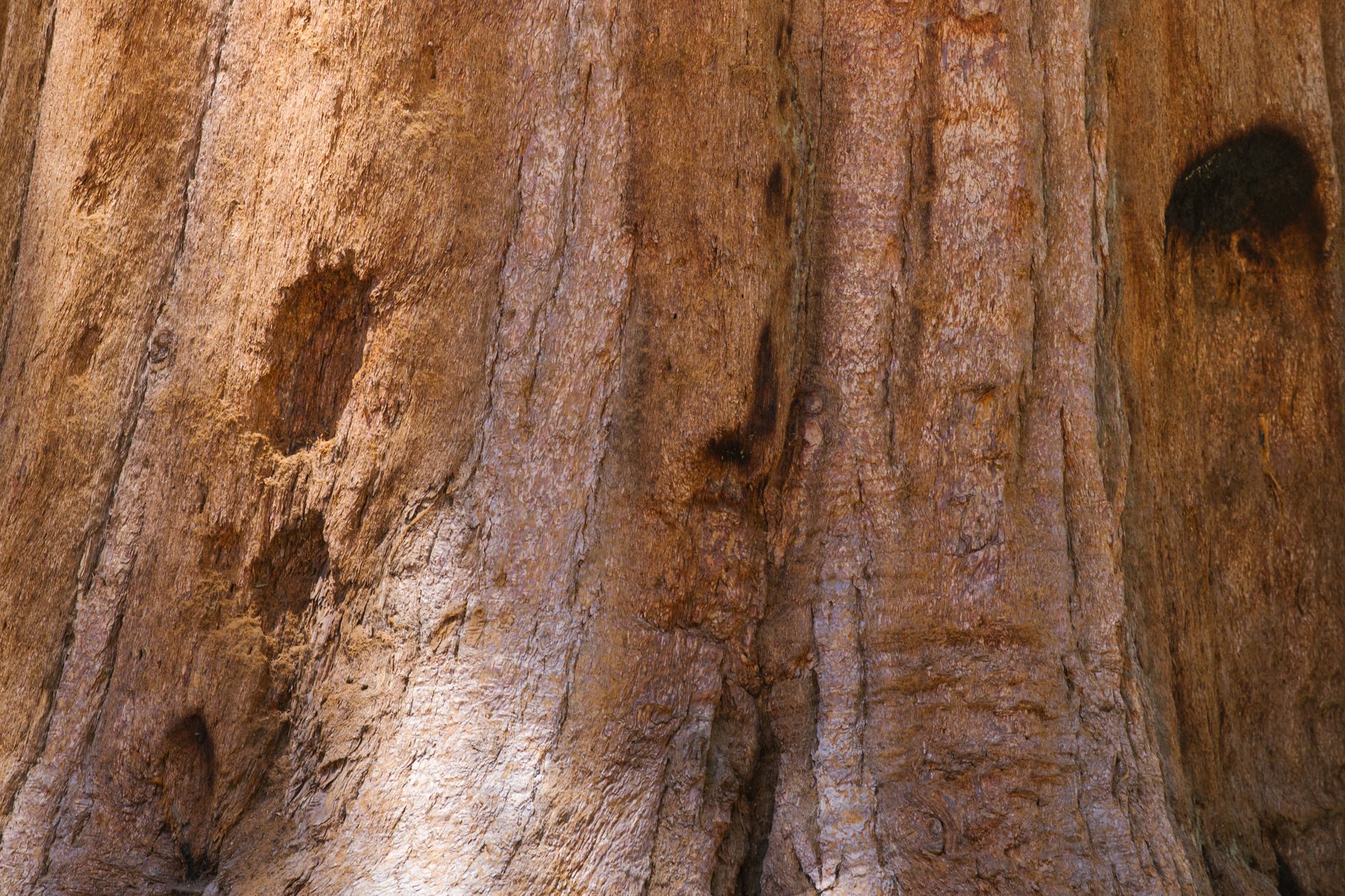
The General Sherman Tree is still growing, and in terms of wood added per year it is growing faster than almost any young tree in the forest. The U.S. Forest Service estimates that it adds only about a millimeter of radius annually, but spread over a trunk 36.5 feet across at the base that works out to 40 to 51 cubic feet (1.13 to 1.44 cubic meters) of new wood every year12. The National Park Service puts the same figure another way: an average mature giant sequoia adds enough wood in one year to make a 60-foot oak with a 3-foot trunk2. What is not growing is its height. Giant sequoias level off near 250 feet between 800 and 1,500 years of age, and at roughly 2,200 years General Sherman passed that point long ago13.
- Wood added per year: about 40–51 cu ft (1.13–1.44 m³)1
- Radial growth per year: about 1 mm, or roughly 2 mm of diameter1
- Height: 274.9 ft, and not increasing; sequoia height growth plateaus at 800–1,500 years12
- Age: about 2,200 years by the NPS estimate; up to 2,700 by others34
- Crown spread: 106.5 ft average2
- The President Tree finding: climbing measurements showed an old sequoia laying down more wood per year than vigorous younger trees5
- Total volume: about 52,500 cu ft (1,487 m³) of trunk2
The largest tree on Earth is not a relic that stopped growing centuries ago. It is an active, expanding organism that gets measurably bigger every year, and it does so at a rate that surprised the scientists who first climbed and measured its neighbors. This page explains what is still growing on the General Sherman Tree, what stopped, how anyone knows, and why very old sequoias produce more wood than young ones. The tree’s vital statistics, its name, and how to reach it are covered on the main General Sherman Tree page, and the wider Sequoia National Park guide has the logistics.
What "still growing" means for a 2,200-year-old tree
A tree grows in two directions. It grows taller at the tips of its shoots, and it grows wider by adding a new layer of wood under the bark all the way up the trunk and out along every branch. For a young sequoia both happen at once. For General Sherman only the second still matters.
The Forest Service’s silvics manual, the standard reference on the species, estimates that General Sherman adds about one millimeter of radius per year1. That is a sliver, less than the thickness of a dime. But the new layer wraps around a trunk that is 102.6 feet in circumference at the ground and still 17 feet across at 120 feet up, and it extends over branches as thick as 6.8 feet in diameter26. Multiply a thin layer by an enormous surface and the total is 40 to 51 cubic feet of new wood a year1.
For comparison, 40 cubic feet of wood is about the volume of a mature oak trunk. The NPS makes exactly that comparison on its General Sherman page: one year of growth on an average mature sequoia equals a 60-foot-tall, 3-foot-diameter oak tree2. A homeowner who planted an oak sapling would wait most of a lifetime for it to reach that size. General Sherman produces it every twelve months.
The President Tree finding: old trees grow faster
For most of the twentieth century, foresters assumed that trees follow the pattern of animals: fast growth in youth, then a slow decline. Giant sequoias broke that assumption when someone finally measured them properly.
In 2011 and 2012, a team led by Stephen Sillett of Humboldt State University climbed the President Tree, a sequoia on the Congress Trail a short walk from General Sherman, and measured it limb by limb. The President is about 3,200 years old, stands 247 feet to the top of a dead spire, and has a base 27 feet across. Counting both trunk and branches, the team found at least 54,000 cubic feet of wood and bark and nearly two billion leaves5. That total places the President second among all sequoias when branches are included, ahead of General Grant7.
The finding that matters here was about growth, not size. The team’s data showed that the rate of growth of a big tree can increase during old age, and that an elderly tree like the President lays down more new wood per year than a robust young tree5. The reason is geometry. A young sequoia has a small trunk and a small crown, so even fast growth produces little wood. An old sequoia has an immense surface to add wood to and a crown with two billion leaves feeding it. As long as the crown stays healthy, the tree’s annual wood production keeps climbing.
General Sherman was not climbed for that study, but the Forest Service’s own figures tell the same story: the diameter growth of an old sequoia is tiny, the volume growth is huge, and neither stops1.
Why General Sherman is not getting taller
Height is where growth does end. According to the silvics manual, a giant sequoia grows upward rapidly for at least its first century, slows after about 400 years, and levels off near 76 meters (250 feet) somewhere between 800 and 1,500 years of age1. General Sherman stands at 274.9 feet, a little above that plateau, and has been there for a very long time2.
A tree stops gaining height for physical reasons. Lifting water 275 feet against gravity and friction is close to the limit of what a conifer’s plumbing can manage, and the top of a very tall tree is the first part to suffer in drought. Lightning and wind also take a toll on the highest shoots. The tallest giant sequoia ever recorded reached about 310 feet, and Save the Redwoods League cites specimens over 316 feet, so the species can go higher than General Sherman, but no individual keeps climbing indefinitely14.
The President, with its dead spire, shows what a sequoia crown looks like after millennia of storms. The tree is still very much alive below the dead top, and its growth in volume has not slowed5.
How growth is measured on a tree this size
Nobody can cut General Sherman down and count its rings, and a living tree of this diameter cannot be cored to its center. Sequoia growth rates come from four kinds of evidence.
Stumps
The 1880s and 1890s logging of groves like Converse Basin left thousands of stumps with complete ring records. In 1911 and 1912, the geographer Ellsworth Huntington measured rings on 458 stumps, mostly in Converse Basin, and published the results in 1914; the U.S. Geological Survey still hosts his dataset8. Those stumps supply the diameter-by-age curve that the Forest Service quotes: about 48 centimeters of diameter at 100 years, 132 at 400, 219 at 800, and 427 centimeters (14 feet) at 2,000 years1. Growth in diameter clearly slows with age, but it never reaches zero.
Cores
An increment borer extracts a pencil-thin core of wood without harming the tree. The Sillett team took cores from the President with a sterilized borer to read recent ring widths at different heights, and combined them with measurements of the trunk and branches to calculate how much wood the tree adds per year5. Cores from the outer part of a giant trunk show the recent growth rate even when the center is out of reach.
Climbing and taping
The direct approach is to climb the tree and measure every section of trunk and every branch, inch by inch, with tapes and lasers, then feed the numbers into a model of the tree’s volume5. Doing this in two different years gives the difference, which is the annual growth. That is how the President’s growth was established, and it is the most accurate method available for a single tree.
Size-to-age estimates
For trees that have not been climbed or cored, age is inferred from diameter using the stump curves. The relationship is loose. The NPS analysis of the 2020 Castle Fire noted that a sequoia 15 feet in diameter has a median age of about 2,000 years but could be anywhere from 800 to 3,1009. That is why General Sherman’s age appears as 2,200 years on its NPS page, as 2,200 to 2,700 at Save the Redwoods League, and as “roughly 2,500” in the Forest Service manual134. All three are estimates from size, not ring counts.
What could slow it down
A sequoia’s growth depends on its crown, and the crown depends on water. During the 2012 to 2016 drought, the most severe in the parks’ 122-year record, individual sequoias in the parks showed crown dieback ranging from none to more than 75 percent. Most recovered by the summer of 2015, but 33 sequoias with recent fire history died standing, killed by native bark beetles, something that had never been documented before10. A tree that loses much of its foliage adds less wood that year.
Fire is the other variable. The 2021 KNP Complex Fire reached Giant Forest on September 18, 2021, and burned at low to moderate intensity around the Sherman Tree because of decades of prescribed burning there, including a 245-acre burn around the tree in 20191112. Crews wrapped the lower 10 to 15 feet of the trunk in protective aluminum material before the fire arrived2. The tree came through without significant damage. The full story is on the page about why General Sherman was wrapped in foil.
Neither drought nor fire has stopped the tree’s growth. In a normal year it produces its 40 to 51 cubic feet of wood, roughly 1,500 new cones, and another millimeter of radius that no visitor will ever notice1.
How long can it keep going?
The oldest ring-counted giant sequoia, a stump in Converse Basin, reached about 3,200 years, and one crossdated count reaches 3,266113. If General Sherman is about 2,200 years old, the species’ record suggests it could live another thousand years. Sequoias rarely die of old age. They die by falling, when wind, saturated soil, or snow load overwhelms a root system that seldom goes deeper than three feet, often at a spot weakened by an old fire scar1. As long as it stands, General Sherman will keep adding wood at a rate that increases, not decreases, with the size of the tree. The largest giant sequoias page covers how the rankings might shift as the trees keep growing.
Frequently Asked Questions
Is the General Sherman Tree still growing?
Is General Sherman getting taller?
How much does General Sherman grow each year?
About one millimeter of radius, which over the whole trunk and branches amounts to 40 to 51 cubic feet (1.13 to 1.44 cubic meters) of new wood1.
Do sequoia trees ever stop growing?
How do scientists know how old General Sherman is?
What is the President Tree?
Will General Sherman ever stop being the largest tree?
Related Articles
Sources
- Sequoiadendron giganteum, Silvics of North America — U.S. Forest Service. Accessed 2026-09-06.
- The General Sherman Tree — National Park Service, Sequoia & Kings Canyon. Accessed 2026-09-06.
- General Sherman Tree (place page) — National Park Service. Accessed 2026-09-06.
- Giant Sequoias — Save the Redwoods League. Accessed 2026-09-06.
- Forest Giant — National Geographic, December 2012. Accessed 2026-09-06.
- Frequently Asked Questions — National Park Service, Sequoia & Kings Canyon. Accessed 2026-09-06.
- The Largest Trees in the World — National Park Service. Accessed 2026-09-06.
- Ellsworth Huntington’s 1914 Giant Sequoia Ages and Tree-Ring Measurements, 458 Stumps — U.S. Geological Survey. Accessed 2026-09-06.
- Wildfires Kill Unprecedented Numbers of Large Sequoia Trees — National Park Service. Accessed 2026-09-06.
- Giant Sequoias Face New Threats — National Park Service. Accessed 2026-09-06.
- KNP Complex Fire — National Park Service. Accessed 2026-09-06.
- Sherman Prescribed Burn Planned in Sequoia National Park — National Park Service. Accessed 2026-09-06.
- Sequoiadendron giganteum — The Gymnosperm Database. Accessed 2026-09-06.