
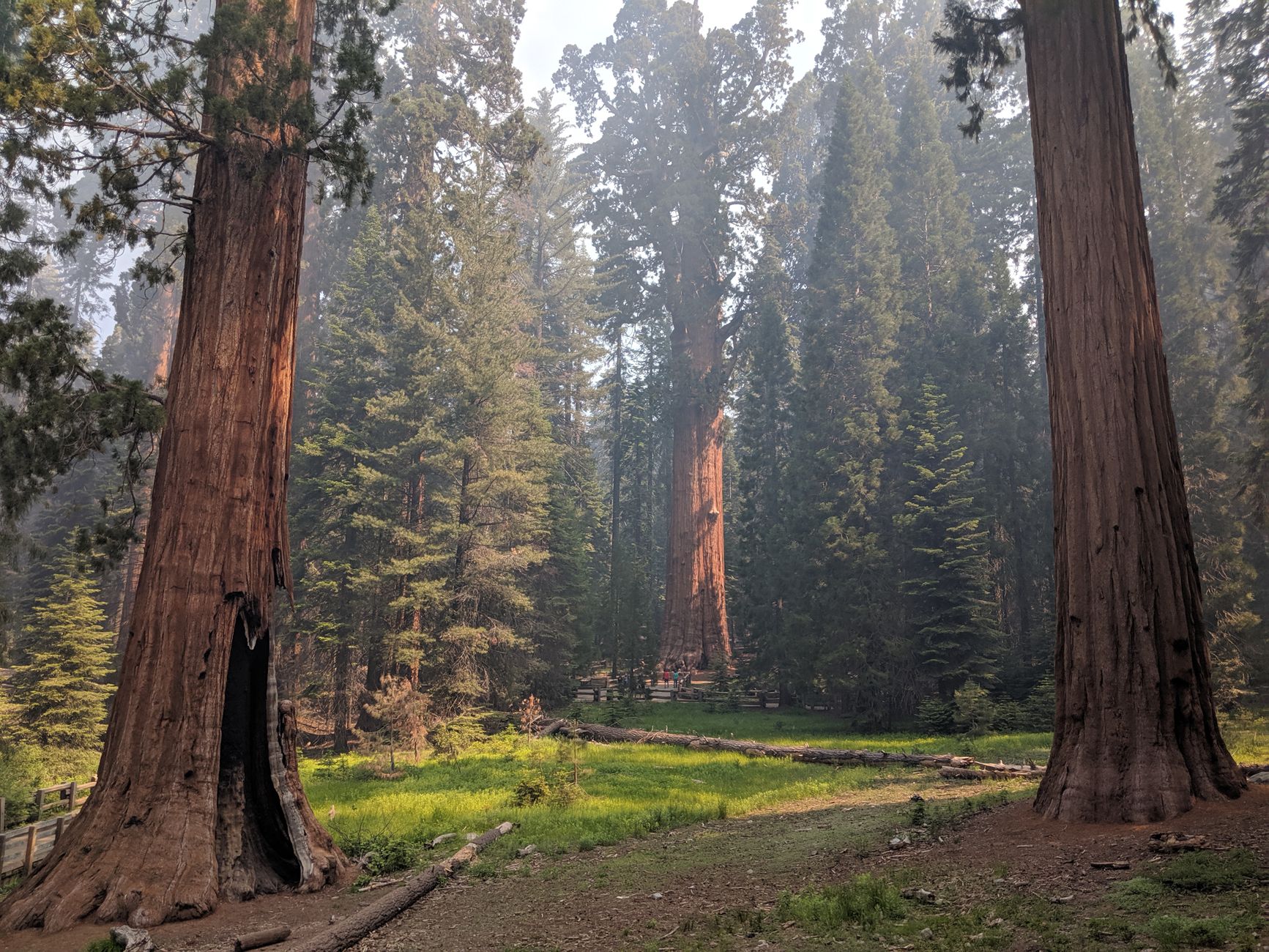
The Congress Trail is a 2.7-mile paved, lollipop-shaped loop in Sequoia National Park’s Giant Forest that starts just before the General Sherman Tree and climbs and descends on gentle grades past the House and Senate groups of sequoias and the President Tree1. The President is the second-largest tree in the world when branch volume is counted, with at least 54,000 cubic feet of wood and bark and an age of about 3,200 years23. The trail begins at the main Sherman Tree parking area off Wolverton Road, two miles north of the Giant Forest Museum, and the only hard part is the 200-foot uphill climb back to that lot at the end1. In summer, free shuttles stop at the trailhead every 15 to 20 minutes, so you can park once at the museum or Lodgepole and ride14. Pets are not allowed1.
- Distance: 2.7 mi round trip, lollipop loop1
- Surface: paved throughout, gentle incline, benches on the Sherman section1
- Elevation: about 7,000 ft; 200 ft climb back to the main lot15
- Named trees: General Sherman, the House group, the Senate group, the President1
- Trailhead: main Sherman Tree lot, Wolverton Road, 2 mi north of the Giant Forest Museum1
- Shuttle: Routes 1 and 4 stop here, May 22 to September 7 in 20264
- Winter: only the Sherman Tree section is plowed; the loop is a snow walk6
Most visitors walk down to the General Sherman Tree, take a photograph, and walk back up. The Congress Trail is what they miss: the loop that continues past the Sherman Tree into the densest part of the Giant Forest, where the trees stand in groups with names borrowed from the U.S. Congress. It adds about 2 miles and an hour to the Sherman visit, all on pavement, and it is the best easy walk in the park. This page covers the route, the trees, the climb, accessibility, the shuttle, and how it fits into the rest of the best hikes in Sequoia and Kings Canyon.
The route
The NPS describes the Congress Trail as a 2.7-mile round-trip lollipop on a gentle, paved incline1. The “stick” of the lollipop is the Sherman Tree Trail itself, which descends about half a mile from the main parking lot on Wolverton Road to the tree5. The loop begins just before the Sherman Tree and returns to the same point, after which you climb the half mile back to the lot.
Because the stick is shared with everyone visiting the Sherman Tree, the first and last quarter hour are crowded in summer. The loop is not. Most people turn around at the tree, and within a few hundred yards of the junction the trail is quiet.
The Giant Forest trail summary calls it a paved two-mile loop, which is the loop portion alone; the 2.7-mile figure on the trail page includes the walk from the lot17. Either way, plan on 1.5 to 2 hours at a browsing pace with the Sherman Tree stop included.
The named trees
The NPS trail page names four stops: the General Sherman Tree, the House group, the Senate group, and the President Tree1. Other signed trees stand along the loop, but the NPS page does not list them, so they are not listed here.
General Sherman Tree
The largest tree on Earth by trunk volume: 274.9 feet tall, 102.6 feet around at the base, about 52,500 cubic feet of trunk, and roughly 2,200 years old89. In September 2021 fire crews wrapped its base in fire-resistant foil as the KNP Complex Fire approached, and it came through undamaged8. Everything about it is on the General Sherman Tree page.
The House and Senate groups
These are two clusters of mature sequoias standing close together, the reason the trail has its name1. Because the trunks are close and the trail passes beside them, this is the one place on an easy walk in the park where you stand inside a group of giants rather than look at a single tree from behind a fence.
The President Tree
The President Tree is the reason to finish the loop. By trunk volume alone the NPS ranks General Sherman first and General Grant second, but “if branch volume is included with trunk volume, the President Tree is the second largest and the Grant Tree is the third largest”3. A 2012 National Geographic project that climbed and measured the tree found at least 54,000 cubic feet of wood and bark, a lightning-blasted dead spire reaching 247 feet, a base 27 feet in diameter, nearly two billion leaves, and an age of about 3,200 years, older than General Sherman by a millennium2. The same measurements showed the President laying down more new wood per year than a vigorous young tree, which is discussed on the page about whether General Sherman is still growing2.
The President’s crown is fuller than General Sherman’s2. Standing beneath it, the difference is obvious: Sherman’s top is dead and its silhouette narrow, while the President still carries a broad, living canopy.
The Washington Tree, nearby but not on the loop
The Washington Tree in the Giant Forest ranked second in the world by trunk volume until fire damage in 2003 dropped it out of the top 303. It is reached by its own trail in the grove, listed on the Giant Forest trail summary as the Washington Tree Trail, not by the Congress loop7. The list of survivors is on the page about the 10 largest giant sequoias.
The 200-foot climb
The loop itself is gentle. What people remember is the end: the NPS tells you to “be prepared for a 200 foot uphill climb when returning from your hike to the main Sherman parking lot”1. That climb is spread over the half-mile Sherman Tree Trail, which has stairs and benches57. At 7,000 feet it is enough to leave a fit adult breathing hard; the NPS notes that the Giant Forest’s elevation of 6,000 to 7,000 feet makes trails feel more strenuous and can bring on altitude sickness10.
Two ways to skip it. In summer, walk down the main trail, do the loop, then continue past the Sherman Tree to the lower accessible parking lot on the Generals Highway and catch the shuttle back up to the main lot5. Or park at the Giant Forest Museum or Lodgepole and start from the lower lot by shuttle, in which case the climb comes at the beginning, when you are fresh, and the loop is the descent.
Accessibility
The NPS accessibility notes for this trail cover the Sherman Tree section: “The trail to the General Sherman Tree is paved with inclines of up to 5% and limited cross-slopes. There are benches along the trail”1. A separate 500-foot paved trail with benches and exhibits reaches the tree from the accessible lot on the Generals Highway, which is 2 miles from the museum and 3 miles from the Lodgepole Visitor Center and reserved in summer for placard holders; five more accessible spaces are in the main lot15. Temporary placards are issued free at visitor centers without documentation, and loaner wheelchairs are available at the Giant Forest Museum and Lodgepole11.
The loop beyond the tree is paved on gentle grades, but the NPS does not list the Congress Trail among its accessible highlights, which are the 500-foot Sherman trail, the Big Trees Trail, the Grant Tree Trail, Panoramic Point, and Roaring River Falls1112. A strong wheelchair user with a companion can do much of it; the return climb to the main lot is the obstacle, and the shuttle from the lower lot is the answer. Fully accessible alternatives are compared on the page about accessible Sequoia and the Big Trees Trail.
Shuttle strategy
The main Sherman Tree lot is one of the busiest shuttle stops in the park and fills by mid-morning in July and August. The free in-park shuttles ran daily from May 22 to September 7 in 2026, plus winter holiday weekends, and all are wheelchair-accessible4. Two routes matter here:
| Route | Stops | When |
|---|---|---|
| Route 1 (Green) | Giant Forest Museum – Sherman Tree Trailhead – Lodgepole Campground – Lodgepole Visitor Center | Daily in season4 |
| Route 4 (Orange) | Sherman Tree Trailhead – Sherman Tree Parking – Wolverton | Daily in season4 |
The plan that works: park at the Giant Forest Museum (or at Lodgepole if you are camping there), ride Route 1 to the Sherman Tree trailhead, walk down, do the loop, and either climb back to the main lot or continue to the lower lot and ride up45. Shuttles reach the Sherman stops every 15 to 20 minutes1. Route 4 connects to Wolverton, which is the trailhead for the Lakes Trail and Alta Peak and the winter snowplay area. The full system is on the Sequoia shuttle guide.
Outside shuttle season, drive to the main lot early. After the first heavy snow, Wolverton Road and the main lot close and everyone parks at the lower lot on the Generals Highway56.
Season and winter
The Congress Trail is a summer and fall walk. In winter the Sherman Tree Trail loop is the only trail in the Giant Forest and Lodgepole areas kept clear of snow, and even there the NPS recommends traction devices6. The Congress loop becomes a snowshoe route; see snowshoeing in Sequoia National Park. Chains may be required on the Generals Highway any time it snows13. Late September and October, after the shuttles stop, are the quiet months.
Rules and what to pair it with
Pets are not permitted on this trail or any other trail in the park114. Stay on the pavement; the fences around the largest trees protect shallow roots. Bears are common in the Giant Forest, so keep food in the car or a bear box, not in a pack left on a bench15. There is no fee beyond park entrance1.
The Congress Trail and Sherman Tree take a morning. The afternoon is Moro Rock and Crescent Meadow by Route 2 (Gray) from the museum, or Tokopah Falls from Lodgepole at the other end of Route 1, 3.4 miles round trip to a 1,200-foot cascade416. See the Tokopah Falls Trail guide, the Giant Forest guide, and the one-day Sequoia itinerary.
Frequently Asked Questions
How long is the Congress Trail?
Is the Congress Trail hard?
Which named trees are on the Congress Trail?
How big is the President Tree?
At least 54,000 cubic feet of wood and bark, a 247-foot lightning-killed spire, a base 27 feet across, and an age of about 3,200 years, according to National Geographic’s 2012 measurements2.
Is the Congress Trail wheelchair accessible?
Can I do the Congress Trail in winter?
Only on snowshoes or with traction devices. The Sherman Tree Trail is the only trail plowed in the Giant Forest; the loop beyond it is not6.
Are dogs allowed on the Congress Trail?
No. Pets are prohibited on all trails in Sequoia and Kings Canyon, paved or not14.
Related Articles
Sources
- Congress Trail — National Park Service, Sequoia & Kings Canyon. Accessed 2026-09-06.
- Forest Giant — National Geographic, December 2012. Accessed 2026-09-06.
- The Largest Trees in the World — National Park Service. Accessed 2026-09-06.
- Park Shuttles — National Park Service. Accessed 2026-09-06.
- The General Sherman Tree Trail — National Park Service. Accessed 2026-09-06.
- Giant Forest and Lodgepole Winter Trails — National Park Service. Accessed 2026-09-06.
- Giant Forest and Lodgepole Trails — National Park Service. Accessed 2026-09-06.
- The General Sherman Tree — National Park Service. Accessed 2026-09-06.
- General Sherman Tree (place page) — National Park Service. Accessed 2026-09-06.
- Giant Forest and Lodgepole — National Park Service. Accessed 2026-09-06.
- Accessibility — National Park Service, Sequoia & Kings Canyon. Accessed 2026-09-06.
- Accessibility in Grant Grove — National Park Service. Accessed 2026-09-06.
- Road Information — National Park Service. Accessed 2026-09-06.
- Pets — National Park Service. Accessed 2026-09-06.
- Bears and Food Storage — National Park Service. Accessed 2026-09-06.
- Tokopah Falls — National Park Service. Accessed 2026-09-06.