
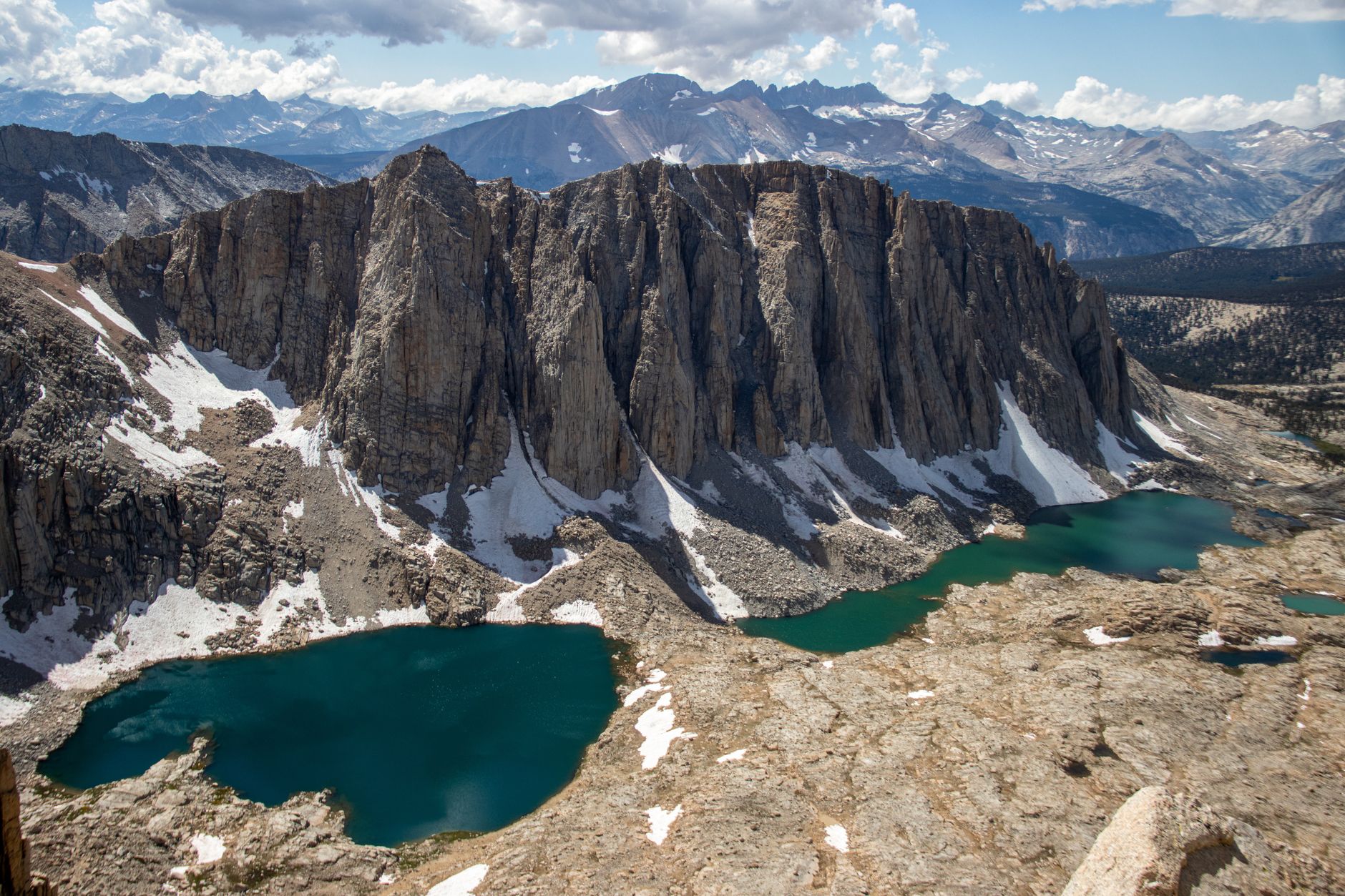
The Lakes Trail runs 6 miles one way from Wolverton, at 7,200 feet, to Pear Lake, at 9,200 feet, passing Heather and Emerald lakes along the way12. Camping is allowed only at Emerald Lake (5 miles in) and Pear Lake (6 miles in); Heather and Aster lakes are closed to overnight use1. Near the top, hikers choose between the Watchtower route, a cliff-edge ridge trail with views of Lodgepole and Tokopah Falls that turns treacherous with any snow or ice, and the Hump Trail, a safer alternative used whenever the Watchtower is icy2. Bear canisters are required at Pear and Emerald lakes from May 1 through October 313. In winter, the Pear Lake Winter Hut sleeps 10 backcountry skiers and snowshoers a night for $75 per person, open roughly February through early April4.
- Distance: 6 miles one way to Pear Lake, 12 miles round trip1
- Elevation gain: about 2,000 feet, from 7,200 feet at Wolverton to 9,200 feet at Pear Lake4
- Camping: Emerald Lake (5 mi) and Pear Lake (6 mi) only; Heather and Aster lakes are closed to camping1
- The Watchtower vs. the Hump: the Watchtower is a ridge route with drop-offs, dangerous when icy; use the Hump Trail instead in those conditions2
- Bear canisters: required at Pear and Emerald lakes, May 1-October 313
- Winter hut: 10 bunks, $75 per person per night, reservations open December 9 at 9 a.m.4
- Permits: a wilderness permit is required for any overnight stay, quota season or not5
The Lakes Trail is the classic backpacking approach out of Wolverton, the trailhead two miles above Lodgepole that also serves Alta Peak. It climbs through red fir forest to a string of glacial lakes below the Tablelands, and it is one of the few trails in the park with a staffed winter hut at the end of it. This page covers the four lakes in order, the Hump-versus-Watchtower decision near the top, camping and permit rules for an overnight, and what the Pear Lake Winter Hut actually involves. For other options in the park, see the best hikes in Sequoia and Kings Canyon.
Trail stats
| Distance | 6 miles one way to Pear Lake (12 miles round trip)1 |
| Elevation gain | About 2,000 ft, 7,200 ft to 9,200 ft4 |
| Days | Long day hike, or 1-3 nights as an overnight |
| Permit | Wilderness permit required for any overnight stay5 |
| Season | Quota season (overnight): May 22-September 26, 2026; winter hut: roughly February 6-April 5, 202645 |
| Trailhead | Wolverton, 7,200 ft |
The four lakes, in order
The Lakes Trail leaves Wolverton and climbs steadily toward the Tablelands, a granite bench above Lodgepole. The National Park Service describes it as “a moderately strenuous climb up through meadows and forests, along granite cliff overlooks, and to several lakes”1.
Heather Lake comes first. It sits below the Watchtower cliff and is a common turnaround point for a day hike, but it is closed to overnight camping1.
Emerald Lake, at 5 miles from the trailhead, is the first legal camping spot on the trail1. It sits in a rockier basin than Heather, ringed by the granite of the Tablelands.
Aster Lake is passed on the way toward Pear Lake but, like Heather, is closed to camping1. Neither the NPS trail page nor the winter hut source that this article draws from gives a separate mileage for Aster Lake; treat it as a waypoint between Emerald and Pear rather than a destination.
Pear Lake, at the end of the trail, sits at 9,200 feet, 6 miles from Wolverton14. It is the second and last legal camping spot, and the site of the winter hut described below.
The Hump Trail vs. the Watchtower
Above Heather Lake, the trail splits into two routes that rejoin further up. The Watchtower segment runs along an exposed ridge with views down onto Lodgepole, the Marble Fork of the Kaweah River, and Tokopah Falls, and the National Park Service is specific about when to avoid it: the route is “extremely treacherous if any snow or ice is present,” and hikers should “choose the Hump Trail instead” under those conditions2. The Hump Trail is the more sheltered, less exposed alternative and is the one to default to in early season or after a late storm, even in summer at this elevation.
Neither route has a published separate mileage in NPS sources, so plan around condition, not distance: check with a ranger at Lodgepole or the Wilderness Office about snow on the Watchtower before committing to it, particularly in June or after an early fall storm.
Day hike or overnight
A day hike to Heather Lake and back is a common half-day trip from Wolverton. Going all the way to Pear Lake and back in a day is a long, full day given the distance and gain, and most hikers who want to see Pear Lake plan on staying the night.
An overnight on the Lakes Trail requires a wilderness permit regardless of season, since Sequoia and Kings Canyon require permits for all overnight wilderness travel5. During the quota season, May 22 through September 26, 2026, permits are limited by trailhead and require a Recreation.gov reservation or a walk-up permit; outside that window they are free and self-issued at ranger stations5. For the full mechanics of the quota system, reservation windows, and walk-up rules, see Sequoia and Kings Canyon wilderness permits.
Camping is restricted to Emerald Lake and Pear Lake. Heather and Aster lakes are closed to overnight use entirely, which means a one-night trip is effectively a there-and-back to Emerald or an out-and-back to Pear, not a multi-lake camping tour1.
Bear canisters and food storage
Pear Lake and Emerald Lake are both inside the zones where the National Park Service requires a bear-resistant canister, in effect from May 1 through October 313. Counterbalance hanging is not an approved substitute in these zones; the park notes that hanging methods “generally do not work” in the Sierra because suitable trees are rare and bears have adapted to raid hung bags3. Canisters can be rented at several visitor centers, though not at Cedar Grove. For which models the park stocks and where to get one, see bear canisters in Sequoia and Kings Canyon, and for the park’s food-storage rules generally, see bears in Sequoia National Park.
The Pear Lake Winter Hut
Once summer camping season ends, the Lakes Trail becomes a ski and snowshoe route to a staffed backcountry hut. The Pear Lake Winter Hut sits about three-eighths of a mile north of Pear Lake at 9,200 feet, reached by the same six-mile climb from Wolverton, now on snow rather than trail4. The Sequoia Parks Conservancy, which runs the hut, describes the approach plainly: begin at 7,200 feet at Wolverton and “ascend a steep six miles” to the hut’s elevation, a route recommended only for “experienced backcountry skiers and snowshoers,” not beginners4.
The hut sleeps 10 people on bunks with mattresses, and it is staffed by a caretaker. It has a wood stove for heat, a composting toilet, Coleman cookstoves, and cooking utensils, though guests still carry in their own food and sleeping bags4. For the 2026 season the hut operated from February 6 through April 5, with the conservancy noting that “weather, snow, and trail conditions may change” the closing date4. Bunks cost $75 per person per night, reservations open December 9 at 9 a.m. on a first-come, first-served basis through the conservancy’s online system, and a free wilderness permit is required in addition to the hut reservation4. There are no refunds or date changes except when the highway or the trail itself is officially closed4.
This is a specialized trip: avalanche terrain, deep snow navigation, and a six-mile climb at altitude separate it from a casual snowshoe outing. For gentler winter options closer to the road, see snowshoeing in Sequoia National Park.
Getting there and when to go
Wolverton sits off the Generals Highway about two miles from Lodgepole and four miles from the Giant Forest Museum. It is also the trailhead for Alta Peak, the park’s hardest day hike, and doubles as the main snow-play area in winter. The Lakes Trail itself is typically snow-free and open for hiking from June through October, though early-season hikers should expect snow patches near Heather Lake and on the Watchtower well into June at this 7,000-to-9,000-foot elevation band, which sees 40 to 45 inches of precipitation a year, most of it snow between December and May, with a deep winter snowpack6.
Frequently Asked Questions
How long is the hike to Pear Lake?
Can I camp at Heather Lake?
No. Heather Lake and Aster Lake are both closed to overnight camping. The only legal camping spots on the Lakes Trail are Emerald Lake, 5 miles in, and Pear Lake, 6 miles in1.
Do I need a bear canister for the Lakes Trail?
Yes, if you are camping at Pear Lake or Emerald Lake. Both are inside zones where the National Park Service requires a bear-resistant canister from May 1 through October 313.
What is the difference between the Hump Trail and the Watchtower?
The Watchtower is an exposed ridge route with views of Lodgepole and Tokopah Falls that becomes dangerous whenever snow or ice is present. The Hump Trail is the safer, more sheltered alternative to use in those conditions2.
Do I need a permit to day hike the Lakes Trail?
No. Wilderness permits in Sequoia and Kings Canyon are required only for overnight stays; day hikers do not need one5.
What is the Pear Lake Winter Hut?
A staffed backcountry hut about three-eighths of a mile north of Pear Lake, open roughly February through early April, sleeping 10 people for $75 per person per night, reached by a steep six-mile ski or snowshoe climb from Wolverton4.
Is the Lakes Trail hard?
The National Park Service rates it moderately strenuous. The gain is steady rather than extreme, but the distance, the altitude above 7,000 feet, and the exposed Watchtower section make it more demanding than the shorter walks around Giant Forest1.
When does the Lakes Trail quota season run?
For overnight permits, the quota season for 2026 runs May 22 through September 26. Outside that window, permits are free and self-issued, though snow may make the trail impassable outside of summer and the winter-hut season5.
Related Articles
Sources
- Lakes Trailhead — National Park Service. Accessed 2026-09-09.
- Wolverton Picnic Area, Trailhead, and Snowplay Area — National Park Service. Accessed 2026-09-09.
- Wilderness Food Storage — National Park Service. Accessed 2026-09-09.
- Pear Lake Winter Hut — Sequoia Parks Conservancy. Accessed 2026-09-09.
- Wilderness Permits — National Park Service. Accessed 2026-09-09.
- Weather — National Park Service. Accessed 2026-09-09.