
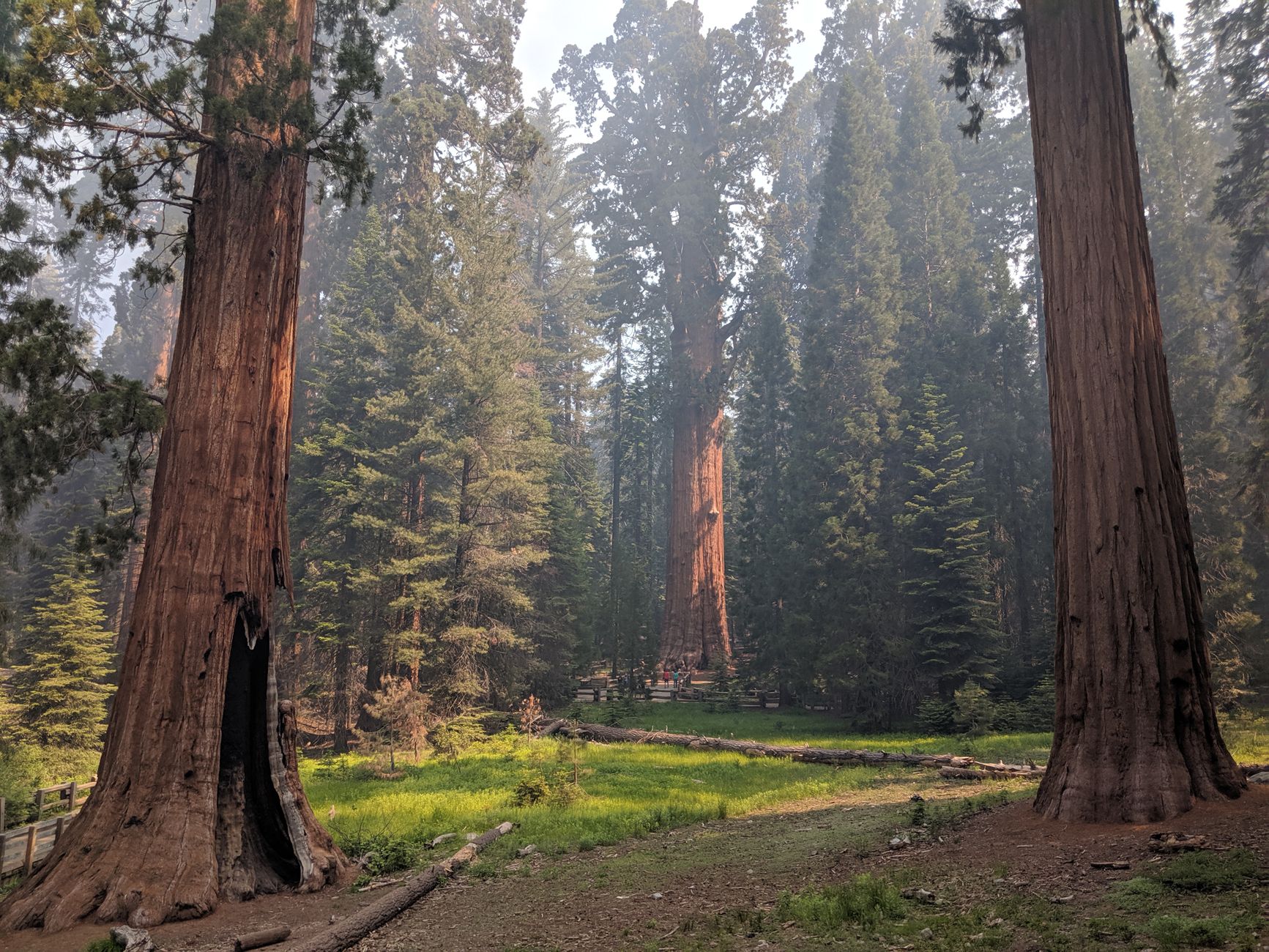
Sequoia and Kings Canyon run free, ranger-led snowshoe walks starting around mid-January whenever snow allows, covering 1 to 2 miles in about 1.5 hours, with snowshoes provided and reservations required no more than a week ahead1. Self-guided snowshoeing follows routes marked with reflective tree markers near Giant Forest and Grant Grove, and rental snowshoes are available at Grant Grove Market and Wuksachi Lodge12. The General Sherman Tree Trail is the only trail in Giant Forest kept plowed of snow, and even there traction devices for boots are strongly recommended3. The main snow-play areas are Wolverton, Big Stump, and Columbine4.
- Ranger-led walks: free, 1-2 miles, about 1.5 hours, from mid-January when snow allows, reservations required within a week of the walk1
- Age minimum: 10 years old for ranger-led walks1
- Group size: capped at 20 people per walk1
- Rentals: snowshoes at Grant Grove Market and Wuksachi Lodge12
- Route marking: reflective markers on trees indicate self-guided snowshoe routes; avoid marked ski tracks1
- Only plowed trail: the General Sherman Tree Trail loop, and traction devices are still recommended there3
- Snow-play areas: Wolverton, Big Stump, and Columbine4
Disclosure: some links on this page are affiliate links, marked by the products, tours and hotels they name. As an Amazon Associate, sequoia.info earns from qualifying purchases. A purchase through these links may earn the site a commission at no cost to you, and it never affects what is recommended. How this works.
Snowshoeing is one of the more approachable winter activities in the park, requiring less gear and less commitment than skiing while covering the same snow-draped groves. This page covers the ranger-led program, the self-guided routes near Giant Forest and Grant Grove, where to rent gear, and how it connects to bigger winter trips like the Pear Lake Winter Hut. For everything else about a winter visit, see Sequoia National Park in winter.
Ranger-led snowshoe walks
The park’s ranger-led snowshoe program typically begins around mid-January, once enough snow has accumulated, and runs until conditions deteriorate later in the season1. Each walk covers roughly 1 to 2 miles and takes about 1.5 hours, rated moderately strenuous1. Snowshoes are provided at no cost, and the walks themselves are free, but reservations are required and can only be made up to a week in advance, either by calling or visiting a visitor center1. Groups are capped at 20 people, children must be at least 10 years old, and a walk can be cancelled on short notice if there isn’t enough snow or the weather turns1.
What to bring: warm, layered clothing, waterproof boots, gloves, a hat, sunglasses, sunscreen, water, and food1. The park supplies the snowshoes; everything else is on the hiker.
Self-guided routes
Outside the ranger program, snowshoeing is self-guided, following marked routes rather than a single named trail. The park uses reflective markers nailed to trees to indicate popular snowshoe and ski paths, and it advises staying clear of dedicated ski tracks so as not to posthole through them1. Ski trail maps, which double as a reference for snowshoe routes through the same terrain, are sold at visitor centers1.
In the Giant Forest and Lodgepole area, the General Sherman Tree Trail loop is the only trail the park actively plows, which makes it the most reliable footing in the area, though the park still recommends traction devices for boots because ice forms on cleared pavement3. Every other route in the area relies on the colored or reflective tree markers rather than grooming or plowing3. On the Grant Grove side, cross-country ski routes wind through the sequoia groves near the village, marked the same way1.
Where to rent gear
Snowshoes rent at Grant Grove Market and at Wuksachi Lodge when it is open for the season12. Sleds are sold, not rented, at Grant Grove Market and at Wolverton2. The Giant Forest Museum sells ski trail maps and stocks some winter gear as well1. None of these locations are inside a town with a full outdoor retailer, so anyone who needs boot traction cleats, gaiters, or a proper winter jacket is better off buying before the drive up; Three Rivers and Visalia have general stores but not dedicated snow-gear shops. The site earns a commission on purchases made through product links, which does not affect what is recommended: worthwhile additions to a snowshoe day pack include traction cleats for the icy sections of the Sherman Tree Trail, gaiters to keep snow out of boots, and trekking poles for balance on the self-guided routes.
Snow-play areas
The park’s main areas for informal snow play, sledding, and building a base for a snowshoe outing are Wolverton, Big Stump, and Columbine4. Wolverton, two miles above the General Sherman Tree, functions as the park’s primary snow-play area and also serves as the trailhead for the Lakes Trail to Pear Lake, which becomes a serious backcountry ski and snowshoe route to a staffed winter hut once the snowpack sets in. Big Stump, near the Kings Canyon entrance on the Highway 180 side, and Columbine round out the three main areas4.
Snowshoeing vs. cross-country skiing
The park treats the two activities as sharing the same terrain rather than as separate trail systems: the same reflective tree markers guide both snowshoers and skiers through Giant Forest and Grant Grove, and the same ski trail maps sold at visitor centers cover both1. The practical difference is etiquette rather than access. Skiers set and rely on a groomed or packed track, and a snowshoer walking directly on top of that track destroys it for everyone behind them, which is why the park’s guidance is to stay clear of marked ski tracks entirely and pick a parallel line through the untracked snow1. For a first winter outing, snowshoeing is the lower-skill option: it requires no technique beyond walking, works on any ungroomed slope, and the rental gear at Grant Grove Market or Wuksachi Lodge needs no fitting beyond boot size12.
Conditions and safety
The sequoia belt, roughly 5,000 to 7,000 feet at Giant Forest, Lodgepole, and Grant Grove, sees 40 to 45 inches of precipitation a year, nearly all of it snow between December and May, with a snowpack that can run several feet deep at midwinter5. That means reliable snow for a longer stretch than lower elevations, but also real winter hazards: carry chains for the drive up regardless of the vehicle, since chain requirements can be posted with little notice; dress in warm layers with backup food and water in case of a delay on the road; and use traction devices on plowed but icy trails like the Sherman Tree loop6. For the driving side of a winter visit, including when chains are actually required, see snow chains for Sequoia National Park.
Frequently Asked Questions
Are there guided snowshoe walks in Sequoia National Park?
Yes. Rangers lead free snowshoe walks starting around mid-January when there’s enough snow, covering 1 to 2 miles in about 1.5 hours, with snowshoes provided1.
Do I need a reservation for the ranger-led snowshoe walk?
Yes, and it can only be made up to a week ahead of the walk, by phone or in person at a visitor center1.
Where can I rent snowshoes in Sequoia National Park?
Is there a minimum age for the ranger-led snowshoe walks?
Yes, children must be at least 10 years old1.
Which trails can I snowshoe on my own?
Self-guided snowshoeing follows routes marked with reflective tree markers near Giant Forest and Grant Grove rather than a single dedicated trail; ski trail maps sold at visitor centers cover the same network1.
Is the trail to the General Sherman Tree open for snowshoeing?
It’s plowed, not snowshoe terrain, and is the only trail in Giant Forest kept clear of snow; the park still recommends traction devices for boots there because of ice3.
Where are the best snow-play areas in Sequoia National Park?
Wolverton, Big Stump, and Columbine are the park’s designated snow-play areas4.
Can I snowshoe to Pear Lake?
Yes, though it is a serious undertaking rather than a casual outing: a steep six-mile climb from Wolverton to 9,200 feet, recommended only for experienced backcountry travelers, with a staffed winter hut at the end of it. See The Lakes Trail to Pear Lake for the full route and hut details.
Related Articles
Sources
- Skiing & Snowshoeing — National Park Service. Accessed 2026-09-09.
- Snowplay — National Park Service. Accessed 2026-09-09.
- Giant Forest and Lodgepole Winter Trails — National Park Service. Accessed 2026-09-09.
- Snowplay — National Park Service, snow-play area list. Accessed 2026-09-09.
- Weather — National Park Service. Accessed 2026-09-09.
- Winter Activities — National Park Service. Accessed 2026-09-09.