
Tire chains can be required on the roads of Sequoia and Kings Canyon National Parks any time it snows, which usually means late fall through spring, and the National Park Service tells every winter visitor to carry them regardless of vehicle12. California uses three chain-control levels. Under R1, chains are required except on vehicles under 6,000 pounds with snow tires on the drive wheels. Under R2, chains are required except on four-wheel-drive or all-wheel-drive vehicles with snow-tread tires on all four wheels. Under R3, every vehicle must chain up, with no exceptions3. The Giant Forest, where the General Sherman Tree stands, sits at about 7,000 feet, and the road to it climbs 5,000 feet from the Foothills entrance4.
- When: any time it snows, typically November through April1
- AWD/4WD: exempt under R1 and R2 only if fitted with snow-tread tires on all four wheels, and chains must still be carried3
- Speed under chain control: 25 mph in the parks5
- No towing, no repairs inside the parks5
- Rentals: in Three Rivers, the gateway town on Highway 198, not inside the park6
- Rental cars: most rental agreements forbid chains, so check yours before buying a set
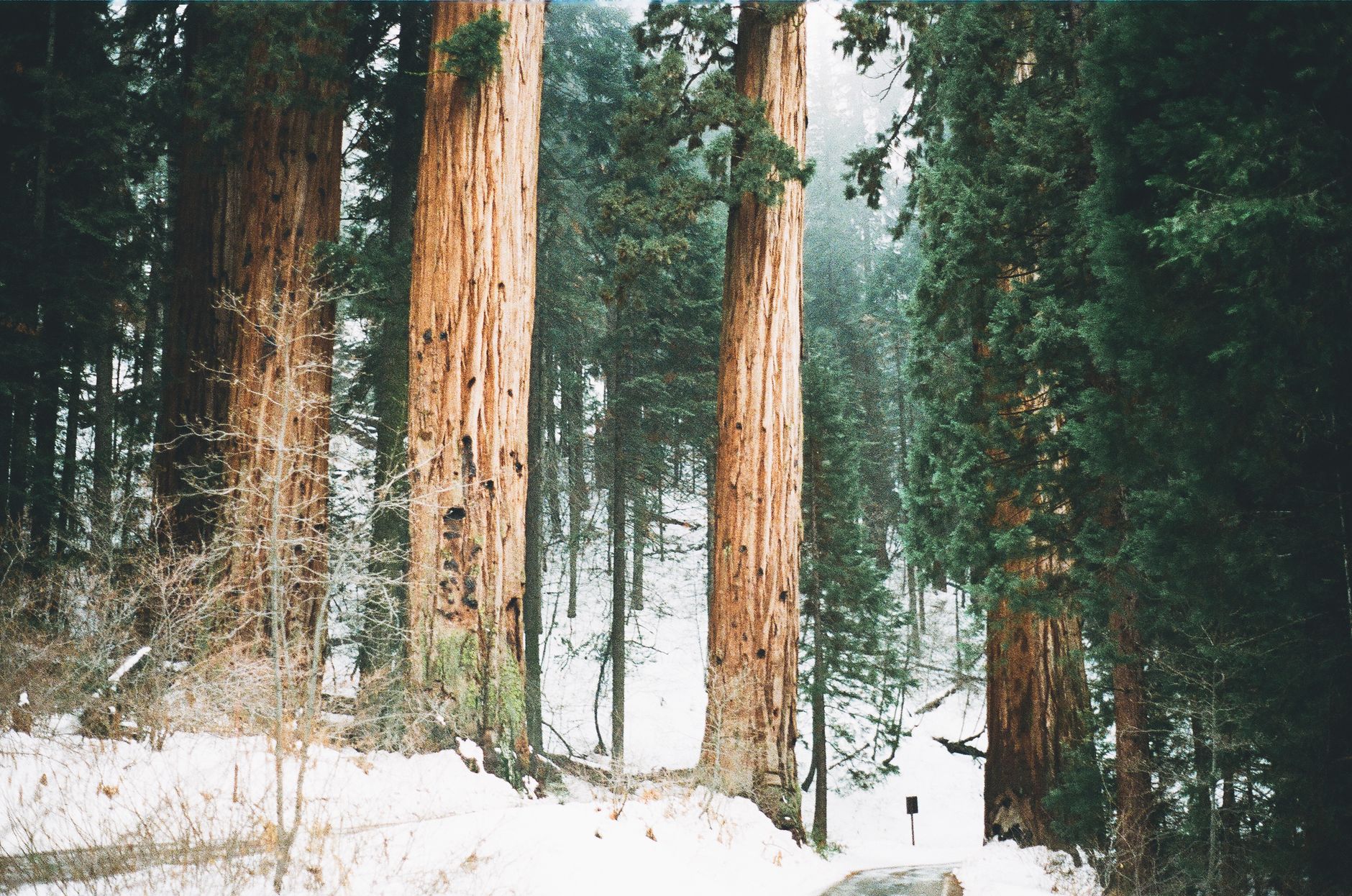
Giant Forest in December looks like a postcard, and the roads to it look like nothing you would want to drive without preparation. This page explains exactly when chains are required in Sequoia and Kings Canyon, what the chain-control levels mean for a two-wheel-drive car, an all-wheel-drive SUV, or a rental, where to buy or rent chains, and how to put them on before you are kneeling in slush at 6,000 feet.
The rule: carry chains from late fall through spring
The NPS road-information page states that chains or cables may be required on park roads any time it snows, most commonly from late fall through spring, and that drivers should always carry chains in winter1. The winter-activities page repeats the advice for every visitor2. Chain requirements are posted at the entrance stations and can change during the day as storms move through; the park’s 24-hour road hotline is 559-565-3341, press 1, then 17.
When chain controls are in effect, the speed limit drops to 25 mph and drive times stretch considerably. The 18-mile drive from the Ash Mountain entrance to the General Sherman Tree already takes about 70 minutes in good conditions5. Under chain control, plan on two hours.
There is one more thing the trip planner makes clear: the parks do not tow or repair vehicles. If you slide off the Generals Highway, the nearest tow truck is coming from Three Rivers or Visalia, and it is coming at its own pace5.
California's three chain-control levels
Caltrans, the state highway agency, defines the levels used on state highways and adopted by the parks3:
| Level | Who must chain up | Who is exempt |
|---|---|---|
| R1 | Most vehicles | Passenger cars and light trucks under 6,000 lb with snow tires on at least two drive wheels |
| R2 | Most vehicles, including 2WD with snow tires | 4WD/AWD vehicles with snow-tread tires on all four wheels |
| R3 | Every vehicle, no exceptions | Nobody |
Two details catch people. First, “snow tires” means tires marked M+S (mud and snow) or with the three-peak mountain snowflake symbol. Standard all-season tires on many cars do carry the M+S marking, but not all do, and it is the marking on the sidewall that a ranger will look for. Second, exemption from installing chains is not exemption from carrying them. Under R1 and R2 conditions, exempt vehicles are still required to have chains on board3. When conditions worsen to R3, which happens during active storms, every vehicle chains up.
Do AWD and 4WD vehicles need chains in Sequoia?
An AWD or 4WD vehicle with snow-rated tires on all four wheels is exempt from installing chains under R1 and R23. That covers most winter days when controls are in effect. It does not cover R3, and it does not cover being pulled over without a set in the trunk. The honest answer for an AWD driver is: buy or rent a set that fits, keep it in the car, and hope not to use it.
Rental cars and chains
Nearly all U.S. rental car contracts prohibit tire chains, because chains fitted badly damage wheel wells, brake lines, and paint. Drivers who install them anyway are liable for the damage. Options, in order of preference:
- Rent an AWD or 4WD vehicle with snow-rated tires and confirm the tire marking at the counter. This is the most reliable way to drive into the park under R1 and R2 conditions without breaking the rental agreement.
- Use the Sequoia Shuttle from Visalia. It runs only in summer, Memorial Day weekend through Labor Day, so it is not a winter solution8.
- Book a guided tour from Fresno, Visalia, or Three Rivers in winter. Tour operators run vehicles equipped for the conditions. See guided tours of Sequoia National Park.
- Buy textile snow socks (fabric traction covers) rather than steel chains. Many rental companies treat them the same as chains, so this does not solve the contract problem, but they cause far less damage if used. Check the contract language.
If a storm closes the road to everything but chained vehicles, the choice for a rental driver is to wait it out in Three Rivers, which is exactly what most people end up doing.
Where to buy or rent chains near Sequoia
Chains are not sold inside the parks. Three Rivers, five miles below the Ash Mountain entrance on Highway 198, has gas, a market, and seasonal chain rental from local businesses6. On the Kings Canyon side, Dunlap on Highway 180 is the last town with services, 20 miles west of Grant Grove6. Auto-parts stores in Visalia and Fresno stock chains and cables through the winter, usually at lower prices than on the mountain.
For buyers, three things matter:
- Fit. Chains are sold by tire size, printed on the sidewall as something like 235/65R17. Buy for that exact size.
- Clearance. Many modern cars, especially those with low-profile tires, have limited space between the tire and the wheel well. The owner’s manual says whether the car accepts chains, cables, or “Class S” low-clearance chains only.
- Practice. Fit them once in a dry driveway. Doing it for the first time in the dark, in falling snow, on the shoulder of the Generals Highway, is how people end up with damaged fenders and cold hands.
A set of cable chains for a mid-size car and a pair of waterproof gloves is a small cost against a ruined trip. Amazon carries the common brands in every size; a kneeling pad and a headlamp are worth adding to the order. The site earns a commission on purchases made through its product links, which does not affect what is recommended.
Which roads are affected
All park roads at elevation are subject to chain controls, but the ones that matter to a winter visitor are:
- Generals Highway from Ash Mountain to Giant Forest (Highway 198 side). Climbs from 1,700 feet to nearly 7,000 feet in 18 miles. This is where most chain controls are enforced45.
- Highway 180 from the Big Stump entrance to Grant Grove. Reaches 6,600 feet at Grant Grove Village9. Wider and less steep than the 198 side, so the NPS recommends it for larger vehicles in any season10.
- Generals Highway between Lodgepole and Grant Grove. Not plowed. Closed from early January to mid-March every winter, and sometimes for storms in December or spring. When it is closed, the two parks connect only via the Central Valley, a 118-mile, 3-hour detour from the Giant Forest Museum to Grant Grove5.
- Moro Rock and Crescent Meadow Road, Panoramic Point Road, Mineral King Road, Crystal Cave Road. Closed to vehicles all winter1.
For closure dates and the live status page, see Sequoia National Park road closures.
What winter driving in the park is actually like
Snow in the sequoia belt is deep and reliable. The groves between 5,000 and 7,000 feet receive 40 to 45 inches of precipitation a year, most of it as snow between December and May, and midwinter snow depths above six feet are normal11. Storms can close roads for hours or days, and the park notes that plowing after a big storm takes time2.
The Generals Highway on the 198 side is a mountain road in the old style: narrow, with continuous curves and a 22-foot vehicle-length advisory between Potwisha and the Giant Forest Museum10. Under chain control at 25 mph it is slow but not frightening, provided the car has traction. The days to avoid are the ones with active snowfall and R3 controls; on those days the road may be closed at the entrance until plows and sanders have passed.
Winter has real rewards for those who prepare. The Sherman Tree Trail is the only trail in Giant Forest kept plowed, and traction cleats for boots are advised12. Wolverton, two miles above the Sherman Tree, is the park’s main snow-play area, and snowshoes rent at Wuksachi Lodge and the Grant Grove Market13. The full winter picture is on the page about Sequoia National Park in winter.
A winter driving checklist
- Chains or cables that fit, plus gloves, a kneeling mat, and a flashlight or headlamp1
- A full tank; there is no gas inside the parks, and the nearest is Three Rivers, Dunlap, or the 24-hour pumps at Hume Lake Market6
- Warm layers, blankets, food, and water in case of a delay2
- Boot traction cleats for the plowed but icy trails12
- The road hotline number, 559-565-3341, and a downloaded offline map, since cell service exists only near the visitor centers and Lodgepole714
Frequently Asked Questions
Do I need chains for Sequoia National Park in December?
Probably. Chain controls are common from late November through March whenever snow is on the road, and the NPS requires winter visitors to carry chains even on days when they are not needed1. Check the road-conditions page or the hotline the morning you drive up.
Does an AWD car need chains in Sequoia National Park?
Under R1 and R2 conditions, an AWD or 4WD vehicle with snow-tread tires on all four wheels does not have to install chains, but it must carry them. Under R3, every vehicle must chain up3.
Can I rent chains in Sequoia National Park?
Not inside the park. Chain rental is available seasonally in Three Rivers on the Highway 198 side, and auto-parts stores in Visalia and Fresno sell chains and cables6.
Can I put chains on a rental car?
Most rental contracts prohibit chains and hold the driver liable for damage. The practical alternative is renting an AWD vehicle with snow-rated tires, joining a guided tour, or waiting in Three Rivers until controls lift.
What is the speed limit with chains on?
Is the road to the General Sherman Tree open in winter?
Yes. The Generals Highway from the Ash Mountain entrance to Giant Forest stays open all winter except during storms, with chain controls as needed. Parking for the Sherman Tree moves to the small lot on the Generals Highway because Wolverton Road is not plowed12.
Is the road between Sequoia and Kings Canyon open in winter?
No. The Generals Highway between Lodgepole and Grant Grove is unplowed and closes from early January to mid-March, with occasional storm closures in December and spring. In that period the two parks are connected only by a three-hour detour through the valley5.
Related Articles
Sources
- Road Information — National Park Service, Sequoia & Kings Canyon. Accessed 2026-09-06.
- Winter Activities — National Park Service. Accessed 2026-09-06.
- Chain Controls — Caltrans. Accessed 2026-09-06.
- Foothills — National Park Service. Accessed 2026-09-06.
- Winter 2025–26 Trip Planner (PDF) — National Park Service. Accessed 2026-09-06.
- Gas Stations & EV Charging — National Park Service. Accessed 2026-09-06.
- Road Conditions — National Park Service, updated September 1, 2026. Accessed 2026-09-06.
- Sequoia Shuttle — City of Visalia. Accessed 2026-09-06.
- Grant Grove — National Park Service. Accessed 2026-09-06.
- Directions & Transportation — National Park Service. Accessed 2026-09-06.
- Weather — National Park Service. Accessed 2026-09-06.
- Giant Forest and Lodgepole Winter Trails — National Park Service. Accessed 2026-09-06.
- Snowplay — National Park Service. Accessed 2026-09-06.
- Frequently Asked Questions — National Park Service. Accessed 2026-09-06.