
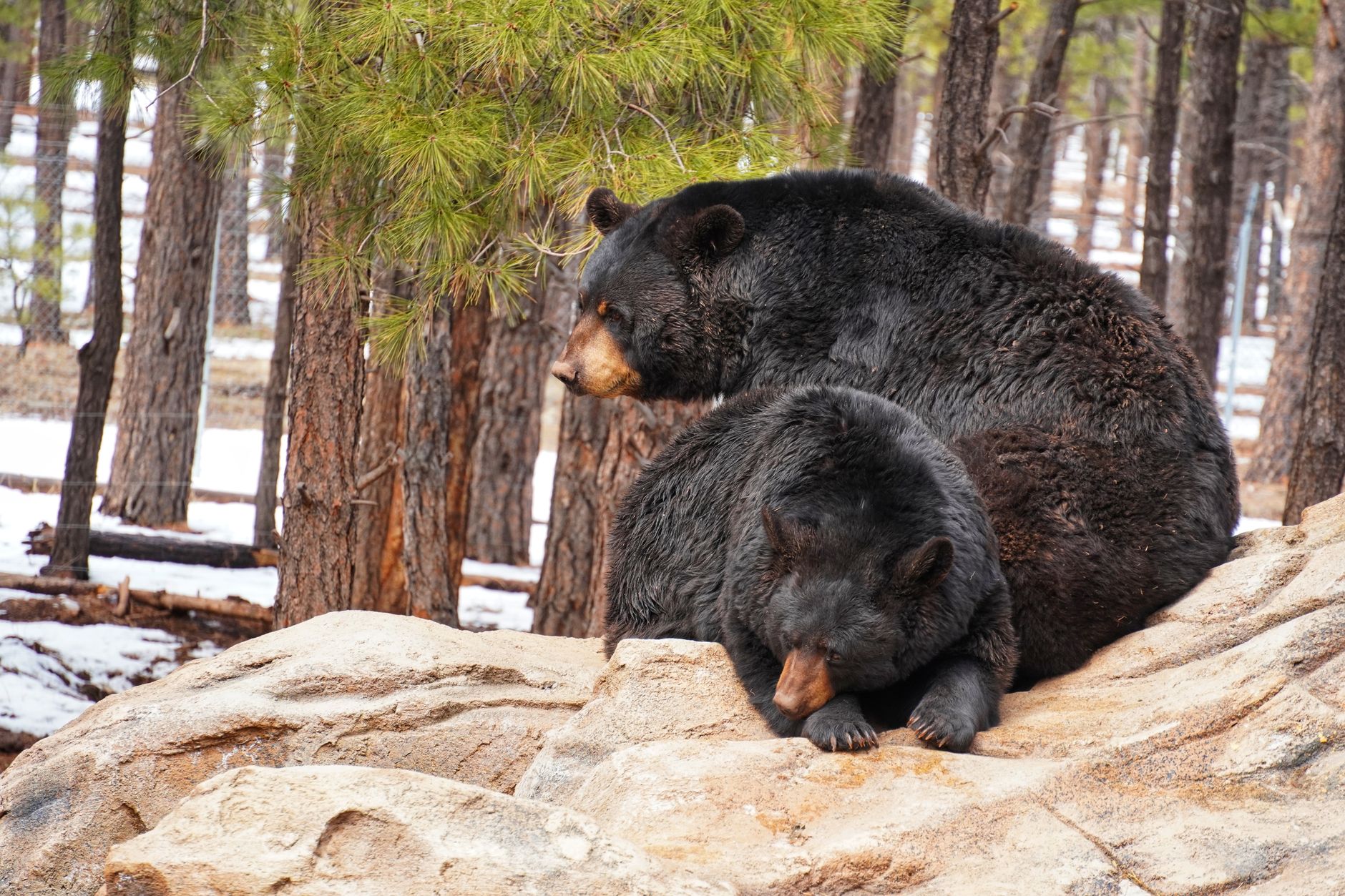
Sequoia and Kings Canyon National Parks are home to several hundred American black bears and no grizzly bears, which were gone from California by the 1920s12. Adult males average 300 to 350 pounds and females 150 to 200, and their coats range from cinnamon to black2. The rule that governs every visit is food storage: all food and anything with a scent, including trash, toiletries, sunscreen, pet food, sealed drinks, coolers, and stoves, must be locked in the metal bear boxes provided in campgrounds, picnic areas, and trailheads, or in a vehicle’s trunk where no box exists3. Rangers remove improperly stored food and issue fines4. In the backcountry, approved bear canisters are required from May 1 to October 31 in Dusy Basin, on the Rae Lakes Loop, at North Dome, Rock Creek, and Pear and Emerald lakes, and are strongly recommended everywhere else5. The NPS says to watch bears from at least the length of two city buses and never to approach one6. Bear spray is prohibited in the parks7.
- Species: black bears only; several hundred in the parks; no grizzlies12
- Store everything with a scent in a bear box or trunk, and latch the box fully3
- Bear box size: 47 by 33 by 28 inches, one per campsite38
- Fines for improper storage; rangers confiscate food4
- Canisters required May 1–Oct 31 in named backcountry areas; rentals $5 for three nights plus $2 per night at visitor centers59
- Distance: at least two city buses; never approach or feed6
- Bear spray: prohibited7
Disclosure: some links on this page are affiliate links, marked by the products, tours and hotels they name. As an Amazon Associate, sequoia.info earns from qualifying purchases. A purchase through these links may earn the site a commission at no cost to you, and it never affects what is recommended. How this works.
Every bear story from these parks begins with a cooler. Black bears in the Sierra are intelligent, strong, and quick to learn that a car with a grocery bag on the seat is a vending machine, and the National Park Service has built its entire bear program around keeping human food out of their reach. This page covers how many bears there are and how likely you are to see one, the storage rules that apply to every campsite, picnic table, and parking lot, what to do during an encounter, and which canisters are approved and where they are required. It is part of the complete Sequoia National Park visitor guide.
How many bears, and will you see one?
The NPS FAQ states that the parks are home to several hundred black bears, but no grizzly bears1. The parks’ mammals page adds that black bears are the only bear species here; grizzlies were extirpated from California by the 1920s, though the state flag still carries one2. Male black bears average 300 to 350 pounds and females 150 to 200 pounds, and despite the name, coats run from light cinnamon to dark black, so a brown bear in Sequoia is still a black bear2.
The NPS does not publish sighting odds, and this site will not guess. What it does say is where bears are most active: the Mineral King area page describes bears there as very active, and the Foothills, campgrounds, and picnic areas are the places where stored food draws them103. The NPS asks visitors to report bear incidents and sightings to a ranger3. Campers are more likely to see one than day visitors on the paved trails, because campgrounds are where the food is.
The food storage rules, in full
The bears page is blunt: all food and anything with a scent, even if you do not consider it food, must be stored3. The list includes garbage, toiletries, sunscreen, air fresheners, pet food, sealed and canned drinks, coolers, grocery bags, and stoves3. The reason is that bears investigate by smell and have learned that coolers and bags contain food whether or not they can smell the contents.
| Where you are | What to do |
|---|---|
| Campsite | Everything in the metal bear box, latched completely; boxes are 47 in long, 33 in deep, 28 in high38 |
| Picnic area or trailhead with a box | Use the box, not the car3 |
| Anywhere without a box | Everything in the trunk; in a vehicle with no trunk, out of sight and covered3 |
| Overnight in the backcountry | Approved canister where required; lockers at some trail camps are first-come and cannot be used to cache food5 |
| Pets | Pet food goes in the bear box like human food11 |
| Lodges | Same rules for anything left in a parked car |
Two details catch people. First, “latched completely” matters; a box that is closed but not latched is an open box to a bear3. Second, the trunk rule applies to hatchbacks and SUVs, where there is no trunk: the NPS says to keep everything out of sight in a vehicle without one, and a cover over the cargo area is the minimum3.
Campground regulations authorize rangers to remove improperly stored food and to issue fines4. Campers who leave a cooler on the table for a ten-minute walk can return to a citation, or to a cooler that has been opened by a bear and confiscated by a ranger, whichever arrives first.
What to do if you see a bear
The NPS wildlife-safety page sets the distance at two city buses and says never to approach any bear, regardless of its size63. Beyond that, the guidance is to give the animal room, keep children close, and let it move on. Bears that obtain human food learn to seek it out, which is the reason the storage rules are enforced as hard as they are.
For the parks’ other large predator, the advice differs: if a mountain lion is encountered, do not run, pick up small children, make yourself look big, and fight back if attacked6. Rattlesnakes, common at lower elevations, bite mostly when harassed6. Bear spray is on the list of items prohibited in the parks, along with BB guns, bows, and slingshots, so it is not an option here7. The site’s page on animals of the sequoia groves covers the rest of the wildlife.
Bear canisters: where they are required and which are approved
Overnight visitors in the wilderness fall under a second set of rules. Canisters are required from May 1 to October 31 in Dusy Basin, on the Rae Lakes Loop, at North Dome, at Rock Creek, and at Pear and Emerald lakes on the Lakes Trail, and are highly recommended everywhere else in the parks’ backcountry5. Counterbalance hanging is allowed only where canisters are not required, and the NPS notes that it generally fails5. Metal food lockers exist at some trail camps, but they are first-come and may not be used to cache food for a later date5.
The parks rent canisters at five stations: the Foothills Visitor Center, the Lodgepole Visitor Center in summer, the Giant Forest Museum in winter, the Kings Canyon Visitor Center, and the Mineral King Ranger Station, which carries the largest selection; Cedar Grove does not rent them12. The models are the BearVault BV450 Solo (6 person-days, 1 lb 6 oz), the Garcia Backpacker’s Cache 812 (6 person-days, 2 lb 11 oz), and the Wild Ideas Bearikade Weekender (6 person-days) and Expedition (9 person-days)12. BearVault and Garcia units rent for $5 for three nights plus $2 per additional night; Bearikades cost $6 the first night plus $3 per night; a credit card deposit is taken, and $90 or $235 is charged if a canister is not returned129.
For anyone planning more than one trip, buying beats renting after a few nights. The BearVault BV450 is the lightest of the rental models and is the one to buy for a solo or two-person trip; BearVault also makes the larger BV5001213. The site earns a commission on purchases made through its product links, which does not affect what is recommended. A model-by-model comparison is on the page about bear canisters in Sequoia and Kings Canyon.
Wilderness permits, which are required for every overnight trip, cost $15 plus $5 per person during the May 22 to September 26 quota season, and the Wilderness Office can be reached at (559) 565-37661415. See the wilderness permits page.
Bears in the national forest
Outside the parks, on Sequoia National Forest land between and around them, the Forest Service’s dispersed-camping rules require food to be stored in bear-proof containers or a vehicle trunk, and trash to be packed out16. The parks’ comparison of park and forest rules adds that the forest allows dogs on trails, dispersed camping, and hunting in season, none of which the parks permit; the bear rules are the one place the two agencies agree17. Details are on the page about free and dispersed camping near Sequoia National Park.
A bear checklist for a car camper
- Empty the car of every scented item at the campsite, including the trash bag, the sunscreen in the door pocket, and the dog’s kibble311.
- Latch the bear box every time, including during meals when someone is at the table3.
- Keep coolers in the box, not the car; a cooler in a car is exactly what a bear is looking for3.
- Buy firewood locally and keep the site clean of food scraps; campground rules require it4.
- Report any bear that approaches a campsite to a ranger3.
- If a bear gets into food, that is a report too; the bear’s future depends on it not happening again3.
Frequently Asked Questions
Are there bears in Sequoia National Park?
Are there grizzly bears in Sequoia National Park?
No. Black bears are the only bear species in the parks. A brown-coated bear in Sequoia is a black bear, whose color ranges from cinnamon to black2.
Will I see a bear in Sequoia National Park?
Do I need a bear canister in Sequoia National Park?
Can I carry bear spray in Sequoia National Park?
No. Bear spray is prohibited in the parks, along with BB guns, bows, and slingshots7.
What happens if I leave food in my car in Sequoia?
How far away should I stay from a bear?
Related Articles
Sources
- Frequently Asked Questions — National Park Service, Sequoia & Kings Canyon. Accessed 2026-09-06.
- Mammals — National Park Service. Accessed 2026-09-06.
- Bears and Food Storage — National Park Service. Accessed 2026-09-06.
- Campground Regulations — National Park Service. Accessed 2026-09-06.
- Wilderness Food Storage — National Park Service. Accessed 2026-09-06.
- Wildlife Safety — National Park Service. Accessed 2026-09-06.
- Laws & Policies — National Park Service. Accessed 2026-09-06.
- Sequoia and Kings Canyon National Parks Announce Campground Fee Increase and Booking Windows — National Park Service. Accessed 2026-09-06.
- Winter 2025–26 Trip Planner (PDF) — National Park Service. Accessed 2026-09-06.
- Mineral King — National Park Service. Accessed 2026-09-06.
- Pets — National Park Service. Accessed 2026-09-06.
- Food Storage Containers for Rent — National Park Service. Accessed 2026-09-06.
- Canister Requirements — BearVault. Accessed 2026-09-06.
- Wilderness Permits — National Park Service. Accessed 2026-09-06.
- Backpacking — National Park Service. Accessed 2026-09-06.
- Dispersed Camping, Hume Lake Ranger District (PDF) — U.S. Forest Service. Accessed 2026-09-06.
- Where Can I…? Parks vs Forests — National Park Service. Accessed 2026-09-06.