
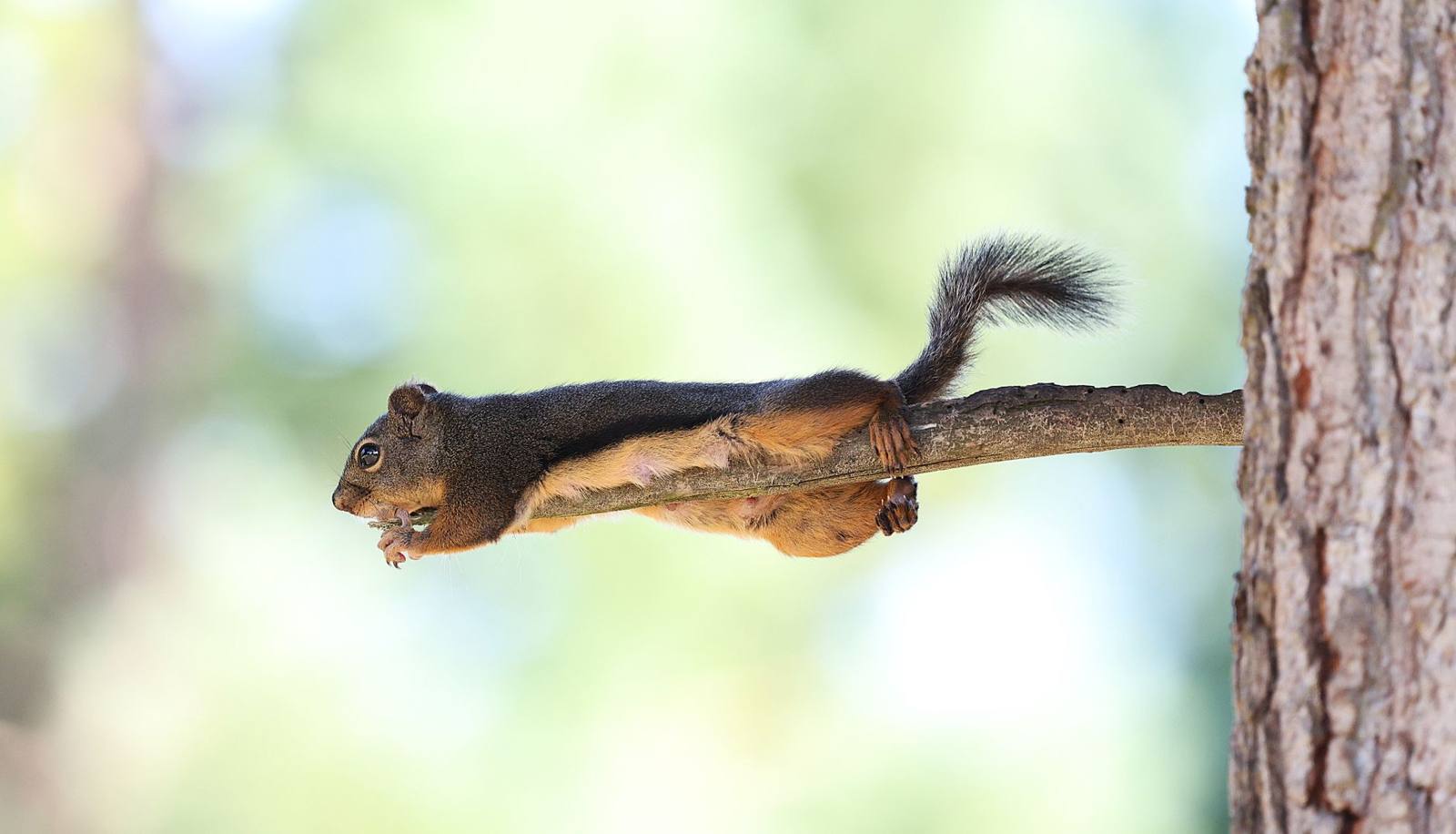
A giant sequoia grove supports wildlife that most visitors never see, starting with the two animals responsible for freeing most of the tree’s seeds: the Douglas squirrel, or chickaree, and a long-horned wood-boring beetle called Phymatodes nitidus, which together keep seed fall going year-round between fires12. Higher up the food chain, the groves and surrounding mixed-conifer forest are habitat for the Pacific fisher, listed as federally endangered in the southern Sierra Nevada in June 2020, and the California spotted owl, proposed for Endangered Species Act protection in the Sierra in 202334. Black bears range through the same forests, shifting their diet from spring grasses to summer berries to fall acorns5. More than 30 bird species and over 150 insect and arachnid species have been documented using a single giant sequoia6.
- Seed-releasing agents: Douglas squirrel and the beetle Phymatodes nitidus, plus fire, which releases the largest seed loads12
- Squirrel appetite: one Douglas squirrel eats 3,000 to 3,500 sequoia cones a year16
- Pacific fisher status: federally endangered in the southern Sierra Nevada population since June 20203
- California spotted owl nest trees: average more than 227 years old and 124 cm in diameter in the southern Sierra4
- Owl status: proposed for Endangered Species Act listing as threatened (Sierra Nevada population) in 20234
- Black bear diet: grasses and roots in spring, berries in summer, acorns in fall5
- Bird species recorded using giant sequoia: more than 306
- Insect and arachnid species recorded: 151 insect species and 37 arachnid species6
Giant sequoia groves look empty compared with a chattering coast redwood forest, but they support a working food web built partly around the tree’s own reproduction. This page covers the animals most tied to giant sequoia groves specifically: the squirrel and the beetle that pry seeds loose, the fisher and owl that depend on old, undisturbed grove structure, and the black bears that pass through on a seasonal circuit. For the biology of the tree itself, see the giant sequoia trees guide.
Douglas squirrel (chickaree): the tree's main seed distributor
The Douglas squirrel, Tamiasciurus douglasii, also called a chickaree, is a small, brownish-gray squirrel about 14 inches long including its tail, with a tawny-orange belly1. It eats conifer seeds, fungi, eggs, berries, buds, and cambium, and it caches surplus cones in middens under favorite feeding perches, a larder-hoarding habit that concentrates food for winter1. John Muir, who watched the species closely in the Sierra Nevada, called it “a fiery, sputtering little bolt of life”1.
Where giant sequoia cones are involved, the squirrel prefers the fleshy green scales of young cones over the pine and fir cones nearby, and it eats the scales rather than the seeds themselves, so most seeds fall free onto the forest floor as it feeds7. One squirrel gets through 3,000 to 3,500 sequoia cones a year16. Wind carries a released seed only about 600 feet from the parent tree, so a chickaree feeding high in the crown effectively reseeds the ground immediately around that tree7. More on the cone side of this relationship is on the giant sequoia cones and seeds page.
The wood-boring beetle most people never notice
A long-horned beetle, Phymatodes nitidus, is the other major animal agent that pries seeds out of sealed sequoia cones, and it is more effective on older cones, four years and up, than the Douglas squirrel is, since the squirrel prefers younger cones two to five years old2. Working together, the beetle and the squirrel keep a low, steady rate of seed fall going in years without fire, while fire itself can release seed loads an order of magnitude larger, up to about 8 million seeds per acre in a single event, onto the bare mineral soil seedlings need to establish2.
Pacific fisher: an endangered resident of old groves
The Pacific fisher, Pekania pennanti, is a forest-dwelling member of the weasel family that depends on structurally complex, old-growth forest, including the mixed-conifer stands that surround giant sequoia groves. The Southern Sierra Nevada population of Pacific fisher was listed as federally endangered in June 20203. Researchers have since used remote cameras and GPS collars to study whether fishers cross or avoid the high-severity burn scars left by the 2020–2021 KNP Complex Fire3. Large areas of fisher critical habitat burned at high severity in those fires, and the National Park Service has been replanting mixed conifers in a corridor south of Redwood Mountain Grove, estimating that as much as 480 acres of new forest may be needed to maintain a connected habitat corridor for the species8.
California spotted owl: needing what old groves provide
The California spotted owl needs dense, shady forest with large old trees and downed logs on the ground, conditions giant sequoia groves and their surrounding mixed-conifer forest supply when they have not recently burned at high severity4. In the southern Sierra Nevada, the trees the owls choose to nest in average more than 227 years old and 124 centimeters in diameter4. The species hunts flying squirrels and woodrats, occurs in Lassen, Yosemite, and Sequoia–Kings Canyon, and faces two compounding threats: high-severity wildfire that removes the old-forest structure it needs, and competition from the invasive barred owl, which has been expanding into its range4. The Sierra Nevada population of California spotted owl was proposed for federal listing as threatened in 20234.
A separate, larger owl, the great gray owl, lives in similar Sierra Nevada meadow-forest habitat, but the National Park Service describes Yosemite specifically, not Sequoia or Kings Canyon, as “the southernmost range and last sanctuary of almost all of California’s great gray owls,” with an estimated 200 to 300 individuals statewide9. Whether great gray owls use Sequoia and Kings Canyon’s giant sequoia groves in any numbers is not established in the sources checked for this article, so it is left out of the tally below.
Black bear: a seasonal visitor, not a specialist
Black bears range throughout both Sequoia and Kings Canyon National Parks and are not specialized to giant sequoia groves the way the fisher and spotted owl are, but their range regularly overlaps with the groves. Their diet shifts through the year: grasses and roots in spring, manzanita and bitter-cherry berries in summer, and large quantities of acorns in fall5. Bears tear apart logs and check tree cavities for food as they forage5. Because sequoia bark is thick, fibrous, and largely free of the sap and resin that draw some insects, sequoia trunks themselves offer bears little to forage directly, and encounters in the groves are more often about a bear passing through than one feeding on the tree. Food storage rules and how common bear sightings actually are in the parks are covered on the bears in Sequoia National Park page.
Everything else that shares the tree
Beyond the species with the strongest ties to giant sequoia specifically, the U.S. Forest Service’s fire-effects database documents more than 30 bird species and 151 insect species plus 37 arachnid species using a single giant sequoia, alongside deer and woodpeckers as common grove associates6. One grove has been measured dropping 9,089 pounds of litter, needles, bark, and cone debris, per acre, feeding a decomposer community on the forest floor that rarely gets attention next to the tree towering above it6.
Frequently Asked Questions
What animal helps giant sequoias reproduce the most?
Are Pacific fishers endangered?
The Southern Sierra Nevada population of Pacific fisher was listed as federally endangered in June 2020, and researchers are still assessing how the 2020–2021 wildfires affected its habitat3.
Do great gray owls live in Sequoia National Park?
Not according to National Park Service sources checked for this article, which identify Yosemite as the southernmost range and last sanctuary of nearly all of California’s great gray owls, an estimated 200 to 300 birds statewide9. The California spotted owl, a different species, is the owl documented in Sequoia and Kings Canyon4.
What do black bears eat in Sequoia National Park?
Grasses and roots in spring, berries such as manzanita and bitter cherry in summer, and acorns in large quantities in fall. Bears also tear apart logs and check tree cavities while foraging5.
How old are the trees California spotted owls nest in?
In the southern Sierra Nevada, nest trees average more than 227 years old and 124 centimeters in diameter4.
How many insect species live on a single giant sequoia?
The U.S. Forest Service documents 151 insect species and 37 arachnid species using a single tree, along with more than 30 bird species6.
Do giant sequoias have animals that live only on them, found nowhere else?
Related Articles
Sources
- Douglas’s Squirrel — National Park Service. Accessed 2026-09-15.
- Sequoiadendron giganteum, Silvics of North America — U.S. Forest Service. Accessed 2026-09-15.
- The Pacific Fisher — Sequoia Parks Conservancy. Accessed 2026-09-15.
- California Spotted Owl — National Park Service. Accessed 2026-09-15.
- Black Bears — National Park Service, Sequoia & Kings Canyon. Accessed 2026-09-15.
- FEIS: Sequoiadendron giganteum — U.S. Forest Service. Accessed 2026-09-15.
- Fallen Green Cones of the Giant Sequoia — National Park Service, Yosemite. Accessed 2026-09-15.
- SEKI post-fire restoration — National Park Service. Accessed 2026-09-15.
- Great Gray Owl — National Park Service, Yosemite. Accessed 2026-09-15.