
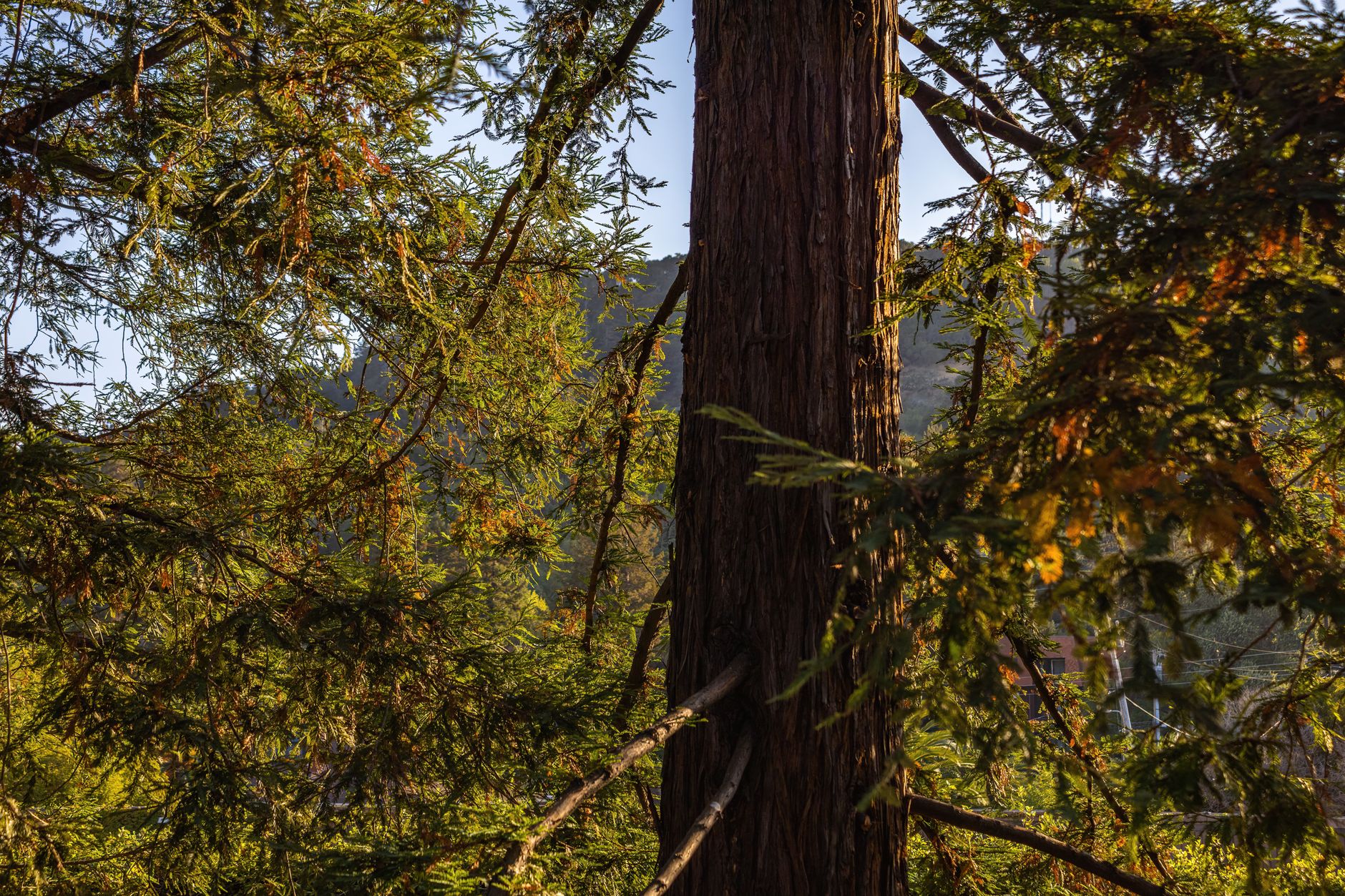
A giant sequoia begins as a seed the size of an oat flake, about 91,000 to the pound, one of roughly 200 packed into a cone that may stay sealed on the tree for 20 years or more12. Fire, a wood-boring beetle, or a Douglas squirrel opens the cone; the seed needs bare mineral soil and sunlight to germinate, and on undisturbed forest floor essentially none survive2. First-summer seedling mortality averages 39 percent, with another 25 percent lost over the following nine months2. Survivors grow fast in height for their first century, slow after 400 years, and stop gaining height near 250 feet somewhere between 800 and 1,500 years of age, after which they keep thickening2. Ring counts on logged stumps exceed 3,200 years, and the trees almost never die of old age; they fall over23.
- Seed size: about 91,000 seeds per pound, each like a flake of oatmeal1
- First cones: at about 20 years of age3
- Cone output at maturity: roughly 1,500 new cones a year, 10,000-30,000 on the tree at once2
- Seedling survival over 7-9 years: 27% on hot-burn patches, 3.5% on other disturbed ground, zero on undisturbed forest floor2
- Diameter by age: 48 cm at 100 years, 132 cm at 400, 219 cm at 800, 427 cm at 2,0002
- Height ceiling: about 250 ft, reached between 800 and 1,500 years2
- Maximum verified age: over 3,200 years by ring count23
- Cause of death: almost always toppling, not disease or fire2
Over a life that can run past three millennia, a giant sequoia needs to produce exactly one surviving offspring to hold its place in the forest1. That single sentence explains the whole strategy: enormous seed output, near-total seedling failure, and an adult phase so long and so well defended that the arithmetic still works. This page walks the sequence from cone to fallen log, with the numbers that scientists have measured at each stage. For the broader picture of the species, start with the giant sequoia trees guide.
Stage 1: The cone and the seed
Giant sequoias are monoecious, carrying male and female cones on the same tree2. The first cones appear at about 20 years of age3. A mature tree produces roughly 1,500 new cones a year and carries 10,000 to 30,000 at any one time2.
Each egg-shaped cone is 2 to 3.5 inches long and holds about 200 seeds2; FEIS puts the figure closer to 2303. The seeds are minute. The NPS describes them as flakes of oatmeal, at about 91,000 to the pound1; the Forest Service gives 200,000 per kilogram, and FEIS gives 81,000 cleaned seeds per pound23. A single mature tree drops 300,000 to 400,000 seeds in a year3.
What makes sequoia cones unusual is that they do not open on their own schedule. They stay green and sealed for 20 years or more, holding viable seed the whole time12. There are three ways they open:
- Fire. Heat rising from a surface fire dries the cones, which crack open and release seed within one to two weeks, onto ground the same fire has just cleared1. A fire can drop about 8 million seeds per acre2.
- The long-horned wood-boring beetle Phymatodes nitidus, most effective in cones four years and older, which chews through the cone’s vascular tissue and cuts off water to the scales2.
- The Douglas squirrel, or chickaree, which prefers cones two to five years old and eats the fleshy green scales rather than the seeds, so most seed falls free24. One animal can go through 3,000 to 3,500 cones a year3.
Between them the beetle and the squirrel keep seedfall running at roughly 400,000 seeds per acre per year, while fire delivers the big pulses2. Wind carries seed only about 600 feet from the parent tree4. More detail is on the giant sequoia cone.
Stage 2: Germination, and why almost nothing germinates
Seed viability depends heavily on where the seed has been. Germination runs 20 to 40 percent for seed taken from green cones and tested at 52 percent for seed from five-year-old cones, but seed lying on the forest floor averages just 1 percent viability2.
Site matters even more than seed quality. Seeds germinate best fully buried in disturbed mineral soil3. First-year seedlings are 30 to 150 times more numerous on disturbed ground than on undisturbed forest floor2. After one high-severity prescribed fire, researchers counted 40,485 seedlings per acre3.
This is why the NPS calls giant sequoias pioneers that need fire intense enough to kill the canopy in small patches, opening sunlit gaps in a shaded forest5. Without it, the species went through widespread reproductive failure across the twentieth century5. The full argument is on why giant sequoias need fire.
Stage 3: The seedling years
Germination is not survival. The Forest Service records first-summer mortality averaging 39 percent, with another 25 percent lost over the next nine months2. Over seven to nine years, survival was 27 percent on hot-burn patches, 3.5 percent on other treated substrates, and zero on undisturbed forest floor2.
Light drives what happens to the survivors. Seedlings growing in grove shade add about 4 centimeters a year between ages seven and ten. Open-grown seedlings in the same period add up to 60 centimeters a year, roughly fifteen times faster2.
Roots reorganize early. A sequoia seedling starts with a taproot, but by six to eight years lateral growth takes over and the taproot stops elongating2. The tree spends the rest of its life without one. See giant sequoia roots for what that means for a 1,400-ton trunk.
Stage 4: Rapid growth, roughly years 10 to 400
Height growth is fastest early. The Forest Service describes it as rapid for at least the first 100 years, slowing after 4002. Diameter follows a slower, steadier curve.
| Age | Typical trunk diameter | Note |
|---|---|---|
| 100 years | 48 cm (1.6 ft) | Height growth still rapid2 |
| 400 years | 132 cm (4.3 ft) | Height growth begins to slow2 |
| 800 years | 219 cm (7.2 ft) | Height approaching its ceiling2 |
| 2,000 years | 427 cm (14 ft) | Volume still increasing2 |
The relationship between diameter and age is loose, and park scientists say so. In the analysis of the 2020 Castle Fire, a 4-foot trunk was put at 200 to 500 years, a 10-foot trunk at a median of 1,000 years with a range of 400 to 2,100, and a 15-foot trunk at a median of 2,000 years with a range of 800 to 3,1006. Two sequoias of identical girth can differ by a thousand years.
By this stage the tree has also built its main defense. Bark reaches up to 18 inches thick, is extremely fibrous, and carries no resin, giving fire resistance better than any species growing alongside it12. Nearly every large sequoia carries black fire scars from surface fires it walked away from1.
Stage 5: Maturity, roughly years 400 to 1,500
Height levels off near 250 feet somewhere between 800 and 1,500 years of age2. The tallest measured giant sequoias run about 310 feet, with the Gymnosperm Database recording a 94.9-meter tree in Redwood Mountain Grove measured in 199827. That is the ceiling. From here on, the tree grows outward. See how tall giant sequoias grow.
Volume growth does not slow. General Sherman, at roughly 2,500 years, adds only about a millimeter of radius per year, but across a trunk that size that works out to 40 to 51 cubic feet of new wood annually2. The NPS frames the same figure as enough wood each year to build a 60-foot oak with a 3-foot trunk8.
Stage 6: Old age, 1,500 to 3,000-plus years
Old sequoias do not wind down. Climbing measurements of the President Tree in Giant Forest, a specimen around 3,200 years old with 247 feet of height and at least 54,000 cubic feet of wood and bark, showed it laying down more new wood each year than vigorous younger trees9. Growth can accelerate in old age.
The upper bound of the lifespan is set by ring counts on stumps rather than living trees, since a tree this size cannot be cored to its center. The Forest Service gives just over 3,200 years for the oldest verified stump, in Converse Basin23. The Gymnosperm Database lists a Converse Basin stump crossdated at 3,266 years, along with counts of 3,220 and 3,075 from Douglass’s early work7. The NPS SEKI page states ages “up to 3,400 years,” the highest figure among official sources1. John Muir once counted about 4,000 rings on a stump; later work corrected that to roughly 3,0007. The measurement problem has its own page: how old giant sequoias get.
Crowns break and tops die. General Sherman has a dead top and is not getting taller2. That is normal for the age class, not a sign of decline.
Stage 7: How a giant sequoia dies
Very little kills a mature sequoia outright. Insects do no serious harm to trees older than about two years within the native range, and decay fungi such as Heterobasidion annosum, Armillaria mellea and Poria species rarely kill a tree on their own2. Few veterans are killed by fire alone2.
What kills them is falling. The Forest Service lists the causes as wind, water-softened soils, stream undercutting, and heavy snow loads acting on an enormous weight carried by shallow roots, with leaning trees and those carrying basal fire scars most at risk2. Fire scars matter twice over: they remove supporting wood and they let decay fungi in2.
That picture has changed slightly in the last decade. Park managers long believed sequoias died only by falling or by crown scorch, but the 2012-2016 drought produced 33 sequoias that died standing1, and the fires of 2020 and 2021 killed mature trees at a scale without precedent. Those developments are covered on are giant sequoias dying.
Stage 8: The log
A fallen sequoia is not finished. The heartwood of downed logs can stay largely intact for thousands of years, because old-growth sequoia wood resists decay even though it is brittle and low in tensile strength2. Fallen trunks in the groves today include logs that hit the ground before the parks existed, and one of them, Tunnel Log, has a road cut through it.
The brittleness that preserves fallen logs is also what defeated the loggers of the 1890s, a story told on why giant sequoia wood is nearly useless for lumber.
Frequently Asked Questions
What is the lifespan of a giant sequoia?
How long does it take a giant sequoia to produce cones?
Do sequoia trees ever stop growing?
They stop growing taller, at around 250 feet, between 800 and 1,500 years old. They never stop adding wood: General Sherman still lays down 40 to 51 cubic feet a year2.
How many sequoia seeds actually become trees?
How do giant sequoias reproduce?
What kills a giant sequoia?
Usually falling over. Wind, saturated soil, snow load, and basal fire scars combine against shallow roots supporting an immense weight. Insects and decay fungi rarely kill a mature tree by themselves2.
How fast does a giant sequoia grow when young?
Fast in the open and slowly in shade. Seedlings in grove shade add about 4 cm a year at ages seven to ten; open-grown seedlings add up to 60 cm a year over the same period2.
Related Articles
Sources
- Giant Sequoias — National Park Service, Sequoia & Kings Canyon. Accessed 2026-09-09.
- Sequoiadendron giganteum, Silvics of North America — U.S. Forest Service. Accessed 2026-09-09.
- FEIS: Sequoiadendron giganteum — U.S. Forest Service, Fire Effects Information System. Accessed 2026-09-09.
- Fallen Green Cones of the Giant Sequoia — National Park Service, Yosemite. Accessed 2026-09-09.
- Giant Sequoias and Fire — National Park Service. Accessed 2026-09-09.
- Wildfires Kill Unprecedented Numbers of Large Sequoia Trees — National Park Service. Accessed 2026-09-09.
- Sequoiadendron giganteum — The Gymnosperm Database. Accessed 2026-09-09.
- The General Sherman Tree — National Park Service. Accessed 2026-09-09.
- Forest Giant — National Geographic, December 2012. Accessed 2026-09-09.