
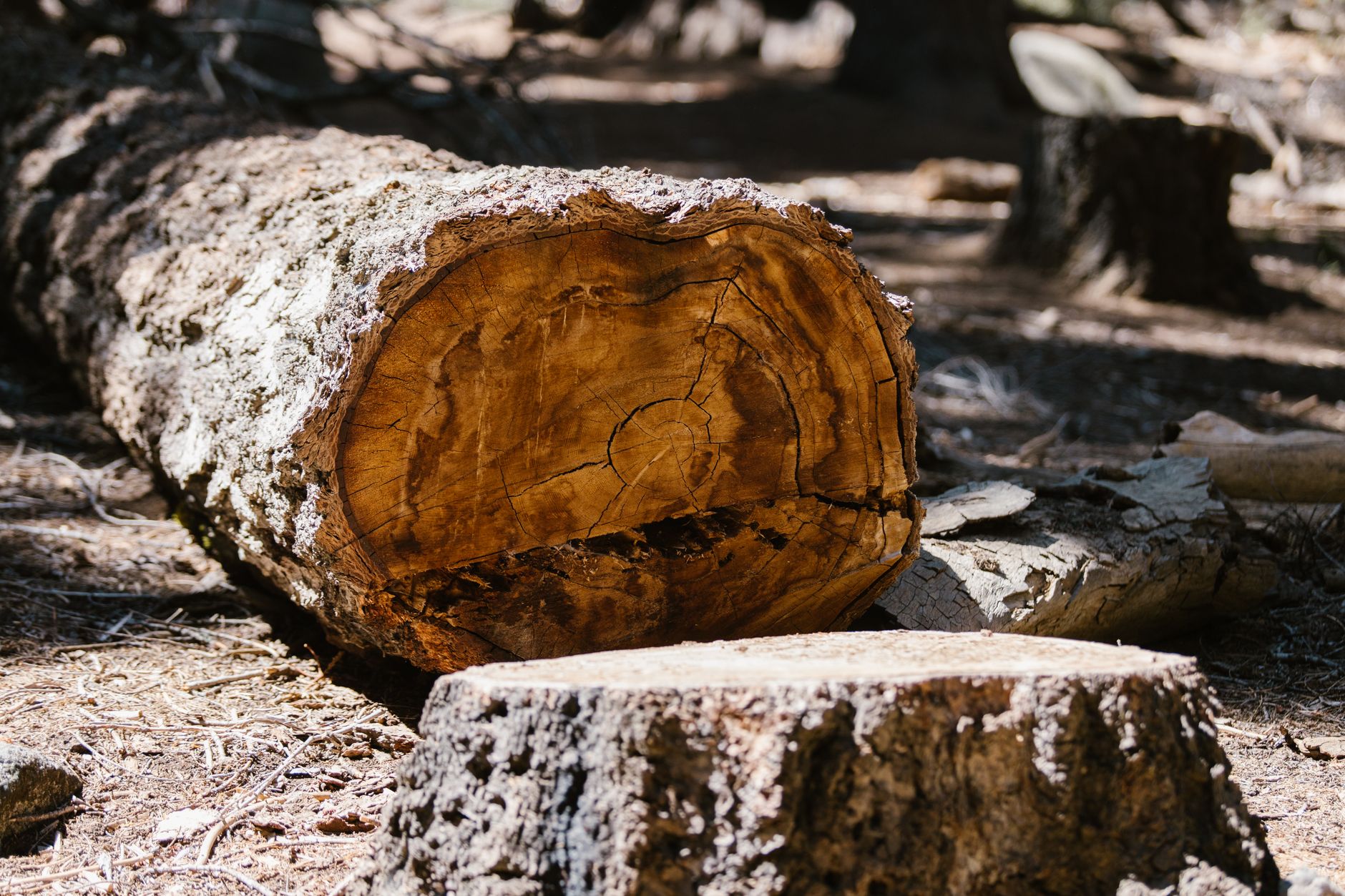
Old-growth giant sequoia wood is brittle and has low tensile strength, which makes it a poor structural timber despite the enormous volume in a single trunk12. Commercial harvest ran from the 1850s to the mid-1950s, and the main products were fence posts, shingles, and pencils rather than framing lumber2. The largest operation, in Converse Basin, cut most of what was then the world’s largest sequoia grove between 1892 and 1918, and according to the Forest Service “the operation never produced a profit for the operators”34. Perhaps 60 large specimens survive there out of thousands4. General Sherman alone is estimated to contain about 630,000 board feet, enough to frame roughly 120 average houses, a figure nobody will ever test5.
- Wood properties: brittle, low tensile strength in old growth; young growth resembles young coast redwood1
- Harvest period: 1850s to the mid-1950s2
- Typical products: fence posts, shingles, pencils2
- Converse Basin: about 4,666 acres, logged 1892-1918, roughly 60 large trees left4
- Profit: none3
- Durability: the heartwood of fallen logs can stay largely intact for thousands of years1
- Outcome: Sequoia National Park was created on September 25, 1890, the first national park established to protect a living organism6
The giant sequoia is the largest tree on Earth by volume, and for a few decades in the nineteenth century that fact read as a business plan. It was not one. The wood that makes the trees enormous is also what makes them close to worthless as structural timber, and the largest logging operation ever mounted against them lost money while destroying a grove that cannot be replaced within a human timescale. This page covers what sequoia wood is actually like, what it was used for, and how the 1890s ended. The species overview is on the giant sequoia trees pillar page.
What is wrong with sequoia wood
Two Forest Service references say the same thing in almost the same words. The silvics manual describes old-growth giant sequoia wood as brittle with low tensile strength, and notes that young-growth wood is different, resembling young coast redwood1. The Fire Effects Information System summary lists the same pair of defects: “low tensile strength and brittleness” in old growth2.
Tensile strength is what a beam needs. A timber that will not hold under tension cannot carry a floor or a roof span, no matter how much of it there is. That is the whole problem in one line.
The wood does have one outstanding property: it does not rot. The heartwood of fallen sequoia logs can stay largely intact for thousands of years1. That durability is why the products that made economic sense were the ones exposed to weather and cut small, where brittleness does not matter and rot resistance does.
What sequoia wood was actually used for
FEIS lists the commercial products of the harvest era as fence posts, shingles, and pencils2. Grape stakes and roofing shakes belong to the same category: small, split, weather-exposed, and undemanding.
The contrast with the volume available is absurd. The NPS estimates General Sherman’s trunk at about 630,000 board feet, enough lumber to frame roughly 120 average houses5. What a tree that size actually yielded, once it had been felled and broken down, was a fraction of that in fence posts.
The harvest era, 1850s to the 1950s
Commercial cutting of giant sequoias ran from the 1850s to the mid-1950s2. It began, effectively, as a stunt.
In spring 1853, Captain William H. Hanford set out to profit from the Calaveras grove that Augustus T. Dowd had publicized the year before. The Discovery Tree was brought down with pump augers and chisels because no saw was big enough; the job took three weeks, and the tree fell on June 27, 18537. Its 27-foot stump then hosted dances, concerts, lectures, and weddings, and the Mammoth Tree Hotel followed in 1853-547. The wood was incidental. The spectacle was the product.
The same logic produced the exhibition trees. The Mother of the Forest at Calaveras had its bark stripped for exhibition; the tree survived the operation and still stands as a snag8. In 1891 the Army cut the Mark Twain Tree in Big Stump Grove, 16 feet in diameter, so slabs could be shown to crowds in New York and London9. The General Noble Tree in Converse Basin was cut into sections, numbered, shipped, and reassembled at the Chicago World’s Fair, where skeptical visitors dismissed it as the “California Hoax”10. The Forest Service dates that cutting to 1893 on one page and 1897 on others; the World’s Columbian Exposition itself was held in 189311410. The stump is still there, and it is still called the Chicago Stump.
John Muir, writing from 1876 onward, warned that “only fire and the ax” threatened the species12. The ax was winning.
Converse Basin: the largest operation, and the one that failed
Converse Basin, about 4,666 acres, was once the largest giant sequoia grove in the world4. Between 1892 and 1918 most of its giants were cut4. The Forest Service’s account of the outcome is one sentence long: “the operation never produced a profit for the operators”3.
The infrastructure was the expensive part. Flumes introduced in 1889 let the Kings River Lumber Company, run by Moore and Smith, move timber out of country that had no other way to reach a mill13. At nearby Big Stump, Joseph H. Thomas arrived in 1862 and Smith Comstock ran a mill from 1883, hiring Italian and Chinese laborers in San Francisco13.
By 1908 the basin had been thoroughly logged11. What survives is a landscape of stumps. Perhaps 60 large specimens remain out of thousands4, and Stump Meadow’s stumps include the oldest ring-counted sequoia on record at just over 3,200 years410. Thousands of second-growth sequoias, now around a century old, have grown up among them4.
Two trees escaped. The Boole Tree, 269 feet tall and the largest tree standing in any national forest, was named around 1895 by the Fresno doctor A. H. Sweeny after Franklin A. Boole, the logging supervisor credited with sparing it; it was considered the world’s largest tree until 1931, and it is the last big sequoia in the basin to have stood continuously since the 1890s14. The 1955 McGee Fire later burned most of the grove10.
The full account of the grove is on Converse Basin, and the Boole Tree has its own page: the largest giant sequoia outside the national parks.
Why the numbers never worked
Nothing in the surviving Forest Service and Park Service record adds up to a viable business, and the pieces are worth listing plainly:
- The product was low-value. Fence posts, shingles, and pencils, from a timber that could not be sold as structural lumber2.
- The wood was brittle. Old-growth sequoia has low tensile strength, ruling out the highest-value uses12.
- The trees were enormous and remote. Felling, bucking, and moving trunks 15 to 20 feet in diameter out of the western Sierra required flumes and mills built from scratch13.
- The grove was finite. Converse Basin took 26 years to cut and cannot regrow to old growth within any planning horizon; the second growth there is about a century old and nowhere near mature4.
The Forest Service’s own history page reaches the conclusion without hedging3. Converse Basin was the most extensive giant sequoia logging operation ever mounted, and it lost money.
What the failure changed
Sequoia National Park was signed into law by President Benjamin Harrison on September 25, 1890, the second national park in the United States and the first created to protect a living organism6. General Grant National Park followed a week later and remained separate until 1940, when Kings Canyon National Park absorbed it6. The lands are the homelands of the Mono (Monache), Yokuts, Tübatulabal, Paiute, and Western Shoshone6. That sequence is covered on the history of Sequoia National Park.
Protection outside the parks came far later. Converse Basin passed to the Forest Service in 1935, and Giant Sequoia National Monument was proclaimed on April 15, 2000, after which the remaining unprotected groves came under federal protection3.
The trees themselves keep their own record of the era. A cut stump is a dated cross-section, and the ring counts taken from Converse Basin stumps produced the oldest verified sequoia ages known410. Ellsworth Huntington measured rings on 458 stumps in 1911-12, mostly in Converse Basin, for climate research, and the dataset is still archived by the USGS15. The science of sequoia longevity rests substantially on trees that were killed for fence posts.
Frequently Asked Questions
Is sequoia wood used for lumber?
Why is giant sequoia wood so weak?
The defect is tensile strength. Silvics of North America describes old-growth wood as brittle with low tensile strength, which rules out the structural uses that make a timber valuable. Young-growth sequoia wood is different and resembles young coast redwood1.
Does sequoia wood rot?
Very slowly. The heartwood of fallen sequoia logs can stay largely intact for thousands of years, which is why the wood suited weather-exposed products such as posts and shingles1.
Did anyone make money logging giant sequoias?
How many giant sequoias were cut down?
No single verified total exists across all groves. In Converse Basin alone, thousands of large trees were cut and perhaps 60 large specimens survive4.
What is the Chicago Stump?
When did logging of giant sequoias stop?
Related Articles
Sources
- Sequoiadendron giganteum, Silvics of North America — U.S. Forest Service. Accessed 2026-09-09.
- FEIS: Sequoiadendron giganteum — U.S. Forest Service, Fire Effects Information System. Accessed 2026-09-09.
- Discover History, Sequoia National Forest — U.S. Forest Service. Accessed 2026-09-09.
- Converse Basin Grove — U.S. Forest Service, Sequoia National Forest. Accessed 2026-09-09.
- The General Sherman Tree — National Park Service. Accessed 2026-09-09.
- History & Culture — National Park Service, Sequoia & Kings Canyon. Accessed 2026-09-09.
- Big Trees, Early Years — Calaveras Heritage Council. Accessed 2026-09-09.
- Calaveras Big Trees State Park Fact Sheet (PDF) — California State Parks. Accessed 2026-09-09.
- Big Stump — National Park Service. Accessed 2026-09-09.
- Converse Basin Grove brochure, 2025 (PDF) — U.S. Forest Service. Accessed 2026-09-09.
- Giant Sequoia National Monument, North — U.S. Forest Service. Accessed 2026-09-09.
- Preserving a “Big Tree” — National Park Service, John Muir National Historic Site. Accessed 2026-09-09.
- Sequoia–Kings Canyon National Parks: A History of the Parks (PDF) — A. Berle Clemensen, National Park Service, 1975. Accessed 2026-09-09.
- Boole Tree — U.S. Forest Service, Sequoia National Forest. Accessed 2026-09-09.
- Ellsworth Huntington’s 1914 Giant Sequoia Ages and Tree-Ring Measurements, 458 Stumps — U.S. Geological Survey. Accessed 2026-09-09.