
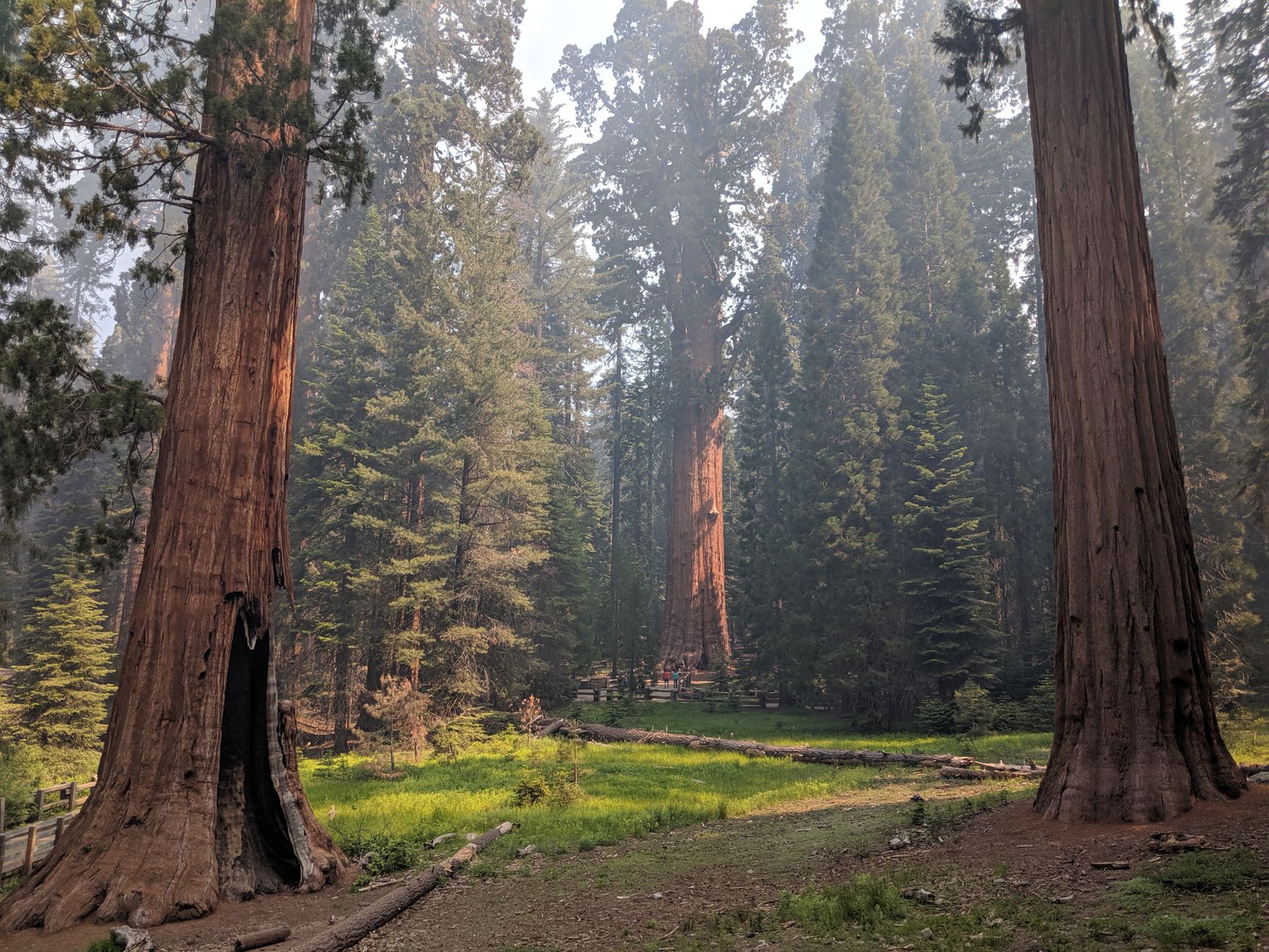
A giant sequoia standing 275 feet tall and weighing close to 1,400 tons is held up by roots that rarely go deeper than 3 feet (1 m) into the soil, with most feeder roots concentrated in the top 2 feet (0.6 m)1. What the roots lack in depth they make up in reach: mature root systems extend 100 feet (30 m) or more from the trunk and occupy 0.7 acre (0.3 ha) or more of ground, often intertwining with the roots of neighboring sequoias12. Seedlings start life with a taproot, but by 6 to 8 years of age lateral growth takes over and the taproot stops elongating for good1. Because the anchoring system is so shallow relative to the tree’s mass, toppling from wind, saturated soil, or heavy snow load has historically been considered the primary way large giant sequoias die, a belief only recently complicated by drought-driven bark beetle deaths13. This page covers root depth and spread, why these trees fall instead of simply dying of old age, and why soil compaction from vehicles and foot traffic became serious enough to reshape how the Giant Forest is managed.
- Maximum typical root depth: rarely more than 3 ft (1 m); most feeder roots in the top 2 ft (0.6 m)1
- Root spread: 100 ft (30 m) or more from the trunk12
- Root system footprint: 0.7 acre (0.3 ha) or more per mature tree1
- Taproot: present in seedlings only; lateral roots dominate by age 6-8 and the taproot stops elongating1
- Largest lateral roots: seldom more than 1 ft (0.3 m) thick1
- Main cause of death, historically believed: toppling, from wind, water-softened soil, stream undercutting, or snow load acting on a shallow root system1
- A newer cause: 33 giant sequoias documented dying standing, from native bark beetles during the 2012-2016 drought, nearly all with prior fire scars3
- Documented threat to roots: cutting mature sequoia roots for construction has been shown to slow tree growth, and decades of vehicle and foot traffic compacted, eroded, and degraded soil across Giant Forest4
The tallest trees at Giant Sequoia Trees are anchored by root systems that barely reach the depth of a basement, a mismatch between height and foundation that would topple almost any other structure. Giant sequoias manage it by trading depth for width, spreading a wide, shallow web of roots that grips a large volume of soil rather than boring straight down. This page covers what is known about that root system: how deep it goes, how far it spreads, why it makes toppling the leading historical cause of death for these trees, and why soil compaction near the roots became enough of a problem that the National Park Service tore out roads and buildings to fix it.
How deep do giant sequoia roots go
Not very. The U.S. Forest Service’s silvics manual for the species states that few giant sequoia roots go deeper than 1 meter (about 3 feet), and that most of the tree’s feeder roots, the fine roots that actually absorb water and nutrients, sit within the top 0.6 meters (roughly 2 feet) of soil1. Save the Redwoods League describes the same pattern more plainly: giant sequoias have no deep taproot at maturity2. That is a striking number set against a tree that can top 275 feet and weigh nearly 1,400 tons. For comparison, a modest oak or maple often anchors itself with roots reaching several times deeper relative to its size. A giant sequoia’s stability comes almost entirely from lateral spread rather than vertical penetration.
Why there is no taproot in a mature tree
Giant sequoia seedlings do start life with a taproot, the same way most conifers do. The silvics manual notes that this taproot elongates for the tree’s first several years, but by around age 6 to 8 lateral root growth takes over entirely and the taproot stops extending1. From that point on, the tree’s whole support system is lateral: a spreading network of roots radiating out from the trunk rather than a single anchor driving down. This shift happens early enough that by the time a sequoia is old enough to be visibly large, it has already committed to the shallow, wide architecture it will keep for the rest of its life, whether that life lasts decades or three millennia.
How far the roots spread
What the roots give up in depth, they make up for in reach. The silvics manual reports that a mature giant sequoia’s root system extends 30 meters (about 100 feet) or more from the trunk and occupies 0.3 hectares (roughly 0.7 acre) of ground or more1. Save the Redwoods League gives the same 100-foot figure and adds a detail that matters for how groves function as a unit: sequoia roots spread out far enough to intertwine with the roots of neighboring trees2. A grove is not simply a collection of individually rooted trees standing near each other; below ground, the root systems of adjacent giant sequoias overlap and interconnect, which likely adds some collective stability even though each individual tree’s own roots stay shallow. The largest of these lateral roots are still modest in cross-section: the silvics manual notes they are seldom more than 0.3 meters (about 1 foot) thick even at the base, thin compared to a trunk that can exceed 30 feet across1.
Toppling: the traditional main cause of death
A tree this tall, this heavy, and rooted this shallowly is vulnerable in a specific way: it is far more likely to fall over than to rot from within or simply die of age. The silvics manual attributes toppling to a combination of forces acting on that shallow root system, including wind, soil that has been softened and weakened by water, undercutting from streams, and heavy snow loads, with leaning trees and trees carrying basal fire scars especially at risk1. A fire scar at the base does more than disfigure the trunk; it removes structural wood and creates an entry point for decay fungi, including species the silvics manual names specifically, Heterobasidion annosum, Armillaria mellea, and Poria species, which rarely kill a sequoia outright but weaken the root collar and trunk base enough to contribute to eventual failure1. The bark’s own resistance to fire, covered in the giant sequoia bark guide, only slows how quickly that damage accumulates; it does not prevent it, and nearly every large old-growth sequoia carries some fire-scar history by the time it dies.
For years, this was understood as close to the entire story: a giant sequoia died by falling, or by fire severe enough to kill it outright, and not much else. The National Park Service states plainly that managers long believed sequoias died only by falling or by crown scorch3. That assumption held until the 2012-2016 drought, one of the most severe in the park’s recorded 122-year history, produced something new: 33 giant sequoias were documented dying standing, upright, killed by native Phloeosinus bark beetles rather than by toppling or fire3. Nearly all of the affected trees carried existing basal fire scars, the same structural weak point that predisposes a tree to falling, suggesting that a scarred tree is vulnerable on more than one front even when it manages to stay upright. What that shift means for the species’ overall survival is covered in are giant sequoias dying.
Soil compaction and why it matters to the roots
Because so much of a giant sequoia’s root mass sits in the top two feet of soil, activity at ground level around a tree’s base has an outsized effect on its health, a fact the National Park Service learned the hard way in Sequoia National Park’s own Giant Forest. For nearly a century, the area around the park’s largest and most visited sequoias carried motels, cabins, a store, employee housing, and paved roads and parking lots built directly among the trees. The Park Service’s own account of the resulting damage states that constructing those roads and lots required pruning sequoia roots outright, and that cutting mature sequoia roots, even for something as routine as replacing underground utility lines, has been shown to decrease the growth rate of mature giant sequoias4. Beyond direct root cutting, decades of vehicle traffic and visitor trampling compacted, eroded, and degraded the soil across the developed area, a condition the Park Service found was also preventing the natural germination and reestablishment of grasses, wildflowers, shrubs, and tree seedlings in the understory4.
The scale of the eventual fix reflects how seriously the Park Service treated the problem. Beginning in the 1990s, the agency demolished 282 buildings and restored 231 acres of Giant Forest, removing roads, cabins, and parking lots and relocating overnight lodging outside the grove entirely to what is now Wuksachi Lodge. During the demolition itself, crews used specific techniques to avoid repeating the original damage: metal sheeting was placed over exposed and shallow root zones to spread out the weight of heavy equipment and prevent wheel damage, travel routes for machinery were designated in advance on contract drawings specifically to constrain where equipment could drive and minimize new soil compaction, and old underground water and sewer lines were pulled out horizontally rather than dug up and lifted, avoiding the kind of excavation that would have cut through shallow roots5. That history is also why the trails that remain through the groves today, including the paved and boardwalk sections of routes like the Congress Trail, keep visitors on a fixed, hardened path rather than allowing foot traffic to spread across the open forest floor: the same compaction that damaged Giant Forest under a century of cars and buildings can happen just as surely under enough uncontrolled footsteps.
Frequently Asked Questions
How deep do giant sequoia roots go?
Rarely more than 3 feet (1 m), with most of the tree’s active feeder roots concentrated in the top 2 feet (0.6 m) of soil, according to the U.S. Forest Service’s silvics manual for the species1.
How far do giant sequoia roots spread?
Do giant sequoias have a taproot?
Why do giant sequoias fall over instead of dying of old age?
Their root systems are shallow relative to their height and weight, so wind, water-saturated soil, stream undercutting, and heavy snow load can topple even a very large, otherwise healthy tree. Trees with fire scars at the base are especially vulnerable because the scars remove structural wood and let in decay fungi1.
Can a giant sequoia die standing up, without falling or burning?
Yes, though it was considered rare until recently. During the severe 2012-2016 drought, 33 giant sequoias were documented dying standing, killed by native bark beetles rather than by toppling or fire, a phenomenon the National Park Service had not previously recorded at this scale3.
Do neighboring giant sequoias' roots grow into each other?
Yes. Because root systems spread 100 feet or more from each trunk, the roots of sequoias growing near one another intertwine underground, according to Save the Redwoods League2.
Why is soil compaction dangerous for giant sequoia roots?
Because so much of the root system sits within the top two feet of soil, compaction from vehicle traffic or heavy foot traffic directly damages the zone the tree depends on most. In Sequoia National Park’s Giant Forest, decades of roads, parking lots, and trampling compacted and degraded soil badly enough that the National Park Service eventually demolished 282 buildings and restored 231 acres to reverse the damage4.
Why do paved trails and boardwalks exist in the sequoia groves?
Keeping visitors on a fixed, hardened path prevents the kind of widespread soil compaction that damaged Giant Forest under a century of uncontrolled vehicle and foot traffic. The National Park Service’s own restoration work used similar logic in reverse, designating specific equipment routes and shielding root zones during demolition specifically to limit new compaction45.
Related Articles
Sources
- Sequoiadendron giganteum, Silvics of North America — U.S. Forest Service. Accessed 2026-09-09.
- Giant Sequoias — Save the Redwoods League. Accessed 2026-09-09.
- Giant Sequoias Face New Threats — National Park Service. Accessed 2026-09-09.
- Impact of Development — National Park Service, Sequoia & Kings Canyon. Accessed 2026-09-09.
- Demolition of Giant Forest Development — National Park Service, Sequoia & Kings Canyon. Accessed 2026-09-09.