
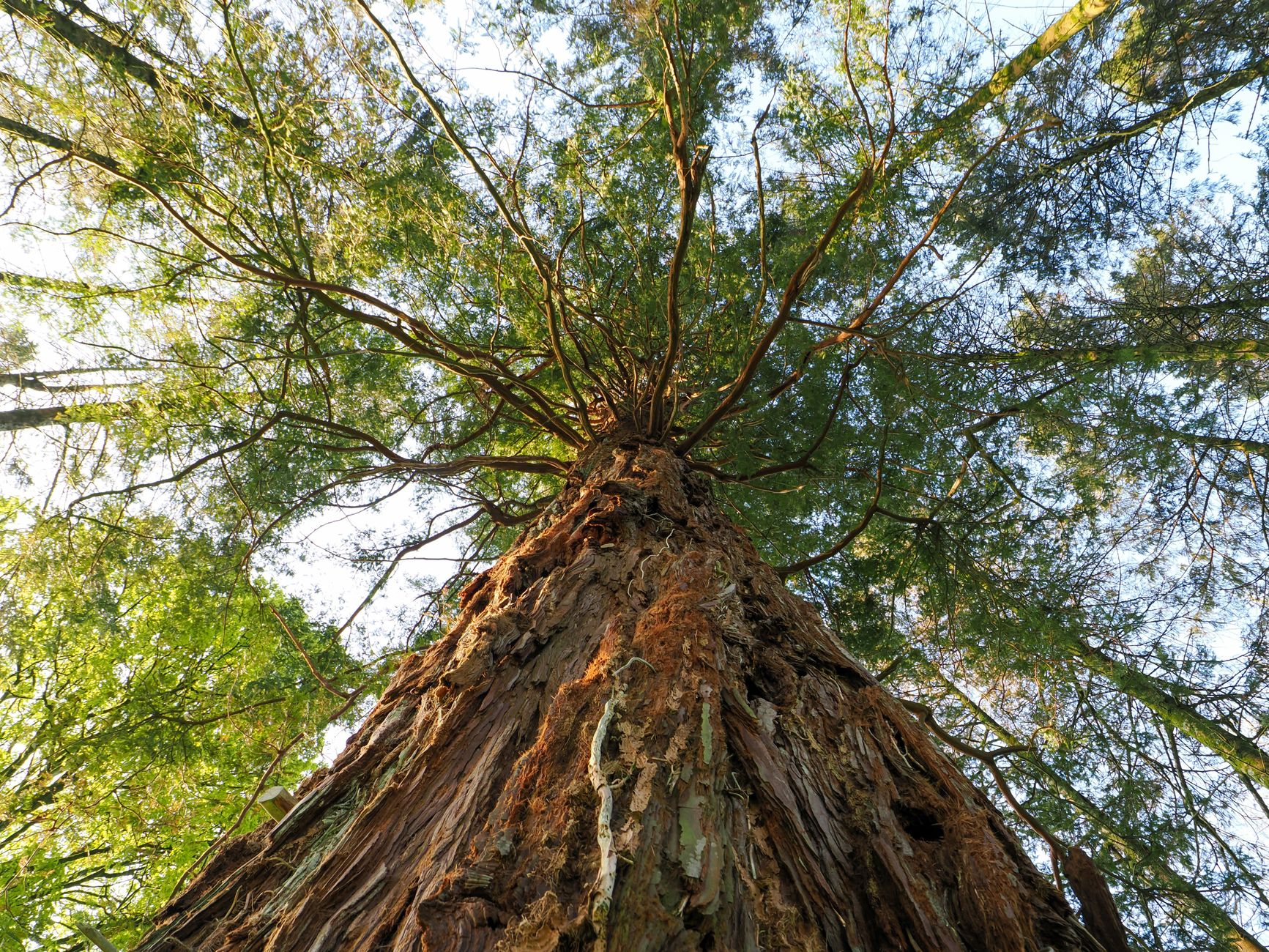
Giant sequoias (Sequoiadendron giganteum) typically stand 250 to 275 feet (76 to 84 m) tall, and the tallest known reaches about 310 feet: the U.S. Forest Service records 94.5 m (310 ft), and the Gymnosperm Database lists a 94.9 m (311 ft) tree in Redwood Mountain Grove measured in 199812. That is well short of the coast redwood, whose tallest specimen, Hyperion, is 380 feet3. Sequoias are the biggest trees by trunk volume rather than height: the General Sherman Tree is 274.9 feet tall but holds about 52,500 cubic feet of wood on a base 36.5 feet across4. Height growth is rapid for the first century, slows after 400 years, and levels off near 250 feet between 800 and 1,500 years of age, while the trunk keeps thickening for the rest of the tree’s life1.
- Typical height: 250–275 ft (76–84 m)5
- Record height: 310–311 ft (94.5–94.9 m); Save the Redwoods League says “more than 316 feet”126
- General Sherman: 274.9 ft tall, 36.5 ft across at the base, 52,500 cu ft4
- Typical diameter: 15–20 ft; record about 35 ft5
- Height plateau: near 250 ft at 800–1,500 years1
- Tallest tree of any kind: coast redwood Hyperion, 380 ft3
- Annual wood gain for a big tree: about 40 cu ft, the volume of a 50-ft tree one foot thick7
People walk up to a giant sequoia expecting to be impressed by its height and end up staring at its width. Giant sequoias are tall, among the tallest trees on the planet, but they hold no height record. What they hold is the record for the most wood in a single trunk. This page gives the height numbers, explains the growth curve from seedling to plateau, sets out why the species grows so large, and answers the question that follows: why sequoias are not taller than coast redwoods. It is part of the guide to giant sequoia trees.
How tall giant sequoias get
The Forest Service describes mature giant sequoias as typically 250 to 275 feet tall, with an average trunk diameter of 15 to 20 feet at breast height and a record diameter of about 35 feet5. The tallest verified sequoias:
| Measurement | Height | Source |
|---|---|---|
| Greatest known height (Forest Service) | 94.5 m (310 ft) | Silvics manual1 |
| Tallest measured individual | 94.9 m (311 ft), Redwood Mountain Grove, measured August 1998 | Gymnosperm Database2 |
| Species maximum (Save the Redwoods League) | “more than 316 feet” | SRL6 |
| General Sherman | 274.9 ft (83.8 m) | NPS4 |
| General Grant | 268.1 ft (88.7 m) | NPS8 |
| Diamond Tree, Atwell Grove | 286 ft, the tallest on the NPS Top Thirty list | NPS7 |
| Boole Tree, Converse Basin | 268.8 ft | NPS7 |
Official sources disagree on the record by a few feet, between 310 and “more than 316.” The 310 to 311 range comes from measured individuals; the SRL figure is not tied to a named tree in its source. None of the thirty largest sequoias by volume exceeds 286 feet, which shows how little height has to do with size in this species7.
For scale, the NPS says the largest sequoias are as tall as an average 26-story building7. The Statue of Liberty is 305 feet from the ground to the tip of its torch, so a record sequoia would overtop it9. General Sherman would not, but it is 2.5 times the height of the statue figure itself, which is 111 feet from heel to head94.
The growth curve: fast, then wide
Giant sequoias grow upward quickly when young. On good sites, the Forest Service reports, rapid height growth continues for at least 100 years; it declines beyond 400 years and levels off near 76 m (250 ft) at an age of 800 to 1,500 years1. Young plantation trees add 1.6 to 2.3 feet of height a year10.
After the plateau, growth goes into the trunk. Typical diameters run 48 cm (19 in) at 100 years, 132 cm (52 in) at 400, 219 cm (86 in) at 800, and 427 cm (168 in) at 2,000 years1. General Sherman, roughly 2,200 years old, adds only about a millimeter of radius a year, but spread over a trunk that size that is 40 to 51 cubic feet of new wood annually111. The NPS describes a large sequoia’s yearly gain as about 40 cubic feet, equal to a 50-foot tree one foot in diameter7.
Old age does not slow this down. When Steve Sillett’s team climbed and measured the President in Giant Forest, a tree about 3,200 years old and 247 feet to its dead spire, they found it producing more new wood each year than vigorous younger trees12. See is General Sherman still growing.
Why giant sequoias get so big
No single trait explains it. Several stack up.
They live long enough. Ring counts on sequoia stumps exceed 3,200 years, and the NPS puts the species’ maximum at up to 3,400113. A tree that adds 40 cubic feet a year for two millennia ends up with tens of thousands of cubic feet. See how old giant sequoias get.
Almost nothing kills them before they fall. Bark up to 18 inches to 2 feet thick, fibrous and non-resinous, gives fire resistance superior to any neighboring species1351. Within the native range, insects do no serious harm to trees older than about two years, and decay fungi rarely kill a tree outright1. Historically, a big sequoia died by falling, not by disease.
They keep growing. Most trees slow their wood production with age. Sequoias do not; the President’s growth rate rose in old age12.
The site is generous. The NPS credits the mid-Sierra zone’s mild temperatures, deep winter snowpack, and long fire history for letting the species reach its greatest size in Sequoia and Kings Canyon7. The groves receive 35 to 55 inches of precipitation a year, most of it as 144 to 197 inches of snow that melts slowly into deep, well-drained soils1. Grant Grove packs an unusual share of trees 10 to 20 feet in diameter into about 90 acres, and Giant Forest holds more exceptionally large sequoias than any other grove14.
The trunk hardly tapers. General Sherman is 36.5 feet across at the base and still 17 feet across at 120 feet up, above the height most trees ever reach415. That column shape is why a 275-foot sequoia contains more wood than a 380-foot redwood.
Why sequoias are not taller than coast redwoods
The two species have chosen, in evolutionary terms, different shapes. Coast redwoods grow in a fog belt with about 70 inches of rain a year and fog that supplies around 40 percent of their moisture, and they climb to 367 to 380 feet on a trunk up to about 20 to 22 feet wide16173. Giant sequoias grow inland with dry summers, where less than 30 mm (about an inch) of rain falls from June through September and the trees live on snowmelt stored in the soil1.
What the record shows is that sequoia height stops climbing near 250 feet after 800 to 1,500 years, while the trunk keeps thickening for another thousand years or more1. Many old sequoias, including the President, carry dead tops, and the NPS notes that even for coast redwoods “tallest” status is temporary because crowns break1218. The most direct physiological explanation, that water cannot be lifted indefinitely against gravity and that leaves at the top of very tall trees run short, is discussed in the tree-height literature, but it is not stated in the sources this page relies on and is left out here. What can be said with sources is this: the sequoia’s size is a volume record built over 3,000 years on a trunk that barely tapers, and the redwood’s is a height record built in a wetter climate on a slimmer trunk.
The two record holders are compared head to head on Hyperion vs General Sherman, and every difference between the species is on sequoia vs redwood.
How height relates to volume
The NPS Top Thirty list ranks sequoias by trunk volume only, without branches, foliage, or roots7. On that list, taller does not mean bigger:
| Tree | Height (ft) | Trunk volume (cu ft) |
|---|---|---|
| General Sherman | 274.9 | 52,508 |
| Diamond (Atwell Grove) | 286 | 35,292 |
| Hart (Redwood Mountain) | 277.9 | 34,407 |
| Grizzly Giant (Mariposa Grove) | 209 | 34,005 |
Source: NPS7. The Grizzly Giant is 77 feet shorter than the Diamond Tree and holds nearly the same volume. Full rankings are on the largest giant sequoias.
Frequently Asked Questions
What is the tallest sequoia tree?
How tall is the General Sherman Tree?
274.9 feet (83.8 m), with a base diameter of 36.5 feet4. It is the largest tree by volume, not the tallest.
Are sequoias taller than redwoods?
Why are sequoia trees so big?
How fast do giant sequoias grow in height?
Do sequoias ever stop growing taller?
Yes. Height levels off near 250 feet at 800 to 1,500 years, after which growth goes into the trunk1.
How wide is a giant sequoia?
Related Articles
Sources
- Sequoiadendron giganteum, Silvics of North America — U.S. Forest Service. Accessed 2026-09-06.
- Sequoiadendron giganteum — The Gymnosperm Database. Accessed 2026-09-06.
- Coast Redwoods — Save the Redwoods League. Accessed 2026-09-06.
- The General Sherman Tree — National Park Service, Sequoia & Kings Canyon. Accessed 2026-09-06.
- Sequoiadendron giganteum, Fire Effects Information System — U.S. Forest Service. Accessed 2026-09-06.
- Giant Sequoias — Save the Redwoods League. Accessed 2026-09-06.
- The Largest Trees in the World — National Park Service. Accessed 2026-09-06.
- The General Grant Tree — National Park Service. Accessed 2026-09-06.
- Statue Statistics — National Park Service, Statue of Liberty. Accessed 2026-09-06.
- Giant Sequoia (Sequoiadendron giganteum) — University of California Agriculture and Natural Resources. Accessed 2026-09-06.
- General Sherman Tree (place page) — National Park Service. Accessed 2026-09-06.
- Forest Giant — National Geographic, December 2012. Accessed 2026-09-06.
- Giant Sequoias — National Park Service, Sequoia & Kings Canyon. Accessed 2026-09-06.
- Exploring Giant Sequoia Groves — National Park Service. Accessed 2026-09-06.
- Frequently Asked Questions — National Park Service, Sequoia & Kings Canyon. Accessed 2026-09-06.
- Sequoia sempervirens, Fire Effects Information System — U.S. Forest Service. Accessed 2026-09-06.
- About the Trees — National Park Service, Redwood National and State Parks. Accessed 2026-09-06.
- Hyperion — National Park Service, Redwood National and State Parks. Accessed 2026-09-06.