
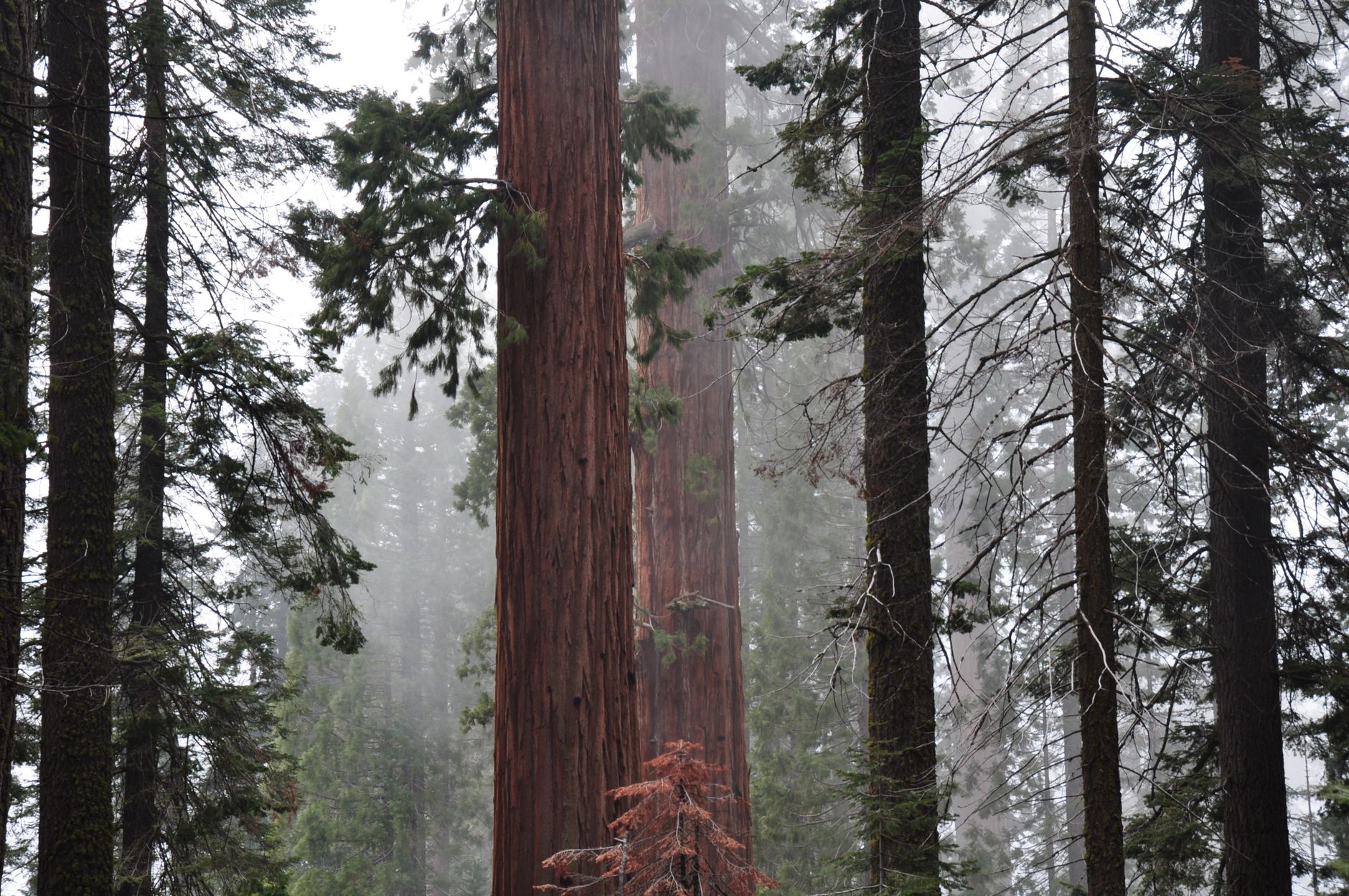
Giant sequoias and coast redwoods are different species in different places. The giant sequoia (Sequoiadendron giganteum) grows only on the west slope of California’s Sierra Nevada, at 4,600 to 7,050 feet, and is the largest tree on Earth by volume: General Sherman holds about 52,500 cubic feet of trunk12. The coast redwood (Sequoia sempervirens) grows in a foggy strip 450 miles long and 5 to 35 miles wide along the Pacific coast, from sea level to 3,000 feet, and is the tallest tree on Earth: Hyperion reaches 380 feet34. Sequoias live longer (ring counts over 3,200 years versus over 2,200), have thicker bark (up to 2 feet versus 12 inches), and reproduce only from seed, while redwoods resprout from stumps and burls1356.
- Biggest by volume: giant sequoia, 52,500 cu ft for General Sherman2
- Tallest: coast redwood, 380 ft for Hyperion4
- Oldest: giant sequoia, ring counts over 3,200 years15
- Bark: sequoia up to 2 ft; redwood up to 12 in53
- Range: Sierra Nevada groves totaling 35,607 acres vs a coastal belt about 450 mi long53
- Water source: Sierra snowpack vs coastal fog, which supplies about 40 percent of a redwood’s moisture76
- Reproduction: sequoia by seed only; redwood by seed and by sprouting56
“Sequoia” and “redwood” get used as if they were one tree. They are two, and the confusion is old: the coast redwood carries the genus name Sequoia, while the giant sequoia was moved into its own genus, Sequoiadendron, in 19398. This page lays out every measurable difference between them, then explains what those differences mean when you stand under each one. It is part of the site’s guide to giant sequoia trees.
The comparison table
| Giant sequoia | Coast redwood | |
|---|---|---|
| Scientific name | Sequoiadendron giganteum8 | Sequoia sempervirens3 |
| Height | Typically 250–275 ft; record 310–311 ft18 | Record 380 ft (Hyperion); NPS cites 367 ft46 |
| Trunk volume | Largest on Earth: General Sherman 52,500 cu ft (1,487 m³)2 | Far less; the President sequoia alone is “far more massive than any coast redwood”9 |
| Diameter | Average 15–20 ft; record about 35 ft5 | Up to 20 ft; NPS cites a 22-ft base36 |
| Age | Ring counts of 3,200–3,266 years; NPS says up to 3,4001810 | Greater than 2,200 years; 600 is routine36 |
| Bark | Fibrous, reddish-brown, up to 18 in to 2 ft thick105 | Thick and fibrous, up to 12 in34 |
| Cones | Egg-shaped, 2–3.5 in, about 200 seeds each; stay closed 20+ years110 | Small; seeds “no bigger than one from a tomato”6 |
| Seeds per pound | About 91,00010 | About 120,0003 |
| Needles | Scale-like, bluish-green, sharp-pointed, spiraling around the twig11 | Flat, needle-like; the species’ name means “evergreen”3 |
| Range | About 75–94 groves on the Sierra west slope, 35,607 acres in a belt 260 mi long and under 15 mi wide15711 | Coastal strip about 450 mi long, 5–35 mi wide, central California to southern Oregon34 |
| Elevation | 4,590–7,050 ft typical; extremes 2,720–8,860 ft1 | Sea level to 3,000 ft3 |
| Climate | 35–55 in precipitation, mostly as 144–197 in of snow; dry summers1 | About 70 in of rain, 90 percent from October to May, plus fog3 |
| Water strategy | Snowpack and deep soil moisture7 | Fog supplies about 40 percent of moisture6 |
| Roots | No taproot; spread 100+ ft, seldom deeper than 3 ft1 | 10–13 ft deep, spreading 60–80 ft6 |
| Reproduction | Seed only; stump sprouts only under about 20 years old5 | Seed plus sprouts from stumps and burls; sprouts can grow 7 ft in a season36 |
| Fire | Needs fire; historic interval 5–35 years512 | Presettlement interval 135–350 years3 |
| Where to see | Sequoia and Kings Canyon National Parks, Yosemite’s Mariposa Grove, Calaveras Big Trees13 | Redwood National and State Parks, Muir Woods, Humboldt Redwoods4 |
Size: biggest versus tallest
The giant sequoia wins on volume, the coast redwood on height, and neither wins on both. General Sherman, in Sequoia National Park’s Giant Forest, holds about 52,500 cubic feet of trunk wood and stands 274.9 feet tall2. Hyperion, a coast redwood in Redwood National Park, stands about 380 feet, more than 100 feet taller, but on a much slimmer trunk4. When National Geographic’s team measured the President sequoia in 2011–12, they described it as far more massive than any coast redwood despite being shorter than the tallest ones9.
The Forest Service puts it in one sentence: one tree species has a greater diameter than giant sequoia, three grow taller, and one lives longer1. Coast redwood is among the three that grow taller. For the height story, see how tall giant sequoias grow, and for the two record holders head to head, Hyperion vs General Sherman.
Age
Giant sequoias are the longer-lived species. The Forest Service records a ring count of 3,200 years from a sequoia stump, and a Converse Basin stump was crossdated at 3,266 years18. The NPS says the species reaches ages “up to 3,400 years”10. For coast redwood, the Forest Service gives a maximum age greater than 2,200 years, and Redwood National Park says trees reach 2,000 years and regularly live 60036. Both are old by any standard; sequoias simply have a longer ceiling. The page on how old giant sequoias get explains how those numbers are measured.
Bark and fire
Both species have thick, fibrous, reddish bark, but the sequoia’s is thicker. The NPS gives up to 18 inches for giant sequoia and the Forest Service up to 2 feet at the base, against up to 12 inches for coast redwood1053. Giant sequoia bark is also non-resinous, which the Forest Service credits for fire resistance superior to any associated species1.
The two trees have very different relationships with fire. Sequoia groves burned naturally every 5 to 35 years, and the species depends on fire to open cones, clear the forest floor, and create sunlit gaps for seedlings512. Coast redwood forests burned far less often, with a presettlement interval of roughly 135 to 350 years3. The page on giant sequoias and fire covers the sequoia side in full.
Cones, seeds, and how they reproduce
Sequoia cones are egg-shaped, 2 to 3.5 inches long, and hold about 200 seeds; the seeds are so small that 91,000 weigh a pound110. Coast redwood seeds are smaller still at about 120,000 to the pound3. The bigger difference is what happens after damage. A coast redwood that is cut, burned, or toppled sprouts new trunks from its stump and basal burls, and a stump sprout can reach 7 feet in one growing season63. A giant sequoia cannot do that past its first two decades. It reproduces only from seed, and its cones stay sealed for 20 years or more until fire, a Douglas squirrel, or a wood-boring beetle opens them51011. Read more on giant sequoia cones and seeds.
Needles: the quickest way to tell them apart
Giant sequoia foliage is scale-like and sharp-pointed, bluish-green, and wraps around the twig in a spiral, like a juniper’s11. Coast redwood foliage is flat and needle-like, arranged in two rows, more like a yew’s3. If you can reach a low branch, this settles it in a second. A dedicated page covers how to tell a sequoia from a redwood, including bark and cone tests.
Range and climate
The giant sequoia’s entire wild range is a strip on the west slope of the Sierra Nevada about 260 miles long and less than 15 miles wide, broken into roughly 75 to 94 groves that together cover just 35,607 acres11157. The groves sit at mid-elevation, mostly 4,600 to 7,050 feet, in a climate with 35 to 55 inches of precipitation a year, most of it arriving as 12 to 16 feet of snow, and summers with almost no rain1. The trees live on that snowpack, which is why warming winters worry researchers7.
The coast redwood’s range is bigger and wetter: a coastal belt about 450 miles long and 5 to 35 miles wide from central California into southern Oregon, from sea level up to 3,000 feet, with about 70 inches of rain a year and summer fog that supplies around 40 percent of the trees’ moisture346. The Gymnosperm Database calculates the sequoia’s total occupied area at 124 km², about 2 percent of the coast redwood’s8. The page on where giant sequoias grow explains why the Sierra strip is so narrow.
Roots
Neither tree is deeply rooted for its size. Giant sequoias lose their taproot within six to eight years; mature roots spread 100 feet or more but rarely go deeper than 3 feet1. Coast redwood roots reach 10 to 13 feet down before spreading 60 to 80 feet and interlocking with neighbors6. Both species fall rather than die standing, at least historically; see giant sequoia roots.
Threats
Both species have lost most of their historic forest, in different ways. Only about 5 percent of the original old-growth coast redwood forest remains4. Giant sequoias were never much logged because the wood is brittle, and their groves were mostly protected by the mid-20th century, but wildfires between 2020 and 2021 killed an estimated 13 to 19 percent of all large sequoias14. See are giant sequoias dying.
Where to see each one
Giant sequoias: the Giant Forest in Sequoia National Park, Grant Grove in Kings Canyon, Mariposa Grove in Yosemite, and Calaveras Big Trees State Park, the only California state park with giant sequoias1315. Coast redwoods: Redwood National and State Parks near Crescent City, Muir Woods north of San Francisco, and Humboldt Redwoods State Park along the Avenue of the Giants4. The two ranges are a full day’s drive apart, so most trips pick one; the page on Redwood National Park vs Sequoia National Park helps choose.
The third redwood
A third species, the dawn redwood (Metasequoia glyptostroboides), is a deciduous conifer from central China, known from fossils before living trees were found in the 1940s16. All three share a lineage that once spanned the Northern Hemisphere7. See the three redwoods compared.
Frequently Asked Questions
Are sequoias and redwoods the same thing?
Which is bigger, a sequoia or a redwood?
Which lives longer, a sequoia or a redwood?
Why are sequoias wider than redwoods?
Do redwoods and sequoias grow in the same place?
Can giant sequoias resprout like redwoods?
Is the redwood or the sequoia California's state tree?
Both. The giant sequoia shares the title with the coast redwood8.
Related Articles
Sources
- Sequoiadendron giganteum, Silvics of North America — U.S. Forest Service. Accessed 2026-09-06.
- The General Sherman Tree — National Park Service, Sequoia & Kings Canyon. Accessed 2026-09-06.
- Sequoia sempervirens, Fire Effects Information System — U.S. Forest Service. Accessed 2026-09-06.
- Coast Redwoods — Save the Redwoods League. Accessed 2026-09-06.
- Sequoiadendron giganteum, Fire Effects Information System — U.S. Forest Service. Accessed 2026-09-06.
- About the Trees — National Park Service, Redwood National and State Parks. Accessed 2026-09-06.
- Giant Sequoias — Save the Redwoods League. Accessed 2026-09-06.
- Sequoiadendron giganteum — The Gymnosperm Database. Accessed 2026-09-06.
- Forest Giant — National Geographic, December 2012. Accessed 2026-09-06.
- Giant Sequoias — National Park Service, Sequoia & Kings Canyon. Accessed 2026-09-06.
- Giant Sequoia (Sequoiadendron giganteum) — University of California Agriculture and Natural Resources. Accessed 2026-09-06.
- Giant Sequoias and Fire — National Park Service. Accessed 2026-09-06.
- Exploring Giant Sequoia Groves — National Park Service. Accessed 2026-09-06.
- Giant Sequoias Face New Threats — National Park Service. Accessed 2026-09-06.
- Calaveras Big Trees State Park — California State Parks. Accessed 2026-09-06.
- Dawn Redwoods — Save the Redwoods League. Accessed 2026-09-06.
- Frequently Asked Questions — National Park Service, Sequoia & Kings Canyon. Accessed 2026-09-06.