
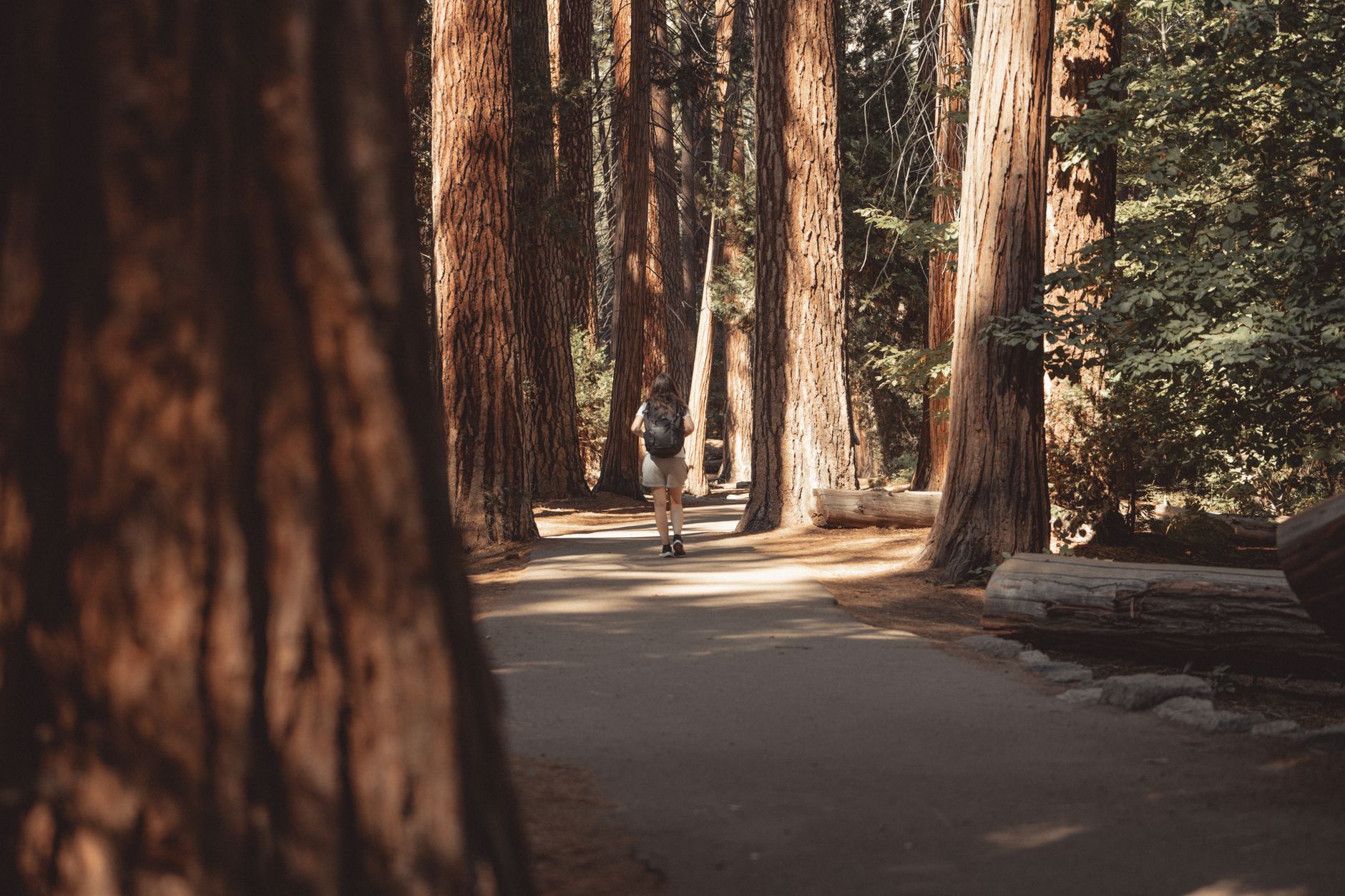
The Grizzly Giant is the largest and oldest named tree in Yosemite’s Mariposa Grove, the tree most visitors come to see. The National Park Service’s own tour page puts its age at about 2,900 years, while the grove’s general visitor page rounds that to roughly 3,00012. A widely cited independent measurement, not an NPS figure, gives the tree at 209 feet tall with a base diameter near 29 feet and a ground circumference near 92 feet3. That same source estimates its age at only about 1,800 years, a figure well below the NPS number and worth noting as a real discrepancy rather than resolving one way3. From the Mariposa Grove Welcome Plaza, most visitors ride the free shuttle to the grove arrival area and then walk the Grizzly Giant Loop, a two-mile round trip that takes 1.5 to 2 hours2. A separate, much shorter wheelchair-accessible route from a dedicated parking area reaches the tree in a 0.26-mile round trip4.
- Age: about 2,900 years per NPS’s tour page, rounded to “about 3,000” on the grove’s visitor page12
- Height: about 209 ft, per an independent measurement (not an NPS figure)3
- Base diameter: about 29 ft3
- Ground circumference: about 92 ft3
- Bark thickness: about 2 ft3
- Grove elevation: about 5,700 ft3
- Main walk: Grizzly Giant Loop, 2 miles round trip from the grove arrival area, 1.5–2 hours2
- Accessible route: 0.26-mile round trip, wheelchair accessible, from dedicated parking, 30–45 minutes4
The Grizzly Giant stands in Mariposa Grove, the largest of Yosemite’s three sequoia groves and the one covered in the guide to where to see giant sequoias. Mariposa holds more than 500 mature giant sequoias, against about two dozen each in the park’s smaller Tuolumne and Merced groves5. This page collects what the National Park Service says about the Grizzly Giant’s age and location, flags where an independent source disagrees, and covers the two ways to walk to it.
How old is the Grizzly Giant?
The most specific NPS figure comes from the agency’s own interpretive tour page for the tree: about 2,900 years old1. The general Mariposa Grove visitor page, aimed at trip planning rather than tree biology, rounds that up to “roughly 3,000 years”2. Both numbers come from the National Park Service, and either is safe to repeat.
A third figure exists outside official sources. A widely cited independent survey of the grove estimates the Grizzly Giant’s age at only about 1,800 years, over a thousand years younger than the NPS figure3. No living giant sequoia can be cored to its center to count rings directly, so every age for a standing tree is an estimate built from diameter, known growth rates, and fire-scar history rather than a hard count. That is the same limitation described on the page about how old giant sequoias get, and it explains why estimates for the same tree can diverge this much. Given the choice between an NPS-published figure and an independent one, the NPS figure of about 2,900 years is the safer number to use.
Whichever figure is right, the Grizzly Giant is not the oldest known giant sequoia. Ring-counted stumps in Converse Basin, in what is now Giant Sequoia National Monument, exceed 3,200 years6, and the General Sherman Tree, by contrast, is only about 2,200 years old despite being far larger by volume7.
How big is it?
The National Park Service’s own dedicated pages about the Grizzly Giant do not publish a height, diameter, or circumference for the tree. The numbers most often repeated come from an independent measurement: about 209 feet tall, a base diameter near 29 feet, a ground circumference near 92 feet, bark about 2 feet thick, at a grove elevation of about 5,700 feet3.
| Measurement | Value | Source |
|---|---|---|
| Height | ~209 ft | Independent survey3 |
| Base diameter | ~29 ft | Independent survey3 |
| Ground circumference | ~92 ft | Independent survey3 |
| Bark thickness | ~2 ft | Independent survey3 |
| Age (NPS) | ~2,900 years | NPS1 |
| Age (NPS, rounded) | ~3,000 years | NPS2 |
| Age (independent) | ~1,800 years | Independent survey3 |
For comparison, General Sherman in Sequoia National Park is 274.9 feet tall with a ground circumference of 102.6 feet7. By the numbers above, the Grizzly Giant is shorter and narrower than General Sherman, though it remains the largest tree in Yosemite. A full ranking of the largest known giant sequoias, including trees far outside Yosemite, is on the 10 largest giant sequoias page.
The tree's famous limb
Photographs of the Grizzly Giant are usually taken from below one particular lower limb, thick enough that visitors regularly mistake it for a second trunk growing out of the first. The Mariposa Grove’s self-guided trail treats the tree as a stop worth lingering at for exactly this reason2. Current NPS pages about the Grizzly Giant do not publish an official diameter for that limb, so no specific number is given here; the visual comparison to a full-size tree trunk is what draws attention to it on the ground.
Fire scars at the base
The Grizzly Giant carries prominent fire scars at its base, visible evidence of the surface fires that have burned through Mariposa Grove for centuries1. Unlike a younger, thinner-barked tree, a mature giant sequoia’s bark, up to about 2 feet thick at the Grizzly Giant, insulates the living tissue enough that repeated low-intensity fires rarely kill the tree outright3. The mechanics of that fire tolerance, and why decades without fire caused problems elsewhere in sequoia country, are covered on the giant sequoias and fire page.
How to walk to the Grizzly Giant
All visitors start at the Mariposa Grove Welcome Plaza, near Yosemite’s South Entrance off Wawona Road (Highway 41), about 1 hour 15 minutes from Yosemite Valley by car5. The Welcome Plaza has about 300 parking spaces, which the National Park Service says can fill by late morning2.
The main route
When the free shuttle is running, it is required between the Welcome Plaza and the grove; walking the closed road or the Washburn Trail, a two-mile walk each way, is the only option when the shuttle is not operating2. In 2026, the published shuttle schedule runs buses roughly every 15 minutes: May 3–September 23 from 8 am to 7 pm, September 24–October 31 from 8 am to 5 pm (weather permitting), and November 1–30 from 8 am to 3:30 pm (weather permitting), with no service December 1 through April 152.
From the grove arrival area where the shuttle drops visitors, the Grizzly Giant Loop is a 2-mile round trip taking 1.5 to 2 hours2. It is one of four marked trails at Mariposa Grove; the shorter Big Trees Loop (0.3 mile, wheelchair accessible) stays near the arrival area, while the longer Guardians Loop (6.5 miles) and full Mariposa Grove Trail (7 miles) continue past the Grizzly Giant to more of the grove’s named trees2.
The accessible route
A separate, dedicated parking area for vehicles with disability placards leads to the tree by a much shorter path: a 0.26-mile round trip, wheelchair accessible, that the NPS lists at 30 to 45 minutes and rates easy4. This route runs on a relatively flat surface with interpretive panels on giant sequoia biology along the way4, distinct from the two-mile loop most visitors take from the Welcome Plaza shuttle stop.
Water and access notes
Water is available year-round at the Welcome Plaza; at the grove arrival area itself, it is available only in summer5. As of September 2026, Yosemite is not using a timed-entry reservation system for general park entry, though commercial vehicles carrying 16 or more passengers do need a reservation for the grove specifically28. Because road and shuttle schedules can shift, check the current status on the National Park Service’s Yosemite trip-planning pages before you go.
Grizzly Giant vs. the rest of Mariposa Grove
The Grizzly Giant shares the grove with other named trees on the same trail network, including the California Tunnel Tree, the Fallen Monarch, the Clothespin Tree, and the fallen Wawona Tunnel Tree2. Mariposa Grove closed for a major restoration in spring 2015 and reopened June 15, 2018, with the old parking lot and gift shop removed from among the trees and the current Welcome Plaza system built at the South Entrance instead2. For the rest of the grove’s trails, named trees, and current access rules, see the full Mariposa Grove guide.
Frequently Asked Questions
How old is the Grizzly Giant?
Is the Grizzly Giant the largest tree in Yosemite?
How far is the walk to the Grizzly Giant?
Do you need the shuttle to see the Grizzly Giant?
When the shuttle is running, the NPS requires it between the Welcome Plaza and the grove. Outside shuttle hours, it is a 2-mile walk each way from the Welcome Plaza along the closed road or Washburn Trail2.
What is the difference between Mariposa Grove and the other Yosemite groves?
Mariposa is the largest, with more than 500 mature giant sequoias, versus about two dozen mature trees in each of Tuolumne and Merced Groves. Mariposa also requires the shuttle system in season, while the other two groves are reached directly from roadside trailheads5.
Does the Grizzly Giant have a famous limb?
Yes. One of its lower limbs is thick enough to be mistaken for a separate trunk, and it is a highlight of the walk. Current NPS pages about the tree do not publish an official diameter for it2.
Did fire ever damage the Grizzly Giant?
Related Articles
Sources
- Grizzly Giant Tour: Enduring Giant — National Park Service, Yosemite. Accessed 2026-09-09.
- Mariposa Grove of Giant Sequoias — National Park Service, Yosemite. Accessed 2026-09-09.
- The Mariposa Grove: Grizzly Giant — YosemiteHikes.com. Accessed 2026-09-09.
- Grizzly Giant Trailhead (Accessible) — National Park Service, Yosemite. Accessed 2026-09-09.
- Giant Sequoias — National Park Service, Yosemite. Accessed 2026-09-09.
- Sequoiadendron giganteum, Silvics of North America — U.S. Forest Service. Accessed 2026-09-09.
- The General Sherman Tree — National Park Service, Sequoia & Kings Canyon. Accessed 2026-09-09.
- Reservations — National Park Service, Yosemite. Accessed 2026-09-09.