
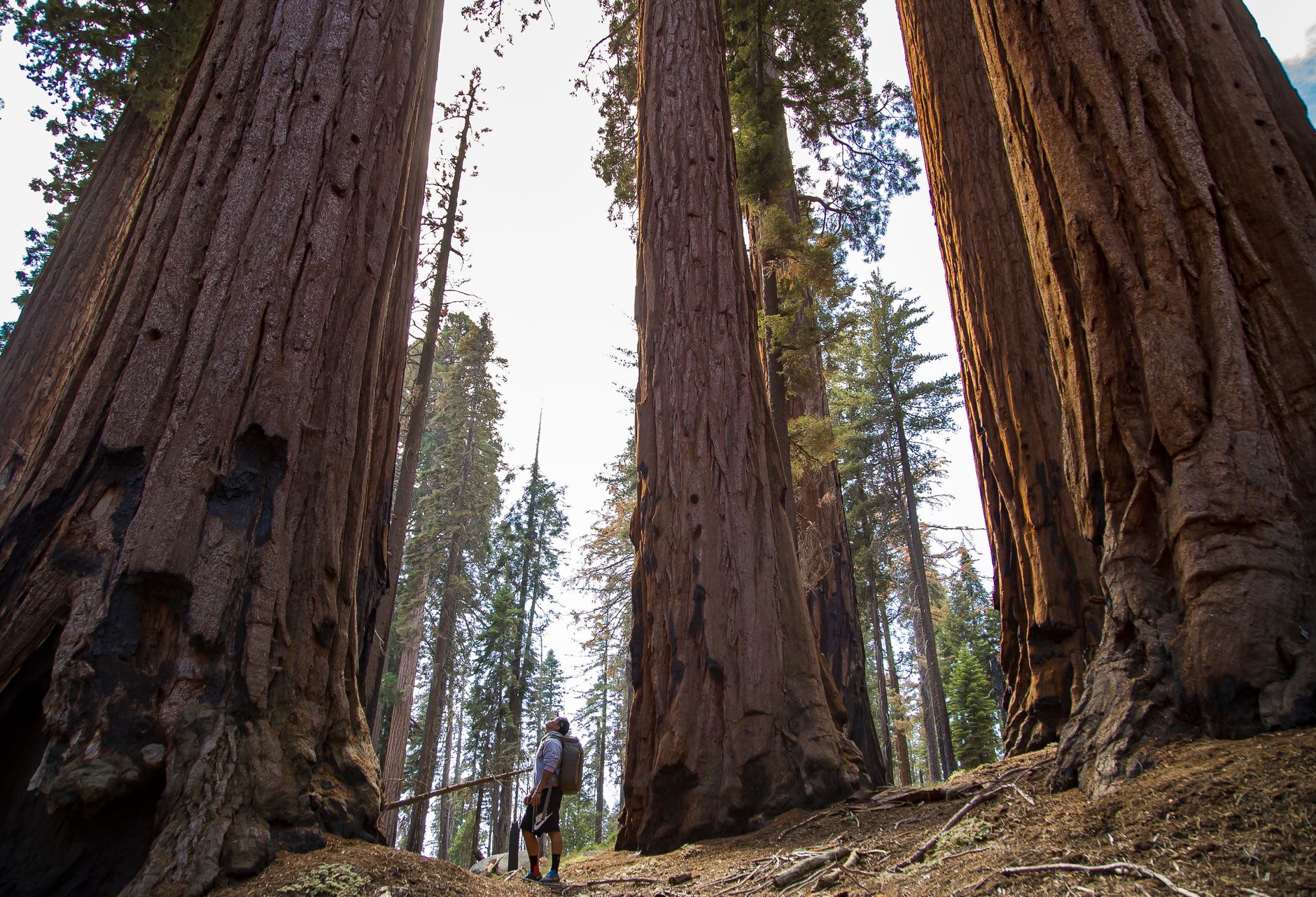
Giant sequoias are the biggest trees in the world. They grow only in California, on the west side of the Sierra Nevada mountains, between 4,000 and 8,000 feet up1. The biggest one, the General Sherman Tree, is 274.9 feet tall and 36.5 feet across at the bottom, and its trunk weighs almost 1,400 tons, about as much as 15 blue whales2. A sequoia starts from a seed the size of an oat flake, and 91,000 seeds weigh only one pound34. The oldest sequoias are more than 3,200 years old, so they were seedlings before Rome was founded3. Their bark can be 18 inches thick and helps them survive forest fires4.
- Biggest tree on Earth: General Sherman, 274.9 ft tall, 52,500 cubic feet of trunk2
- Seeds: as small as an oat flake; 91,000 in a pound34
- Age: up to about 3,400 years by the National Park Service’s figure4
- Bark: up to 18 inches thick4
- Home: about 75 to 94 groves in California’s Sierra Nevada, and nowhere else in the wild35
- Fire: the cones need heat from fire to open and drop their seeds4
- Cars: you can drive through Tunnel Log, a sequoia that fell in 19376
Disclosure: some links on this page are affiliate links, marked by the products, tours and hotels they name. As an Amazon Associate, sequoia.info earns from qualifying purchases. A purchase through these links may earn the site a commission at no cost to you, and it never affects what is recommended. How this works.
This page is for readers ages 8 to 12, and for the adults who get asked the questions. Every fact has a number next to it, like2, that points to where the fact came from at the bottom of the page. The sources are the National Park Service, the U.S. Forest Service, and scientists who study these trees. For the grown-up version, see the main page on giant sequoia trees.
20 giant sequoia facts
1. Giant sequoias are the biggest trees in the world
Not the tallest, and not the oldest. The biggest, which means they have the most wood in their trunks2. The tallest trees are coast redwoods, their cousins near the ocean, which grow to about 380 feet7. Giant sequoias are shorter but much fatter.
2. The biggest one has a name: General Sherman
The General Sherman Tree lives in Sequoia National Park. It is 274.9 feet tall and 102.6 feet around at the ground2. If 19 kids and grown-ups held hands in a circle, they might just reach around it. Read more on the page about how big General Sherman is.
3. It is taller than the Statue of Liberty
The Statue of Liberty is 111 feet 1 inch tall from her heel to the top of her head8. General Sherman is almost two and a half times taller than that. With her stone pedestal, the statue is 305 feet 1 inch to the tip of the torch, so she wins by about 30 feet, but only with the pedestal8.
4. Its trunk weighs as much as 15 blue whales
The National Park Service says General Sherman’s trunk weighs nearly 1,400 tons, about the same as 15 adult blue whales, 10 diesel train locomotives, or 25 army tanks2. A blue whale can be 110 feet long and weigh up to 330,000 pounds9.
5. It is still growing
Every year General Sherman adds enough new wood to make a whole 60-foot-tall oak tree with a trunk 3 feet wide2. It does not get taller anymore, but it keeps getting fatter.
6. Sequoias only grow wild in one place on Earth
They grow on the western side of the Sierra Nevada mountains in California, between 4,000 and 8,000 feet above sea level, in about 75 to 94 patches called groves135. All the groves together cover about 35,600 acres, which is smaller than many cities5.
7. The seeds are tiny
A sequoia seed is about the size of a flake of oatmeal34. It takes 91,000 of them to weigh one pound4. The biggest tree on Earth starts from one of the smallest seeds in the forest.
8. The cones are small too
A sequoia cone is only 2 to 3.5 inches long, about the size of a chicken egg, and holds about 200 seeds10. A big tree can carry 10,000 to 30,000 cones at once and grow about 1,500 new ones every year10.
9. The cones can stay shut for 20 years
Sequoia cones stay green and closed on the tree for as long as 20 years, holding their seeds inside4. They open when they dry out, and the fastest way to dry them is the heat of a forest fire4.
10. Sequoias need fire
That sounds wrong, but it is true. Fire dries the cones so they drop seeds, burns away dead leaves so the seeds land on bare soil, and opens gaps in the forest so sunlight reaches the seedlings411. Sequoia seeds only sprout well on bare dirt, and without fire almost no baby sequoias grew during the 1900s11. Rangers now set careful fires on purpose to help them. There is a whole page on why sequoias need fire, for kids.
11. The bark is thicker than a ruler is long
Sequoia bark can be 18 inches thick, spongy, and full of fibers4. It does not burn easily and protects the living wood inside from the heat of a fire. Almost every big sequoia has black burn marks at its base from fires it lived through410.
12. A squirrel helps plant them
A small squirrel called the Douglas squirrel, or chickaree, chews on green sequoia cones. It eats the juicy scales, not the seeds, so the seeds fall to the ground12. One squirrel can eat 3,000 to 3,500 cones a year5.
13. Sequoias can live more than 3,000 years
Scientists counted the rings on a sequoia stump and found it was more than 3,200 years old10. The National Park Service says sequoias can reach about 3,400 years4. A tree that old sprouted around the time of the ancient Greeks, long before the Roman Empire.
14. The oldest sequoia is not the biggest
General Sherman is about 2,200 years old13. The Grizzly Giant in Yosemite is about 3,000 years old but much smaller14. Trees grow at different speeds depending on where they stand, so a fatter tree is not always an older one.
15. A sequoia’s roots are shallow
You might think a tree this big needs roots that go down as deep as it is tall. It does not. The roots spread out more than 100 feet from the trunk but mostly stay in the top 3 feet of soil10. That is why the biggest danger to an old sequoia is falling over, not fire10.
16. You can drive through one
Tunnel Log in Sequoia National Park is a sequoia that fell across the road in 1937. Workers cut a tunnel through it the next summer, 17 feet wide and 8 feet high, and cars still drive through it615. No living sequoia has a tunnel for cars anymore, because cutting one hurts the tree15. See every tunnel tree in California.
17. At 120 feet up, the trunk is still 17 feet wide
General Sherman’s trunk is still 17 feet across at 120 feet above the ground16. That is higher than most trees ever grow, and the trunk up there is still wider than a car is long.
18. Sequoia wood is bad for building
People cut down thousands of sequoias in the 1800s, but the wood is brittle and often shattered when the trees hit the ground10. Most of it was used for fence posts, shingles, and pencils, and the loggers lost money517. That helped convince people to protect the trees instead.
19. Sequoia National Park was created to protect them
In 1890, Sequoia became the second national park in the United States, after Yellowstone, and the first one created to protect a living thing18. The General Sherman Tree was named in 1879 by a soldier who had fought under General William Tecumseh Sherman in the Civil War19.
20. Sequoias grow in other countries too, because people planted them
Seeds were carried to Britain in 1853, and today there are about half a million giant sequoias and coast redwoods growing there20. They grow in parks and gardens across Europe, in New Zealand, and in the eastern United States, but the only wild ones are in California21. You can even grow one at home from a seed; kits like the Jonsteen Company’s Giant Sequoia Seed Grow Kit, about $11, come with seeds, soil, and a tiny greenhouse22. The site earns a commission on purchases made through product links, which does not affect what is recommended. See how to grow a giant sequoia.
Fun comparisons
| Sequoia fact | Something kids know |
|---|---|
| General Sherman’s height, 274.9 ft2 | about 2.5 Statues of Liberty (the figure alone, 111 ft)8 |
| General Sherman’s trunk weight, about 1,400 tons2 | 15 blue whales2 |
| Sequoia seed3 | one flake of oatmeal |
| 91,000 seeds4 | one pound, about the weight of a football |
| Bark up to 18 in thick4 | longer than a 12-inch ruler |
| Trunk 17 ft wide at 120 ft up16 | wider than a car is long |
| Cone, 2–3.5 in10 | a chicken egg |
| Oldest sequoias, 3,200+ years10 | older than ancient Rome |
Where kids can see a giant sequoia
The easiest walks are the half-mile trail to the General Sherman Tree and the 0.7-mile paved Big Trees Trail in Sequoia National Park, both with signs to read along the way2324. In Yosemite, the 0.3-mile Big Trees Loop in Mariposa Grove is flat and short14. Every visitor center hands out a free Junior Ranger booklet; finish the activities and you earn a badge25. The best parks and trails for families are on the Sequoia National Park with kids page.
Frequently Asked Questions
How big is a giant sequoia?
The biggest, General Sherman, is 274.9 feet tall, 36.5 feet across at the base, and holds about 52,500 cubic feet of wood in its trunk2. Most big sequoias are 200 to 300 feet tall.
How old is the oldest sequoia?
How small are sequoia seeds?
Why do sequoias need fire?
Do sequoias grow anywhere besides California?
Can you drive through a sequoia tree?
Related Articles
Sources
- Giant Sequoia Groves — National Park Service, Sequoia & Kings Canyon. Accessed 2026-09-06.
- The General Sherman Tree — National Park Service, Sequoia & Kings Canyon. Accessed 2026-09-06.
- Giant Sequoias — Save the Redwoods League. Accessed 2026-09-06.
- Giant Sequoias — National Park Service, Sequoia & Kings Canyon. Accessed 2026-09-06.
- Sequoiadendron giganteum, Fire Effects Information System — U.S. Forest Service. Accessed 2026-09-06.
- Tunnel Log — National Park Service. Accessed 2026-09-06.
- Coast Redwoods — Save the Redwoods League. Accessed 2026-09-06.
- Statue Statistics — National Park Service, Statue of Liberty. Accessed 2026-09-06.
- Blue Whale — NOAA Fisheries. Accessed 2026-09-06.
- Sequoiadendron giganteum, Silvics of North America — U.S. Forest Service. Accessed 2026-09-06.
- Giant Sequoias and Fire — National Park Service, Sequoia & Kings Canyon. Accessed 2026-09-06.
- Fallen Green Cones of the Giant Sequoia — National Park Service, Yosemite. Accessed 2026-09-06.
- General Sherman Tree (place page) — National Park Service. Accessed 2026-09-06.
- Mariposa Grove of Giant Sequoias — National Park Service, Yosemite. Accessed 2026-09-06.
- The Myth of the Tree You Can Drive Through — National Park Service, Sequoia & Kings Canyon. Accessed 2026-09-06.
- Frequently Asked Questions — National Park Service, Sequoia & Kings Canyon. Accessed 2026-09-06.
- Discover History — U.S. Forest Service, Sequoia National Forest. Accessed 2026-09-06.
- History & Culture — National Park Service, Sequoia & Kings Canyon. Accessed 2026-09-06.
- Sequoia–Kings Canyon National Parks: A History of the Parks — A. Berle Clemensen, NPS, 1975. Accessed 2026-09-06.
- Giant Sequoia in the UK: Carbon Storage Potential and Growth Rates — Holland et al., Royal Society Open Science, 2024. Accessed 2026-09-06.
- Sequoiadendron giganteum — The Gymnosperm Database. Accessed 2026-09-06.
- Giant Sequoia Seed Grow Kit — The Jonsteen Company. Accessed 2026-09-06.
- The General Sherman Tree Trail — National Park Service. Accessed 2026-09-06.
- Big Trees Trail — National Park Service. Accessed 2026-09-06.
- Junior Ranger — National Park Service, Sequoia & Kings Canyon. Accessed 2026-09-06.