
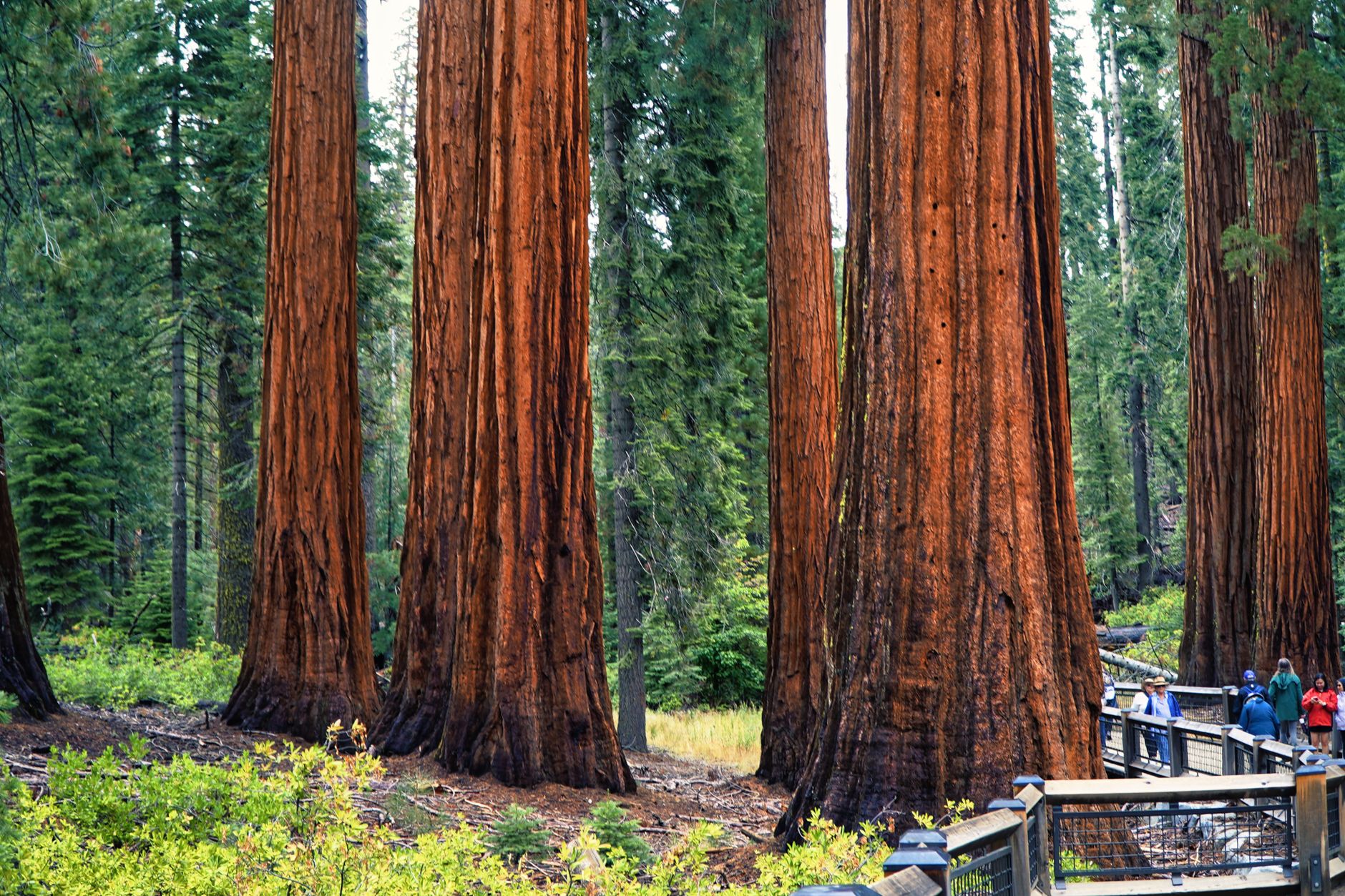
Sequoia National Park is one of the easier national parks to visit with children, because its most famous sights sit beside short paved trails. The General Sherman Tree is a half-mile walk each way from the main lot or about 500 feet on a paved accessible path from the Generals Highway; the Big Trees Trail is a flat 0.7-mile paved loop; and Tunnel Log, the fallen sequoia with a road cut through it, needs no walking at all123. Every visitor center hands out a free Junior Ranger booklet, and children who finish it earn a badge; the National Park Service aims the program at ages 7 to 12 with an adult helping45. The real risks are the rivers, which are the most frequent cause of death in the parks, and the altitude, since most trails are above 5,000 feet67.
- Best walks under a mile: Sherman Tree accessible trail (500 ft), Big Trees Trail (0.7 mi loop), Grant Tree Trail (0.5 mi loop), Roaring River Falls (0.5 mi)1289
- Best walks of 1 to 2 miles: Crescent Meadow loop (about 1.8 mi) with Tharp’s Log, Zumwalt Meadow (0.8 mi)1011
- Junior Ranger: free booklet at any visitor center, badge on completion, aimed at ages 7 to 1245
- Ranger programs: free, no reservations, mostly Memorial Day to Labor Day12
- Rivers: drowning is the most frequent cause of death in the parks; supervise children constantly near water6
- In-park shuttles: free and wheelchair accessible, which means stroller accessible, May 22 to September 7, 202613
- Winter: sledding at Wolverton, Big Stump, and Columbine; sled feet-first, helmets advised14
This page is for parents deciding how to spend a day or two in Sequoia National Park with children, from toddlers in a carrier to teenagers who will want the 350 steps of Moro Rock. It lists the walks by distance, explains the Junior Ranger program, covers the hazards that matter for kids, and suggests a one-day plan. Everything general about the park, fees, entrances, seasons, and where to stay, is in the complete Sequoia National Park guide.
Why the park suits children
The General Sherman Tree is 274.9 feet tall and 36.5 feet across at the base, and its trunk weighs about 1,400 tons, which the NPS compares to 15 adult blue whales15. The sights that thrill children most, a road through a log, a cabin inside a tree, a meadow with bears in it, are all within 3 miles of the Giant Forest Museum31016. Summer highs in the groves run 68 to 76°F, far cooler than the 89 to 97°F in the foothills below or the Central Valley17.
The walks, by distance
| Walk | Distance | Surface | Notes | Source |
|---|---|---|---|---|
| Sherman Tree accessible trail | about 500 ft | paved, inclines under 5% | from the Generals Highway lot; placard holders only in summer, everyone in winter | 118 |
| Sherman Tree main trail | 0.5 mi each way | paved, steps | 200 ft of climb on the way back | 1 |
| Big Trees Trail | 0.7 mi loop | fully paved, flat | benches, interpretive panels, around Round Meadow | 2 |
| Grant Tree Trail (Kings Canyon) | about 0.5 mi loop | paved, some steep bits | walk through the hollow Fallen Monarch | 8 |
| Roaring River Falls (Kings Canyon) | 0.5 mi | paved, 10% grade | 40-ft waterfall; loudest late spring | 9 |
| Zumwalt Meadow (Kings Canyon) | 0.8 mi | dirt, with a bridge | rebuilt after 2019 floods | 1119 |
| Crescent Meadow loop | about 1.8 mi | partly paved | Tharp’s Log, the 1858 cabin inside a log | 1020 |
| Congress Trail | 2.7 mi loop | paved, gentle | starts beside General Sherman | 21 |
| Tokopah Falls | 3.4 mi round trip | dirt, 600 ft gain | about 2 hours; river hazards | 22 |
| Moro Rock | 0.25 mi | stairway, about 350 steps | 300 ft of gain; closes in storms | 23 |
The four walks that work for almost any age
The General Sherman Tree. From the main lot on Wolverton Road the paved trail drops half a mile to the tree, and the 200-foot climb back is the part small children complain about1. In summer the trick is to walk down, see the tree, and continue to the lower lot on the Generals Highway to catch the free shuttle back up, which the NPS suggests for anyone who wants to skip the climb1. A low fence keeps everyone off the roots1. Full details on the General Sherman Tree page.
The Big Trees Trail. A 0.7-mile paved loop around a meadow with almost no elevation change, benches, and interpretive panels2. It begins 0.3 mile from the Giant Forest Museum, whose free exhibits are the best 20 minutes of context in the park216. Stroller-friendly end to end.
Tunnel Log. A sequoia fell across the Crescent Meadow Road in 1937, and the Civilian Conservation Corps cut a tunnel through it instead of clearing it3. Driving through takes seconds; children want to do it twice. On summer weekends the road is closed to cars and the free shuttle stops there instead24. See the Tunnel Log page.
Crescent Meadow and Tharp’s Log. The loop is about 1.8 miles and partly paved, with Tharp’s Log at the far side: a hollow fallen sequoia that a cattleman named Hale Tharp fitted with a window, a shingled wall, and a fireplace and lived in each summer from 18581020. Children can look inside.
For children who can manage more
The Congress Trail adds 2.7 paved miles past the House and Senate groups and the President Tree, and pairs with the Sherman Tree for a half-day21. Tokopah Falls is the park’s classic family hike, 3.4 miles round trip along a river to a 1,200-foot cascade, but the NPS warns that undercurrents have swept visitors away, so the rule is no wading and no rock-hopping22. Moro Rock is the one that teenagers ask for: a quarter-mile stairway of about 350 steps up a granite dome, closed during thunderstorms or when static is in the air2325. It is not a walk for a child who bolts. The Moro Rock page explains the exposure.
The Junior Ranger program
Ask for the free booklet at any visitor center, complete the activities, and the child earns the official Sequoia and Kings Canyon National Parks badge4. The NPS lists the program for ages 7 to 12 with an adult present5. The park also posts pre-trip pages on caves, bears, dark skies, and giant sequoias so the reading can be done at home4. Do the booklet across the day rather than at the end. There is a separate page on how to earn the Junior Ranger badge.
Ranger programs are free and need no reservations. Most run from Memorial Day through Labor Day and include grove walks, wildlife talks, and evening programs at campground amphitheaters12. During the Dark Sky Festival, September 11 to 13 in 2026, there are Junior Ranger events, telescope star parties, and bat walks, all free apart from park entry2627.
Caves, snow, horses, and rivers
Boyden Cavern in Kings Canyon is the easier cave with children: tours of 45 to 60 minutes after a steep 5-minute walk, walk-up tickets usually available, 55°F inside, open through November 8 in 202628. Crystal Cave in Sequoia has a 50-minute guided tour at 50°F after a half-mile walk down to the entrance, with tickets sold online only at least 36 hours ahead, and its 2026 season ended on September 7 with the road closed for repairs until 20272930. See the Crystal Cave page.
Snow. From December into spring, Wolverton, 2 miles above the Sherman Tree, plus Big Stump and Columbine near Grant Grove are the park’s designated snow-play areas14. Sleds are sold at the Grant Grove Market and at Wolverton, and the NPS advises sledding feet-first, wearing a helmet, and staying away from roads and parking lots14. Snowshoes rent at Wuksachi Lodge and the Grant Grove Market14. More on Sequoia National Park in winter.
Horses. Grant Grove Stables runs one- and two-hour guided rides to the Grant Tree and North Grove, and the Cedar Grove Pack Station runs rides from an hour to a full day, both typically June to mid-October with up to six riders per family group31.
Rafting and the lake. Kaweah Whitewater Adventures in Three Rivers runs a Family Lower trip of 4 miles and 2 to 3 hours during a season that usually falls in April to June32. Lake Kaweah, the reservoir between Visalia and Three Rivers, has swimming, a marina with boat rentals, and Saturday evening campground programs from June to August33.
Hazards that matter with children
Rivers. Drowning is the most frequent cause of death in the parks. Snowmelt makes the rivers swift and icy in spring and early summer, and the NPS rule is never to swim alone or near drop-offs and to supervise children constantly634.
Bears and mountain lions. Black bears are common. Watch from at least the length of two city buses, never approach, and store every scented item, including sunscreen and sealed drinks, in a metal locker or trunk3536. If a mountain lion appears, pick up small children, look big, and do not run35. See bears in Sequoia National Park.
Altitude. Giant Forest is near 7,000 feet, and most park trails are above 5,000 feet; expect children to tire faster and drink more than usual7. See Sequoia National Park elevation and altitude sickness.
The foothills. Below 4,000 feet, summer heat runs 80 to 115°F, poison oak is plentiful, rattlesnakes are common, and ticks are active from early spring to late summer37. Save the foothills walks such as Hospital Rock and Paradise Creek for cool months. At Hospital Rock the pictographs are sacred to the Mono, Yokuts, and Tübatulabal descendants of the village that stood there; children should not touch the rock art38.
Moro Rock in storms. The stairway closes with lightning risk and with ice; do not argue with a closure sign25.
A one-day plan with kids
- 8:30 am — Giant Forest Museum lot; walk the Big Trees Trail and pick up the Junior Ranger booklet when the museum opens at 927.
- 10:00 am — General Sherman Tree; in summer, walk down and ride the shuttle back up1.
- 12:00 pm — Lunch at the Lodgepole Market, open mid-April to mid-October, or a picnic at Wolverton39.
- 1:30 pm — Tunnel Log and Crescent Meadow, by car on weekdays or by the Gray shuttle from the museum on weekends324.
- 3:30 pm — Badge ceremony at the museum, then Beetle Rock, a 5-minute walk from the museum lot, for the view40.
That is a full day. The timings behind it are on the one-day Sequoia itinerary. With two days, add Kings Canyon’s Grant Tree, Roaring River Falls, and Boyden Cavern, which are laid out on the two-day itinerary.
Where to stay with children
Lodgepole Campground, with more than 200 sites, flush toilets, and a market, showers, and laundry a quarter mile away, is the campground families choose in Sequoia; Azalea and Sunset serve Grant Grove414243. Wuksachi Lodge, the only hotel inside Sequoia, has 102 rooms and a restaurant44. Between the parks, Montecito Sequoia Lodge runs an all-inclusive summer family camp and a winter program with tubing and a kids’ club included45. Every option is compared on where to stay for Sequoia National Park.
What to bring
The site earns a commission on purchases made through product links, which does not affect what is recommended. Three things earn their space: a child carrier for anyone under four; traction cleats for every family member in winter, which the NPS advises for the icy Sherman Tree Trail18; and a giant sequoia seed kit from the visitor center store or online, which turns the trip into a months-long project at home, as explained on the seed kits page. The full list is on what to pack for Sequoia National Park, and the best picture books about sequoias are worth reading before the drive. Cell coverage exists only around the Foothills Visitor Center, Lodgepole, and the Kings Canyon Visitor Center, so download maps and entertainment in advance46.
Frequently Asked Questions
Is Sequoia National Park good for kids?
Can I see the giant sequoias without hiking?
Is the trail to the General Sherman Tree stroller-friendly?
What age is the Junior Ranger program for?
Is Tokopah Falls kid-friendly?
The trail is 3.4 miles round trip with about 600 feet of climb and takes about 2 hours. The NPS warns that undercurrents have swept visitors away, so keep children out of the river22.
Will we see bears?
Is there sledding in Sequoia National Park?
Yes, at Wolverton in Sequoia and at Big Stump and Columbine near Grant Grove once snow arrives. Sleds are sold at the Grant Grove Market and Wolverton; helmets are advised14.
Related Articles
Sources
- The General Sherman Tree Trail — National Park Service, Sequoia & Kings Canyon. Accessed 2026-09-06.
- Big Trees Trail — National Park Service. Accessed 2026-09-06.
- Tunnel Log — National Park Service. Accessed 2026-09-06.
- Junior Ranger — National Park Service. Accessed 2026-09-06.
- Junior Ranger Activity (event details) — National Park Service. Accessed 2026-09-06.
- River Safety — National Park Service. Accessed 2026-09-06.
- Winter 2025–26 Trip Planner (PDF) — National Park Service. Accessed 2026-09-06.
- General Grant Tree Trailhead — National Park Service. Accessed 2026-09-06.
- Roaring River Falls — National Park Service. Accessed 2026-09-06.
- Crescent Meadow — National Park Service. Accessed 2026-09-06.
- Cedar Grove Day Hikes — National Park Service. Accessed 2026-09-06.
- Ranger Programs — National Park Service. Accessed 2026-09-06.
- Park Shuttles — National Park Service. Accessed 2026-09-06.
- Snowplay — National Park Service. Accessed 2026-09-06.
- The General Sherman Tree — National Park Service. Accessed 2026-09-06.
- Giant Forest and Lodgepole — National Park Service. Accessed 2026-09-06.
- Weather — National Park Service. Accessed 2026-09-06.
- Giant Forest and Lodgepole Winter Trails — National Park Service. Accessed 2026-09-06.
- Zumwalt Meadow — National Park Service. Accessed 2026-09-06.
- Tharp’s Log Wayside — National Park Service. Accessed 2026-09-06.
- Congress Trail — National Park Service. Accessed 2026-09-06.
- Tokopah Falls — National Park Service. Accessed 2026-09-06.
- Moro Rock — National Park Service. Accessed 2026-09-06.
- Road Conditions — National Park Service, updated September 1, 2026. Accessed 2026-09-06.
- Moro Rock (place page) — National Park Service. Accessed 2026-09-06.
- Dark Sky Festival 2026 — National Park Service. Accessed 2026-09-06.
- Dark Sky Festival — Sequoia Parks Conservancy. Accessed 2026-09-06.
- Boyden Cavern — Boyden Cavern. Accessed 2026-09-06.
- Crystal Cave — National Park Service. Accessed 2026-09-06.
- Crystal Cave — Sequoia Parks Conservancy. Accessed 2026-09-06.
- Horseback Riding — National Park Service. Accessed 2026-09-06.
- FAQ — Kaweah Whitewater Adventures. Accessed 2026-09-06.
- Lake Kaweah — Visit Visalia. Accessed 2026-09-06.
- Safety — National Park Service. Accessed 2026-09-06.
- Wildlife Safety — National Park Service. Accessed 2026-09-06.
- Bears and Food Storage — National Park Service. Accessed 2026-09-06.
- Foothills — National Park Service. Accessed 2026-09-06.
- Hospital Rock Pictographs — National Park Service. Accessed 2026-09-06.
- Where to Eat — National Park Service. Accessed 2026-09-06.
- Moro Rock and Granite Domes — National Park Service. Accessed 2026-09-06.
- Lodgepole Campground — Recreation.gov. Accessed 2026-09-06.
- Azalea Campground — Recreation.gov. Accessed 2026-09-06.
- Sunset Campground — Recreation.gov. Accessed 2026-09-06.
- Wuksachi Lodge — Delaware North, Sequoia & Kings Canyon lodging. Accessed 2026-09-06.
- Montecito Sequoia Lodge — Montecito Sequoia Lodge. Accessed 2026-09-06.
- Frequently Asked Questions — National Park Service. Accessed 2026-09-06.