
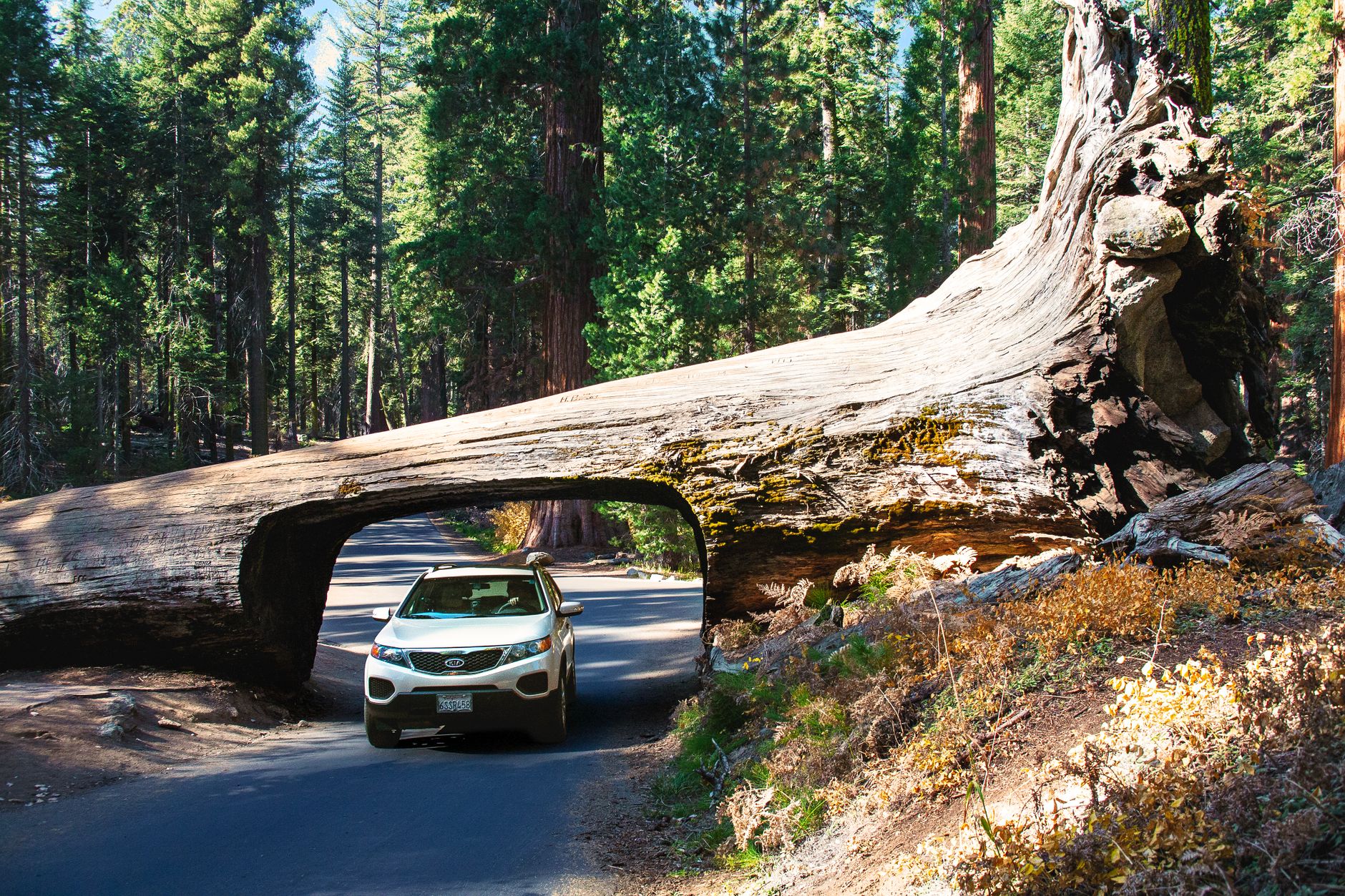
Tunnel Log is a giant sequoia that fell across Moro Rock/Crescent Meadow Road in the Giant Forest of Sequoia National Park, and rather than remove it, Civilian Conservation Corps workers cut a tunnel through the trunk so cars could keep using the road1. It is the only tree you can drive through in Sequoia and Kings Canyon National Parks1. The NPS place page dates the fall to 1937; the park’s trip-planning pages say people have driven through it since 1935, so official sources differ by two years12. Vehicles taller than 8 feet cannot use the tunnel and take a bypass road beside it2. The log is 0.5 mile past Moro Rock on a road closed to private cars on summer weekends and holidays, closed to vehicles over 22 feet at all times, and closed by snow in winter234.
- What it is: a fallen giant sequoia with a vehicle tunnel cut by the CCC1
- When: the tree fell across the road in 1937 per the NPS place page; other NPS pages say 193512
- Height limit: vehicles over 8 ft (2.4 m) tall use the bypass2
- Where: Moro Rock/Crescent Meadow Road, 0.5 mi past Moro Rock, about 1.5 mi from the Giant Forest Museum25
- Time: 5–10 minutes2
- Summer weekends and holidays (May 22–Sept 7, 2026): road closed to private vehicles; the free shuttle passes the log but does not drive through it36
- Winter: road closed; reach it on foot, skis, or snowshoes1
Tunnel Log is the photograph everyone takes and nobody plans for. It is a five-minute stop on the way to Crescent Meadow, and the question most people ask when they arrive is whether the car will fit. This page answers that, explains why a road crew in the 1930s decided to cut through a tree rather than around it, and lays out the rules that determine whether you can drive to it at all on the day you visit. The road it sits on is described in the Giant Forest guide, and the park’s logistics are in the Sequoia National Park guide.
Will your car fit?
The only dimension the National Park Service publishes is the height limit: vehicles taller than 8 feet (2.4 meters) cannot use the tunnel and are directed onto a bypass road that loops around the log2. A sedan, a crossover, a minivan, or a pickup without a tall camper shell will fit. A full-size van with a high roof, a pickup with a rooftop tent deployed, or a small motorhome will not.
Width is the other question, and the NPS does not publish a figure for it. Rather than repeat the numbers that circulate online, this page notes only that the NPS’s sole published limit is height, which implies ordinary passenger vehicles fit, that drivers of wide trucks should look before committing, and that the bypass is always there. In practice the 22-foot vehicle-length limit on the road as a whole removes most of the vehicles that would have trouble4.
If you are unsure, the bypass costs nothing. The log is a photograph either way, and the photograph is better with someone else’s car in the tunnel.
How it got there
Giant sequoias do not die of old age. They fall. Their roots seldom go deeper than three feet, and a tree carrying a thousand tons over shallow roots comes down when wind, soaked soil, or heavy snow finally tips the balance, often at a base weakened by an old fire scar7. This one came down across the only road into the Crescent Meadow end of the Giant Forest.
The NPS place page for the log says the tree fell across the road in 1937 and that Civilian Conservation Corps workers tunneled through it1. The park’s Giant Forest trip-idea page and the Tunnel Log activity page both say people have been driving through it “since 1935”28. The pages are all from the National Park Service and they do not agree. What they agree on is the decade, the builder, and the reasoning: cutting a tunnel was easier than moving a log that size, and it made a roadside attraction out of a road hazard.
The CCC was doing a great deal of work in the park in those years. The park’s history overview credits the corps with trails, campgrounds, and facilities across Sequoia in the 1930s, including the first steps up Moro Rock, and the Generals Highway connecting the two parks was dedicated in 1935910. Tunnel Log fits that era of building things for the automobile. The log is still there ninety years later because sequoia heartwood resists decay: the Forest Service notes that the heartwood of fallen sequoia logs can remain largely intact for thousands of years7.
The only drive-through tree in the parks
Tunnel Log is the only “tree you can drive through” in Sequoia and Kings Canyon1. The distinction matters. The famous drive-through trees of California were living sequoias with tunnels cut through their standing trunks, and the most famous of them, the Wawona Tunnel Tree in Yosemite’s Mariposa Grove, collapsed in 19691. No national park would cut a tunnel through a living sequoia today.
Tunnel Log involved no such harm. The tree was already down. That is why it survives as an attraction while the standing tunnel trees are gone or fenced. The history of all of them, including the ones on private land you can still drive through, is on the page about tunnel trees in California and the page about the Wawona Tunnel Tree.
Getting there: the road rules
Tunnel Log is on Moro Rock/Crescent Meadow Road, which begins at the Giant Forest Museum. Moro Rock’s parking area is about 1 mile from the museum, and Tunnel Log is 0.5 mile beyond it, with Crescent Meadow at the end of the road, 2.6 miles from the museum2511. Plan 5 to 10 minutes at the log2.
Three rules decide whether you can drive it:
| Condition | Rule | Source |
|---|---|---|
| Summer weekends and holidays, May 22–Sept 7, 2026 | Road closed to private vehicles; free shuttle Route 2 (Gray) from the Giant Forest Museum is the only access | NPS36 |
| Any time | Vehicles over 22 ft, including trailers, not allowed | NPS4 |
| Winter | Road closes with snow and reopens by the Wednesday before Memorial Day | NPS212 |
On a shuttle day you cannot drive through the log. The bus does not go through it either. Shuttle riders get off at the Moro Rock or Crescent Meadow stops and walk to the log for the photograph, which is a pleasant half-mile on a road with no cars. On a summer weekday, drive it, but expect the small Moro Rock lot to be full; the NPS says it fills fast even on weekdays5.
In winter the road is unplowed and closed to vehicles. The NPS says to hike, snowshoe, or ski in1. The road from the museum plaza is a marked ski and snowshoe route, and Tunnel Log in snow, with no cars for miles, is a different place from the summer version13.
What to combine it with
The road is short, and the three stops on it make one outing:
- Moro Rock, the 350-step granite dome, 30 to 120 minutes5. See the Moro Rock page.
- Tunnel Log, 5 to 10 minutes2.
- Crescent Meadow, a 1.8-mile partly paved loop to Tharp’s Log, the 1858 cabin built into a hollow sequoia11. See Crescent Meadow and Tharp’s Log.
Crescent Meadow is also the trailhead for the High Sierra Trail, the 72-mile route to Mount Whitney14. The NPS “Experience the Giant Forest” plan strings these together after the museum, the Big Trees Trail, and the General Sherman Tree, and admits the full list wants more than one day8. A version that fits in a day is on the one-day Sequoia itinerary.
Rules at the log
Do not climb on the log. Sequoia wood is brittle and the bark and top of the trunk are not built for foot traffic7. Do not stop in the tunnel with cars waiting; pull through, park in the pull-out, and walk back for the photograph. Pets may be in the car and in the parking area but not on any trail, including the road when it is closed to vehicles and being used as a trail15. Drones are prohibited16.
Frequently Asked Questions
Can my car fit through Tunnel Log?
If it is under 8 feet tall, yes. The NPS directs vehicles over 8 feet (2.4 meters) to a bypass road beside the log. Width is not published; ordinary passenger vehicles fit2.
What is the height limit at Tunnel Log?
8 feet (2.4 meters). Taller vehicles use the bypass2.
When did Tunnel Log fall?
Can you still drive through a sequoia tree?
In Sequoia and Kings Canyon, only through Tunnel Log, a fallen tree. The standing Wawona Tunnel Tree in Yosemite collapsed in 1969. A few tunnel trees on private land elsewhere in California still admit cars; see the tunnel trees page1.
Is Tunnel Log open in winter?
Can I drive to Tunnel Log on a weekend in summer?
Do RVs fit through Tunnel Log?
Related Articles
Sources
- Tunnel Log (place page) — National Park Service. Accessed 2026-09-06.
- Tunnel Log — National Park Service. Accessed 2026-09-06.
- Road Conditions — National Park Service, updated September 1, 2026. Accessed 2026-09-06.
- Directions & Transportation — National Park Service. Accessed 2026-09-06.
- Moro Rock — National Park Service. Accessed 2026-09-06.
- Park Shuttles — National Park Service. Accessed 2026-09-06.
- Sequoiadendron giganteum, Silvics of North America — U.S. Forest Service. Accessed 2026-09-06.
- Experience the Giant Forest — National Park Service. Accessed 2026-09-06.
- History & Culture — National Park Service, Sequoia & Kings Canyon. Accessed 2026-09-06.
- The Generals Highway — National Park Service. Accessed 2026-09-06.
- Crescent Meadow — National Park Service. Accessed 2026-09-06.
- Road Information — National Park Service. Accessed 2026-09-06.
- Skiing and Snowshoeing — National Park Service. Accessed 2026-09-06.
- High Sierra Trail — National Park Service. Accessed 2026-09-06.
- Pets — National Park Service. Accessed 2026-09-06.
- Laws & Policies — National Park Service. Accessed 2026-09-06.