
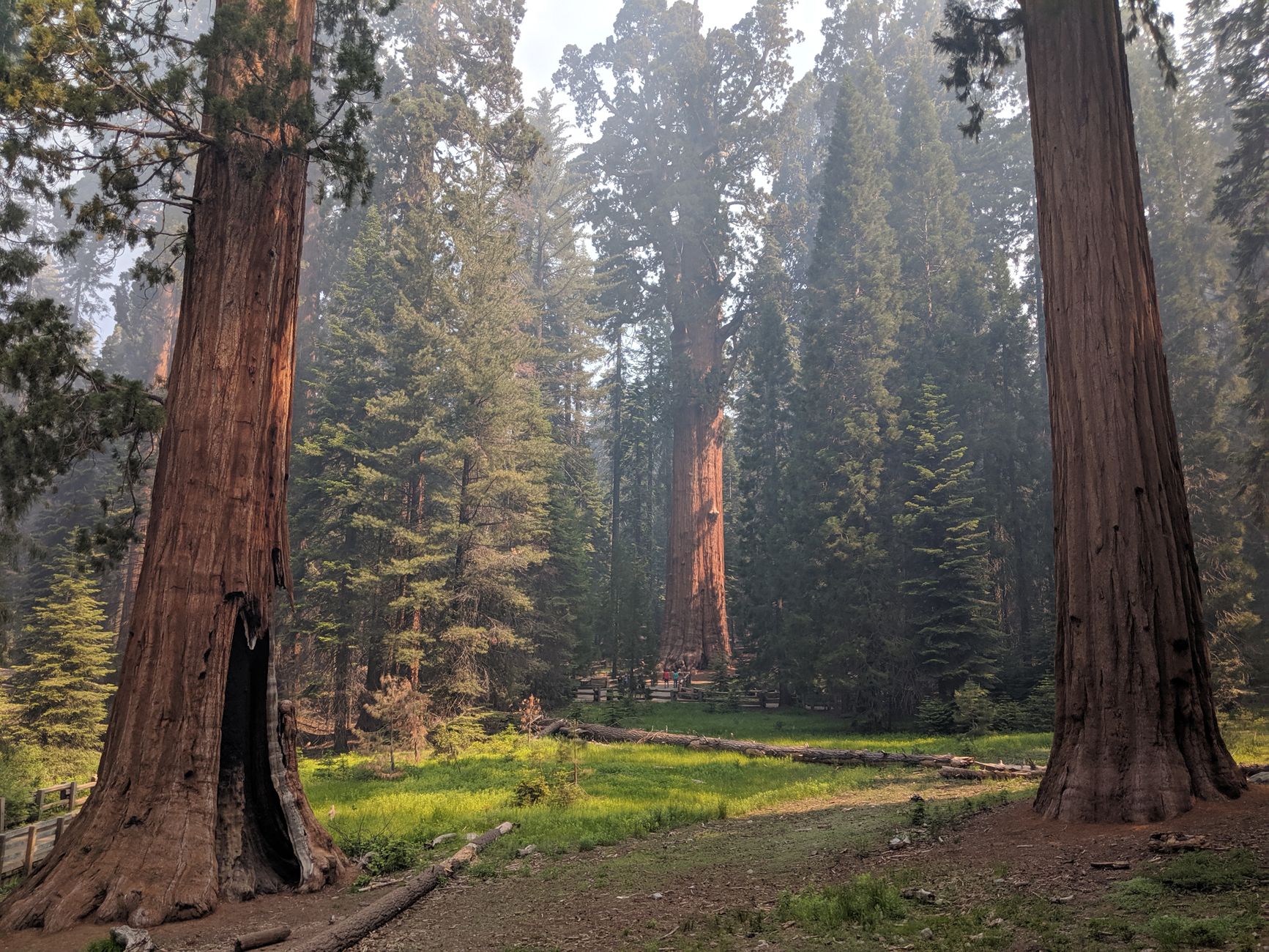
Crescent Meadow is a roughly 1.8-mile round-trip loop, partially paved, around one of Giant Forest’s largest meadows, at the end of Moro Rock–Crescent Meadow Road, 2.6 miles from the Giant Forest Museum12. The loop connects to Log Meadow and Tharp’s Log, a cabin the settler Hale Tharp built into a 70-foot hollow fallen sequoia in 1858, complete with a window, a shingled wall, and a granite fireplace13. Tharp grazed cattle here until Sequoia National Park was created in 1890, using the log as his summer home for over three decades3. The Crescent Meadow picnic area at the road’s end is also the trailhead for the High Sierra Trail, the 6-day route to Mount Whitney2. The access road opens seasonally, generally the Wednesday before Memorial Day, and is closed to private vehicles on summer weekends and holidays, when the free shuttle serves it instead14.
- Loop distance: about 1.8 miles round trip, partially paved1
- Distance from Giant Forest Museum: 2.6 miles by road to the picnic area and trailhead2
- Tharp’s Log: a 70-foot hollow sequoia Hale Tharp made into a cabin in 18583
- Tharp’s use of the cabin: summer home and cattle camp until the park’s creation in 18903
- Road season: typically opens the Wednesday before Memorial Day1
- Weekend access: road closed to private cars on summer weekends and holidays; free shuttle only14
- Also here: the High Sierra Trail trailhead, with vault toilets and picnic tables2
Crescent Meadow sits at the far end of the road that also passes Moro Rock and Tunnel Log, and it draws a different kind of visitor than those two stops: people headed out for a longer walk, or in for a quiet stretch of meadow framed by sequoias. This page covers the loop itself, the Tharp’s Log side trip, the settler history behind it, and the High Sierra Trail that starts here. For the wider area, see the Giant Forest guide and the Sequoia National Park guide.
The Crescent Meadow loop
The trail around Crescent Meadow runs about 1.8 miles round trip and is partially paved, with connections extending to the adjacent Log Meadow1. It is one of the gentler walks in Giant Forest, following the meadow’s edge rather than climbing, and it is where the loop to Tharp’s Log branches off. Accessible parking at the meadow is limited1. The picnic area at the road’s end, 2.6 miles from the Giant Forest Museum, has vault toilets and picnic tables2.
Tharp's Log
Tharp’s Log is a section of a fallen, hollowed-out giant sequoia that the settler Hale Tharp converted into a cabin in 1858, adding a window, a shingled wall, and a granite fireplace to the 70-foot log3. Tharp had first visited Giant Forest that same year. Chief Chappo of the local village invited him in, and Monache (Mono) and Yokuts guides led him on the high routes into the mountains that he later used to bring cattle up from the foothills3. Tharp used the log as his summer home while grazing cattle in Log Meadow until Sequoia National Park was created in 1890, after which that use ended3. It stands as one of the earliest documented examples of a fallen giant sequoia being reused as a shelter, decades before the Tunnel Log or the drive-through tunnel trees of the tourist era existed.
Today a low door and a window let visitors look inside the log without entering it. The site is a short walk off the Crescent Meadow loop, on the Log Meadow side, and is one of the few places in Giant Forest where a piece of the pre-park settlement history is still standing rather than described on a wayside sign.
Road status and when you can drive here
Moro Rock–Crescent Meadow Road generally opens for the season the Wednesday before Memorial Day1. Once open, it is closed to private vehicles on summer weekends and holidays, when the National Park Service runs it exclusively by free shuttle from the Giant Forest Museum14. On weekdays outside that restriction, and outside the shuttle season entirely, driving in is possible when the road is open. When the shuttle is running, Route 2 (Gray) connects the Giant Forest Museum, Moro Rock, and Crescent Meadow daily throughout the 2026 summer season9. In winter, the road is not plowed and access to Crescent Meadow is on foot, ski, or snowshoe only from the Giant Forest Museum plaza4.
The High Sierra Trail starts here
The Crescent Meadow picnic area and trailhead is also where the High Sierra Trail begins, the roughly 6-day route across the Sierra Nevada to the summit of Mount Whitney2. The trail itself was completed by the Civilian Conservation Corps in 19325. Most visitors to Crescent Meadow are doing the short meadow loop, but everyone attempting the full High Sierra Trail starts from this same parking area. Planning details, including permits and a suggested itinerary, are covered on the High Sierra Trail guide.
The Charles Young and Booker T. Washington trees
Two named sequoias near Crescent Meadow honor Captain Charles Young, who in the summer of 1903 led 96 troopers of the 9th Cavalry as acting superintendent of Sequoia National Park, becoming the first Black superintendent of a U.S. national park8. Young’s soldiers pushed the wagon road toward Giant Forest faster than earlier Army detachments had managed, stopped poaching and illegal grazing, and improved 18 miles of trail toward Mineral King during his tenure8. The Charles Young and Booker T. Washington trees, near Crescent Meadow, were named in his honor8. He was posthumously promoted to brigadier general in 20218.
Nearby stops on the same road
Crescent Meadow sits at the end of Moro Rock–Crescent Meadow Road, which also passes:
- Moro Rock, a 0.25-mile stairway climb with about 350 steps and 300 feet of elevation gain to a granite dome overlook6.
- Tunnel Log, a fallen sequoia the CCC cut a drive-through tunnel into in 1937, the only such tunnel in these parks7.
See the Moro Rock guide and the Tunnel Log guide for those separately. Combining all three in one visit is straightforward when the road is open to private cars.
Frequently Asked Questions
What is Tharp's Log?
Tharp’s Log is a 70-foot hollow fallen sequoia that settler Hale Tharp converted into a summer cabin in 1858, adding a window, a shingled wall, and a stone fireplace. He used it until Sequoia National Park was created in 18903.
Who was Hale Tharp?
Hale Tharp was a stockman who reached Giant Forest in 1858, the first documented Euro-American to settle in the area. He grazed cattle in Log Meadow and summered in what became known as Tharp’s Log until the park’s creation ended that use in 18903.
How long is the Crescent Meadow loop?
About 1.8 miles round trip, partially paved, with a connecting route to Tharp’s Log in adjacent Log Meadow1.
Is the road to Crescent Meadow open in winter?
No. Moro Rock–Crescent Meadow Road is unplowed and closed to vehicles in winter. Access is on foot, ski, or snowshoe from the Giant Forest Museum plaza4.
Can I drive to Crescent Meadow on a summer weekend?
What trail starts at Crescent Meadow?
The High Sierra Trail, a roughly 6-day route to the summit of Mount Whitney, begins at the Crescent Meadow picnic area and trailhead2.
Who are the Charles Young and Booker T. Washington trees named for?
Charles Young, a West Point graduate who led 9th Cavalry troops as acting superintendent of Sequoia National Park in 1903, becoming the first Black superintendent of a U.S. national park. Two trees near Crescent Meadow honor him and Booker T. Washington8.
Is Crescent Meadow wheelchair accessible?
Accessible parking at Crescent Meadow is limited, and the loop is only partially paved, so accessibility is mixed. Check current conditions with a ranger before planning around it1.
Related Articles
Sources
- Crescent Meadow — National Park Service, Sequoia & Kings Canyon. Accessed 2026-09-09.
- Crescent Meadow Picnic Area and Trailhead — National Park Service. Accessed 2026-09-09.
- Tharp’s Log Wayside — National Park Service. Accessed 2026-09-09.
- Winter Activities — National Park Service. Accessed 2026-09-09.
- History & Culture — National Park Service. Accessed 2026-09-09.
- Moro Rock — National Park Service. Accessed 2026-09-09.
- Tunnel Log — National Park Service. Accessed 2026-09-09.
- Charles Young — National Park Service. Accessed 2026-09-09.
- Park Shuttles — National Park Service. Accessed 2026-09-09.