
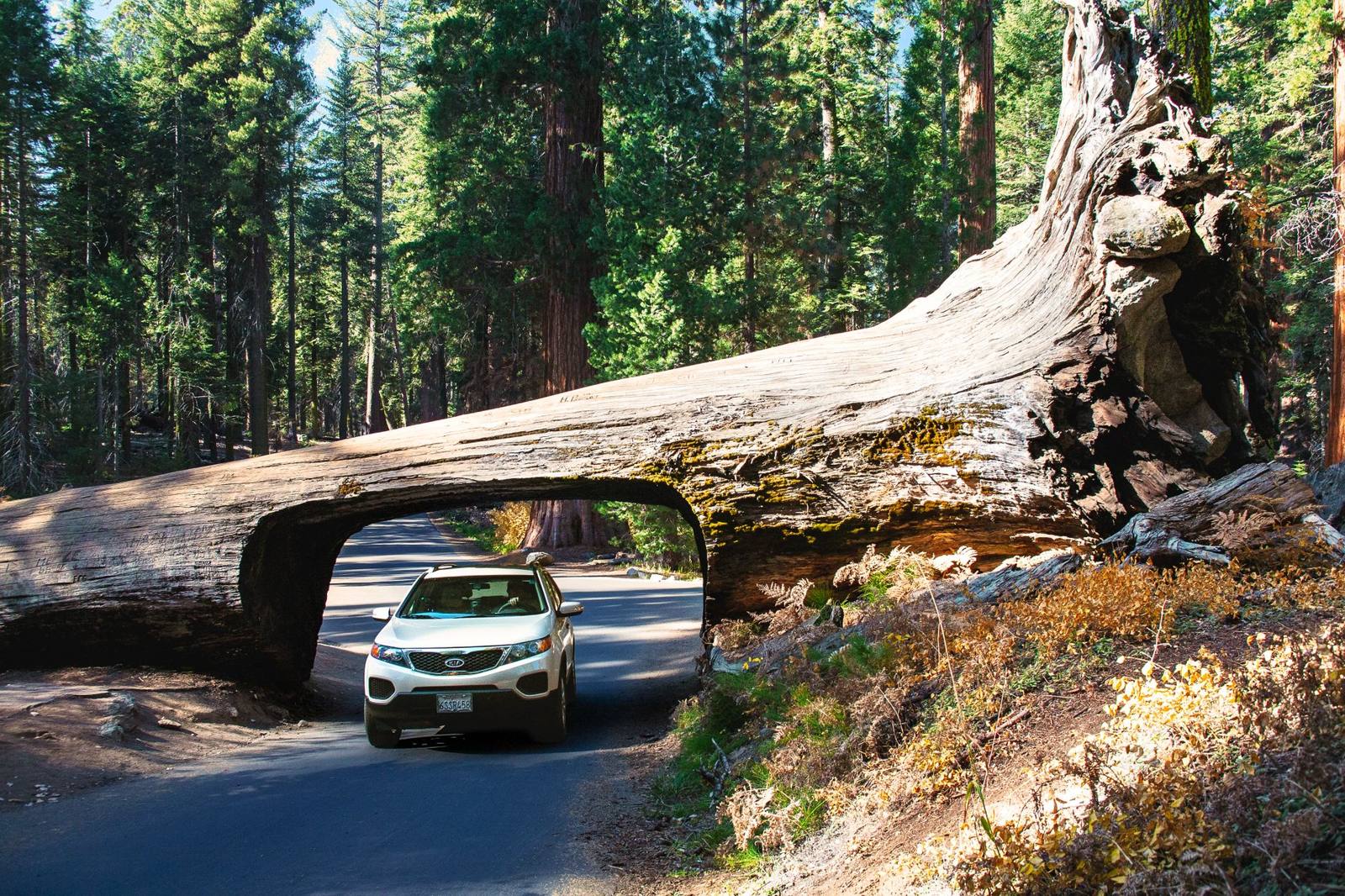
Hale Tharp, a stockman working out of the Three Rivers area, first visited the Giant Forest in 1858, traveling with two Monache and Yokuts companions along the Middle Fork of the Kaweah River1. In 1861 he turned a fallen, fire-hollowed sequoia log into a cabin, carving a window, building a shingled wall to close off one end, and adding a granite fireplace and chimney12. He grazed cattle in the meadow beside it each summer, wintering his herd in the foothills, and lived this way until Sequoia National Park was created in 189012. John Muir visited Tharp there in 1875, the same year Muir named the surrounding grove the Giant Forest2. The cabin survives today as Tharp’s Log, a short walk from Crescent Meadow.
- First visit to Giant Forest: 1858, guided by two Monache and Yokuts companions1
- Cabin built: 1861, inside a 70-foot hollow sequoia log12
- Cabin features: a carved window with a horseshoe-hinged shutter, a shingled wall, and a granite fireplace and chimney1
- Use: summer cattle grazing at Log Meadow; wintered stock near Horse Creek in the foothills2
- Notable visitor: John Muir stopped at the cabin in 18752
- Occupation ended: 1890, with the creation of Sequoia National Park12
Before Sequoia National Park existed, before General Sherman had a name anyone remembers, a cattleman was already spending his summers in the grove that would become its centerpiece. Hale Tharp’s cabin is one of the few structures in the park that predates the park itself, and his arrival is one of the opening chapters in the history of Sequoia National Park.
Guided into the Giant Forest, 1858
Tharp reached the Giant Forest for the first time in 1858, traveling with two Monache and Yokuts companions along the Middle Fork of the Kaweah River, past what is now Moro Rock, and into the grove around Log Meadow1. According to descendants of the Native families involved, the companions who accompanied Tharp did so at least partly for his safety, since the route climbed through treacherous, high-elevation terrain unfamiliar to an outsider1.
That contact was not accidental. Local chief Chappo had invited Tharp to visit Pah-din, a village site now known as Hospital Rock, in the foothills below the Giant Forest1. The pictographs at that site remain sacred to the Mono (Monache), Yokuts, and Tübatulabal families with ties to the land, and their meaning has never been made public1. For the fuller story of the people who lived in and managed these mountains long before Tharp arrived, see the Indigenous peoples of the sequoia groves.
The cabin inside a fallen sequoia
Tharp did not build a cabin from timber. He adapted one that was already there. A giant sequoia had fallen and burned out along much of its length, and in 1861 Tharp turned the resulting hollow log into a livable shelter1. He carved a window into the log and hung a shutter on horseshoe hinges, built a shingled wall to enclose the open end of the log, and added a fireplace and chimney made from granite boulders1. The result is often described as the first non-Native structure in the Giant Forest1.
The log itself was about 70 feet long, and Tharp’s cabin occupied only part of that length, with the rest of the hollow trunk left open1. It was a rough shelter, built for a working season rather than year-round living, but it held up. It still stands.
A rancher's summer commute
Tharp was a stockman by trade, and the Giant Forest was, to him, first and foremost pasture2. He used the meadow beside his cabin, now called Log Meadow, as seasonal grazing ground each summer, then moved his cattle down to lower elevations near Horse Creek in the foothills for the winter2. That pattern, summers high in the sequoia groves and winters in the foothills, matched the seasonal rounds that Native families in the same mountains had followed for generations, based on where feed, water, and mild weather could be found at each time of year.
Tharp kept up this routine for roughly three decades. He was, by most accounts, the only non-Native person living seasonally in the Giant Forest for much of that period, well before railroads, wagon roads, or organized tourism reached the area.
John Muir's visit, 1875
In 1875, John Muir made his way into the grove and stopped at Tharp’s cabin. It was the same year Muir gave the surrounding forest its name, calling it simply the Giant Forest2. Muir arrived with his mule, Brownie, and found Tharp a hospitable host2. The visit came at a moment when Muir’s writing was starting to draw wider attention to the sequoia groves and the threats facing them; within a year he would begin publishing the essays that helped build the case for protecting them. For that side of the story, see John Muir and the giant sequoias.
The end of an era: 1890
Tharp’s arrangement with the land was informal, the kind of use that predates any park boundary or land survey. It lasted until Congress created Sequoia National Park on September 25, 1890, the second national park in the country and the first established specifically to protect a living organism3. The new park’s boundaries took in the Giant Forest and, with it, Tharp’s summer grazing ground. He is generally credited as the first Euro-American settler in the Giant Forest, a distinction that held for roughly three decades before the land came under federal protection13.
The Kaweah Colony, a socialist cooperative that had been trying to build a road into the grove during the same years Tharp was still grazing cattle there, saw its own land claims dissolved by the same 1890 park creation. That story is told in full on the page about the Kaweah Colony.
Visiting Tharp's Log today
Tharp’s Log sits just off the Crescent Meadow loop trail, an easy, partially paved walk of about 1.8 miles round trip that also passes Log Meadow itself4. The Crescent Meadow Road that serves the trailhead generally opens the Wednesday before Memorial Day and is closed to private vehicles on summer weekends and holidays, when the shuttle serves the area instead4. For the full walking route and what else to see nearby, see the guide to Crescent Meadow and Tharp’s Log.
Frequently Asked Questions
Who was Hale Tharp?
What is Tharp's Log?
Tharp’s Log is a cabin Hale Tharp built inside a fallen, fire-hollowed giant sequoia trunk near Log Meadow in what is now Sequoia National Park. He carved a window, built a shingled wall, and added a stone fireplace inside the log1.
Who guided Hale Tharp into the Giant Forest?
Two Monache and Yokuts companions traveled with Tharp on his first visit in 1858, following a route along the Middle Fork of the Kaweah River. Descendants of those families say the guides likely came along partly to help Tharp navigate the difficult high-elevation terrain safely1.
Did John Muir visit Hale Tharp?
Yes. John Muir stopped at Tharp’s cabin in 1875, the same year Muir named the surrounding grove the Giant Forest. Muir was traveling with his mule, Brownie, and later described Tharp as a hospitable host2.
How long did Hale Tharp live in the Giant Forest?
Can you still visit Tharp's Log?
Yes. It sits just off the Crescent Meadow loop trail, a roughly 1.8-mile round trip from the Crescent Meadow parking area, reachable when Crescent Meadow Road is open4.
Related Articles
Sources
- Tharp’s Log Wayside — National Park Service. Accessed 2026-09-15.
- Tharp’s Log (place page) — National Park Service. Accessed 2026-09-15.
- History & Culture — National Park Service, Sequoia & Kings Canyon. Accessed 2026-09-15.
- Crescent Meadow — National Park Service. Accessed 2026-09-15.