
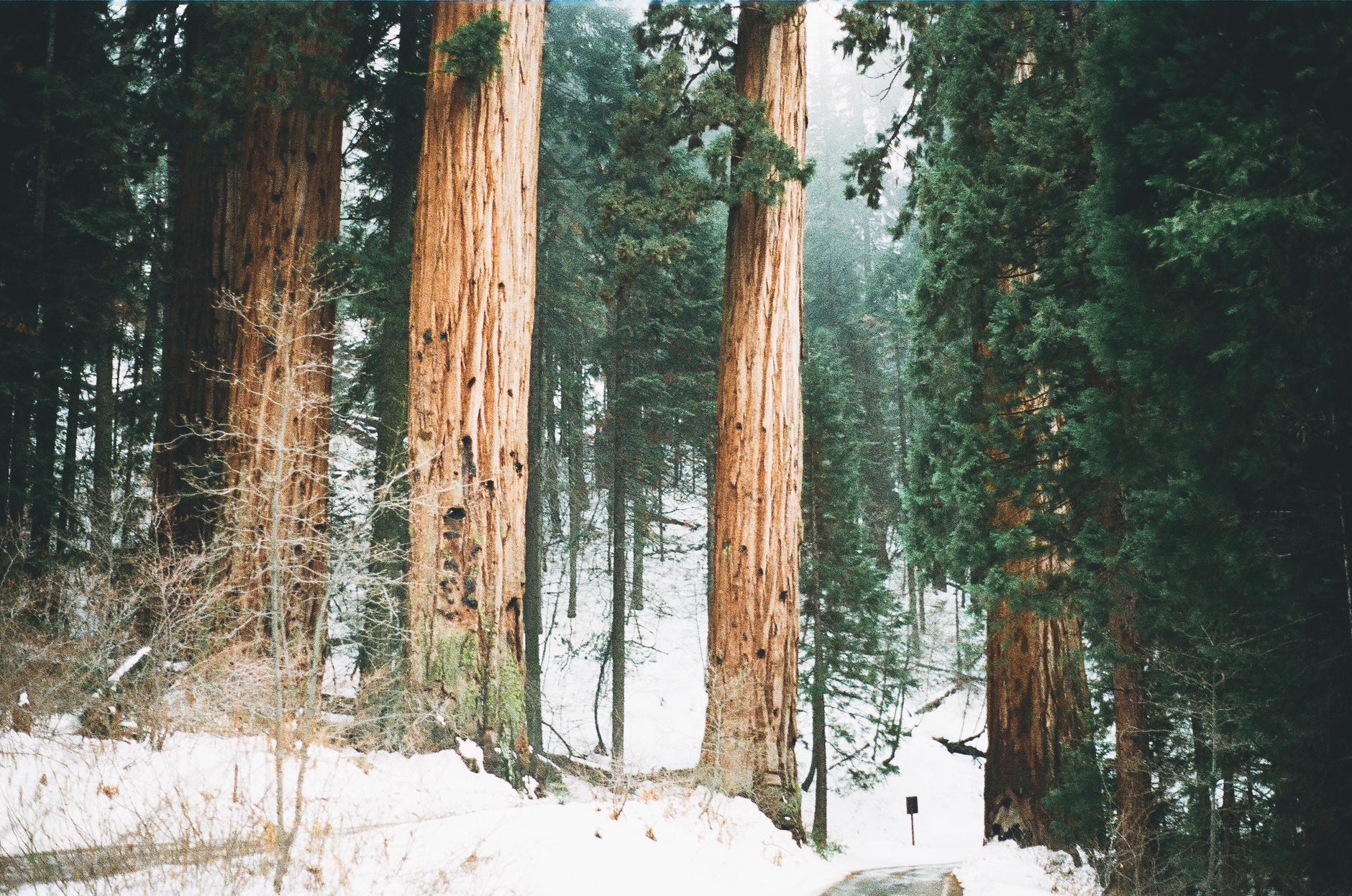
The Wawona Tunnel Tree, in Yosemite’s Mariposa Grove, was a living giant sequoia with a tunnel cut through its base in 1881 so tourists could ride carriages and later drive cars through it1. It stood for another 88 years before falling in the winter of 1968–69, brought down by heavy snow on wet, saturated soil, with the tunnel itself a significant factor in its structural failure1. The National Park Service gives its age as roughly 2,100 years, its height as 234 feet, and its base diameter as 26 feet1. It was the second sequoia ever tunneled, after the Tuolumne Grove’s Dead Giant in 1878, and it was famous enough that President William Howard Taft and John Muir visited it together in 19091. The tree still lies where it fell, signed today as the Fallen Tunnel Tree on the Mariposa Grove map1. No living sequoia has been tunneled since; the National Park Service now treats cutting through a living tree as incompatible with preserving the grove’s natural condition1.
- Tunnel cut: 1881, the second sequoia ever tunneled1
- Years standing after tunneling: 88 years1
- Fell: winter of 1968–69, under heavy snow on saturated ground1
- Age at fall: about 2,100 years, per NPS1
- Height: 234 feet1
- Base diameter: 26 feet1
- Notable visitors: President William Howard Taft and John Muir, together, in 19091
- Today: lies where it fell, signed as the Fallen Tunnel Tree1
The Wawona Tunnel Tree is the best-known casualty of a nineteenth-century tourism trend: cutting tunnels through living giant sequoias so visitors could ride or drive straight through the trunk. This page covers when it was tunneled, how it fell, what stands in its place today, and the small number of drive-through trees that remain. For every tree in this category, see every tunnel tree in California you can still walk or drive through; for a walkable fallen sequoia in Sequoia National Park, see Tunnel Log.
Why anyone cut a tunnel through a living tree
In the late 1800s, a tunnel through a giant sequoia’s trunk was a novelty attraction, proof that a single tree could be wide enough to drive a stagecoach through. The Tuolumne Grove’s Dead Giant was the first sequoia tunneled, in 1878. The Wawona Tree, in Yosemite’s Mariposa Grove, followed in 1881, becoming the second1. For decades afterward it was one of the most photographed trees in the National Park System, its trunk framing generations of visitors on horseback, in horse-drawn carriages, and eventually in early automobiles.
The tree’s fame reached the top of government. In 1909, President William Howard Taft visited the tunnel together with John Muir, whose writings and advocacy had helped build the case for protecting Yosemite and the Sierra’s other giant groves1. A photograph of a president driving through a living tree did more for the tunnel’s reputation than any advertisement could have.
The numbers
According to the National Park Service, the Wawona Tunnel Tree stood about 234 feet tall, with a base diameter of roughly 26 feet, and was estimated at around 2,100 years old at the time it fell1. Those figures put it solidly in the range of a large, mature giant sequoia, though well short of record-holders like General Sherman.
| Measurement | Value | Source |
|---|---|---|
| Tunnel cut | 1881 | NPS1 |
| Height | 234 ft | NPS1 |
| Base diameter | 26 ft | NPS1 |
| Estimated age at fall | ~2,100 years | NPS1 |
| Years standing after tunneling | 88 | NPS1 |
| Fell | Winter 1968–69 | NPS1 |
Why it fell in 1969
The National Park Service’s own account of the event is direct about the cause: heavy snow accumulated on the crown during the winter of 1968–69, at a time when the ground beneath the tree was already saturated with water, and the tree came down under that combined weight1. Crucially, the agency’s page on the myth of drive-through trees states plainly that the tunnel itself was a significant factor in the tree’s structural collapse, having removed a large portion of the trunk’s base and its ability to bear the weight above it for the better part of a century1. A tree that had stood for around two thousand years survived only 88 more after a hole was cut through its foundation.
The fall marked a turning point in how the National Park Service thought about attractions like it. The agency’s current position, stated on its “Myth of the Tree You Can Drive Through” page, is that cutting tunnels through living trees for tourism is no longer compatible with the goal of preserving giant sequoia groves as close to their natural condition as possible1. No living sequoia has been tunneled since.
What stands in its place
The fallen tree was not removed. It still lies on the ground in Mariposa Grove today, signed on the current trail map as the Fallen Tunnel Tree, a marker for where the attraction used to stand rather than a replacement for it1. Nearby, on the Grizzly Giant Loop Trail, the California Tunnel Tree remains standing and is one of the stops visitors pass on a walk through the grove, offering something closer to what the Wawona Tree once provided, without the specific history of celebrity visits2.
Mariposa Grove itself underwent a major restoration between 2015 and 2018, closing in spring 2015 to address declining conditions caused by infrastructure encroaching on sequoia roots and natural water flow, and reopening on June 15, 20182. A free shuttle now runs seasonally, typically May through November, with buses arriving roughly every 15 minutes to ferry visitors between the grove’s welcome plaza and its network of trails, which include the easy, wheelchair-accessible Big Trees Loop, the moderate Grizzly Giant Loop, and the more strenuous Guardians Loop and Mariposa Grove Trail2.
Other tunnel trees, for comparison
The Wawona Tree was not the only sequoia ever tunneled, and it was not even the last to fall. The Pioneer Cabin Tree at Calaveras Big Trees State Park, its tunnel enlarged in 1881 for the same tourism purpose, stood until January 8, 2017, when it fell during heavy winter storms from a combination of trunk and root decay and storm runoff3. Unlike the Wawona Tree, which fell under snow load, Pioneer Cabin came down under rain-driven decay decades later, but the underlying vulnerability was the same: a tunnel had removed structural wood the tree needed to stay upright.
The one sequoia-related drive-through structure that survives in Sequoia National Park itself, Tunnel Log, is a different kind of tree entirely. It is not a standing tree with a hole cut through it, but a sequoia that fell naturally across Crescent Meadow Road in 1937, through which the Civilian Conservation Corps cut a tunnel the following summer so the road could keep using the log rather than remove it4. Because the tree was already dead and on the ground, cutting through it carried none of the structural risk that doomed the living tunnel trees. See the full Tunnel Log guide for its dimensions and how to drive through it today.
Frequently Asked Questions
When was the Wawona Tunnel Tree cut?
The tunnel was cut in 1881, making it the second giant sequoia ever tunneled, after the Tuolumne Grove’s Dead Giant in 18781.
Why did the Wawona Tunnel Tree fall?
Heavy snow accumulated on its crown during the winter of 1968–69 while the ground beneath it was saturated with water. The National Park Service says the earlier tunnel cut was a significant factor in the structural failure that followed1.
How old was the Wawona Tunnel Tree when it fell?
About 2,100 years old, according to the National Park Service, after standing 88 years with a tunnel cut through its base1.
Can you still see the Wawona Tunnel Tree?
Yes. It lies where it fell in Mariposa Grove, signed on the current trail map as the Fallen Tunnel Tree1.
Is there still a living tree you can drive through in Yosemite?
What is the difference between the Wawona Tunnel Tree and Tunnel Log?
Related Articles
Sources
- The Myth of the Tree You Can Drive Through — National Park Service, Sequoia & Kings Canyon. Accessed 2026-09-09.
- Mariposa Grove of Giant Sequoias — National Park Service, Yosemite. Accessed 2026-09-09.
- State Parks Begins Study of Fallen Tunnel Tree — California State Parks. Accessed 2026-09-09.
- Tunnel Log — National Park Service. Accessed 2026-09-09.