
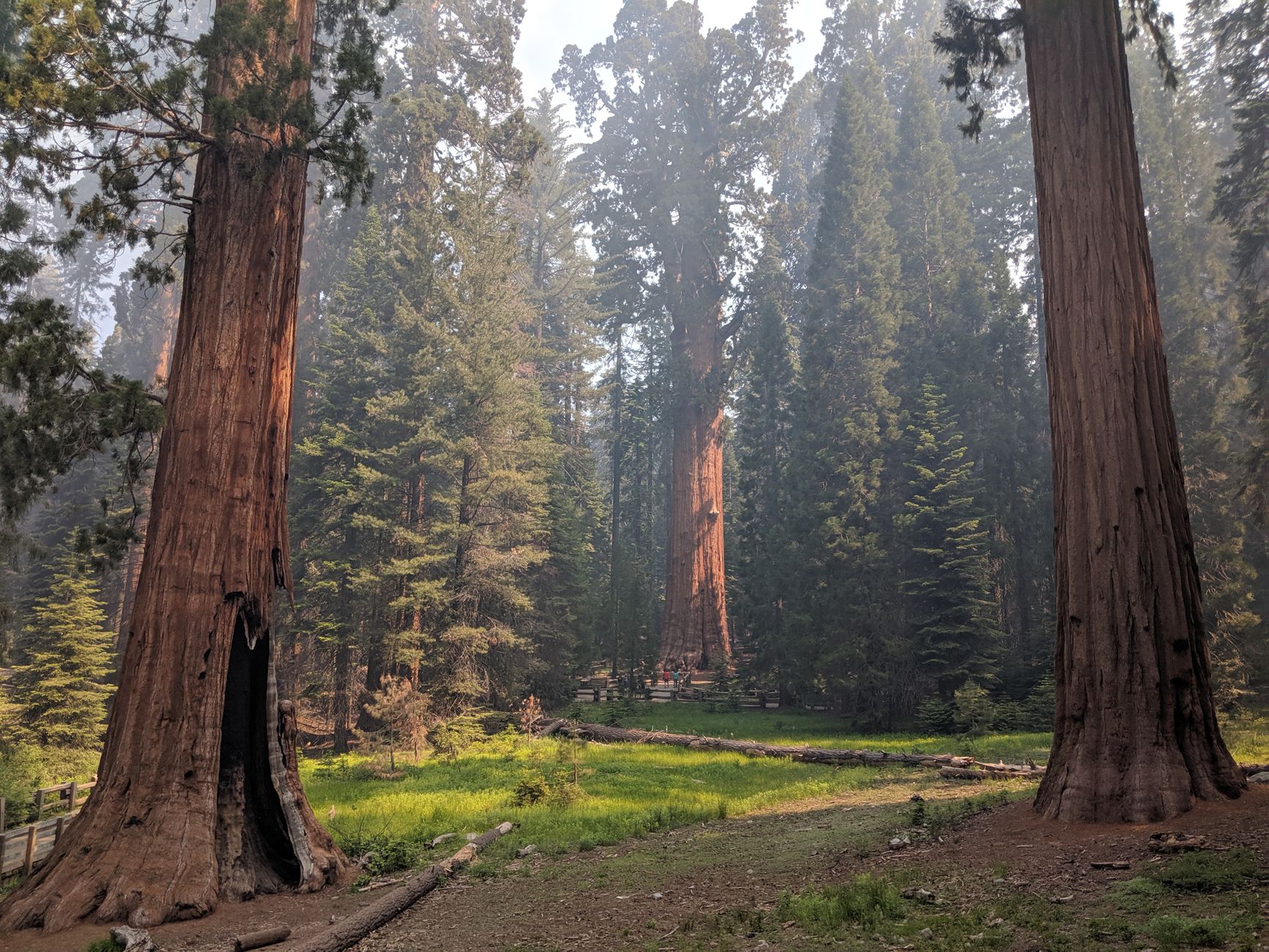
Calaveras Big Trees State Park, on Highway 4 four miles northeast of Arnold, is the only California state park with giant sequoias and the place where the outside world first learned of them in 185212. It has two groves: the North Grove, beside the entrance, with more than 150 sequoias, and the South Grove, nine paved miles in, reached by a road that closes from the first big snow or December 1 until May 113. Day use is $10 per vehicle ($12 on holiday weekends) and camping is $35 a night across 129 sites in two campgrounds, all open from May 1514. The North Grove holds the Discovery Stump, the Mother of the Forest, and the site of the Pioneer Cabin tunnel tree, which fell on January 8, 2017235.
- Location: Highway 4, 4 mi northeast of Arnold; about 35 min from Angels Camp, 1.5 hrs from Stockton, about 1.5 hrs from Sacramento16
- Day use: $10 per vehicle, $12 holiday weekends; seniors 62+ $9/$111
- Camping: $35 per night ($33 senior); 129 sites in the North Grove and Oak Hollow campgrounds; all sites open from May 1514
- Groves: North Grove, 150+ sequoias about 2,000 years old; South Grove, a roughly 5-mile hike, road closed in winter134
- Dogs: campgrounds and fire roads only1
- History: Discovery Tree publicized 1852, felled 1853; park established 193127
- Pioneer Cabin Tree: tunnel enlarged 1881, fell January 8, 20173
Calaveras Big Trees is the northern end of sequoia tourism, closer to Sacramento and the Bay Area than any national park grove, and the place with the longest history of people paying to look at these trees. This page explains the two groves and how they differ, the fees and seasons as they stood in September 2026, camping, and the three trees that made the park famous: the Discovery Tree, the Mother of the Forest, and the Pioneer Cabin Tree. It is one of the groves ranked on the where to see giant sequoias page.
Where it is and what it costs
The park sits on Highway 4 northeast of Stockton, four miles past the town of Arnold, at 1170 East Highway 416. State Parks puts it about 35 minutes from Angels Camp and 1.5 hours from Stockton; the Calaveras Big Trees Association gives about 1.5 hours from Sacramento via Highway 99 to Stockton and Highway 4 east16. From the Bay Area the association’s route is I-580 over the Altamont Pass, I-205, Highway 99 north, then Highway 4 east; it gives no total time6. The park phone is (209) 795-23341.
| Fee (as of September 2026) | Regular | Holiday / holiday weekend |
|---|---|---|
| Day use, per vehicle | $10 | $12 |
| Day use, senior 62+ | $9 | $11 |
| Camping, per night | $35 | $40 |
| Camping, senior | $33 | $38 |
Source: California State Parks1. Day use runs sunrise to sunset, and the park is open on holidays1.
North Grove vs South Grove
The park was established in 1931 and protects a mixed-conifer forest with two separate sequoia groves, plus the Stanislaus River and Beaver Creek between them17.
| North Grove | South Grove | |
|---|---|---|
| Location | beside the entrance and visitor center | about 9 mi in on the Walter W. Smith Parkway |
| Sequoias | more than 150, about 2,000 years old3 | a larger, wilder grove in a natural setting4 |
| Walk | short loop trail through the grove | about 5 miles round trip4 |
| Season | year-round | road closes at the first significant snowfall or Dec 1, reopens May 1 or later1 |
| Named trees | Discovery Stump, Mother of the Forest, Pioneer Cabin Tree (fallen)23 | Agassiz Tree, Palace Hotel Tree, Smith Cabin Tree5 |
| Crowds | busiest part of the park | quiet |
North Grove
The North Grove is the historic one. Its loop trail starts at the visitor center and passes every tree with a story, so it is where first-time visitors and families should go. State Parks describes it as more than 150 giant sequoias roughly 2,000 years old3. A hobbyist site gives the loop as about 1.8 miles and wheelchair accessible, but State Parks does not publish a length on its park page, so treat that as unconfirmed and allow an hour or more1.
South Grove
The South Grove is a different experience. The Walter W. Smith Parkway runs about nine miles from the entrance to its trailhead, and the grove is reached only on foot4. The Calaveras Big Trees Association describes it as a five-mile hiking trip through sequoias in their natural setting, with none of the North Grove’s development4. The parkway closes at the first significant snowfall or December 1, whichever comes first, and does not reopen until May 1 or later if snow lingers1. That closure also cuts off access to the Stanislaus River1. Two hollowed “cabin” trees still stand here, the Palace Hotel Tree and the Smith Cabin Tree5.
Camping
The park has two campgrounds, North Grove and Oak Hollow, with 129 sites between them4. All campsites open from May 151. The rate is $35 a night, $40 on holidays, with senior discounts1. The park is popular enough in summer that reservations through ReserveCalifornia are the safe course. Dogs are allowed in the campgrounds and on fire roads but nowhere else, which rules out the grove trails1.
This page carries lodging links; the site earns a commission on bookings made through them, which does not affect what is recommended. Arnold, four miles down Highway 4, and Angels Camp, 35 minutes away, are the nearest towns with beds for anyone not camping1.
The Discovery Tree and the Big Stump
Emigrant parties had noted the North Grove as early as 1849, but the tree that put giant sequoias in the newspapers was found in 1852 by Augustus T. Dowd, a hunter supplying the Union Water Company2. The following spring a promoter, Captain William H. Hanford, set out to make money from it. No saw was big enough, so the crew bored through the trunk with pump augers and chisels; the job took three weeks and the tree fell on June 27, 18532. Its bark had been stripped for exhibition first2.
The stump, about 27 feet across, became a dance floor and later a roofed pavilion used for concerts, lectures, weddings, and Fourth of July celebrations; the Mammoth Tree Hotel went up beside it in 1853–54, and a 60-guest hotel followed in 18612. The felling drew public disgust that fed the argument for protecting sequoias, a story told in full on the page about who discovered the giant sequoias.
The Mother of the Forest
A short walk from the Discovery Stump stands the Mother of the Forest, a sequoia whose bark was stripped in the 1850s to be reassembled as an exhibit for paying crowds7. The tree survived the stripping for a time but could not last without its bark, and it still stands as a dead snag7. It has its own page: the Mother of the Forest.
The Pioneer Cabin Tree, 1881–2017
The Pioneer Cabin Tree was the North Grove’s tunnel tree. Lightning in the 1800s had hollowed its base; in 1881 the hollow was squared and enlarged into a tunnel to compete with Yosemite’s Wawona Tunnel Tree, and for 60 years visitors rode horses and carriages through it, then automobiles in the 1920s35. State Parks gave its size as about 205 feet tall and more than 19 feet in diameter at 6 feet above the ground3.
It fell at about 2:30 pm on Sunday, January 8, 2017, during a storm that had dropped nearly a foot of rain in two weeks and more than three inches that day. State Parks attributed the collapse to a combination of trunk and root decay and storm-water runoff35. Afterward, State Parks, Save the Redwoods League, and a Humboldt State dendrochronologist spent about ten hours cutting a 7.5-by-3.5-foot section to study its rings for drought, rainfall, and fire history, with the piece intended for an interpretive display3. The tree lies where it fell. Why no living sequoia is tunneled anymore, and which tunnel trees still stand, is explained on the tunnel trees page.
When to go
- May to October is the full-park season: both groves, all campsites, and the river1.
- November to April the North Grove stays open for day use, but the South Grove road is closed and Highway 4 can carry chain controls in storms; the park sits high enough for real snow1.
- Fall brings dogwood color to the groves and the smallest crowds of the open season.
Calaveras compared with the national park groves
Calaveras has hundreds of sequoias; Sequoia National Park’s Giant Forest has thousands, including the largest tree on Earth8. What Calaveras offers instead is proximity to Northern California, a $10 fee against $35 at the national parks, campgrounds inside the grove, and the most important historic site in the sequoia story19. For a visitor from Sacramento or the Bay Area with one day, it is the practical choice; for anyone who wants scale, drive south. The full comparison is on the closest sequoias to Los Angeles, San Francisco, and Sacramento page.
Frequently Asked Questions
What is the difference between the North Grove and South Grove at Calaveras?
How much does Calaveras Big Trees cost?
Day use is $10 per vehicle, or $12 on holiday weekends; camping is $35 a night, $40 on holidays, as of September 20261.
Can you bring a dog to Calaveras Big Trees?
Only into the campgrounds and onto fire roads. Dogs are not allowed on the grove trails1.
Is the Pioneer Cabin Tree still standing?
How far is Calaveras Big Trees from Sacramento?
About 1.5 hours by car via Highway 99 to Stockton and Highway 4 east, according to the Calaveras Big Trees Association6.
Is Calaveras open in winter?
The North Grove and day-use areas are open year-round, sunrise to sunset. The South Grove road closes at the first significant snowfall or December 1 and reopens May 1 or later1.
Where was the first giant sequoia discovered?
Related Articles
Sources
- Calaveras Big Trees State Park — California State Parks. Accessed 2026-09-06.
- Big Trees, the Early Years — Calaveras Heritage Council. Accessed 2026-09-06.
- State Parks Begins Study of Fallen Tunnel Tree — California State Parks. Accessed 2026-09-06.
- Park Info — Calaveras Big Trees Association. Accessed 2026-09-06.
- Pioneer Cabin Tree Falls — Calaveras Big Trees Association. Accessed 2026-09-06.
- Directions to Big Trees — Calaveras Big Trees Association. Accessed 2026-09-06.
- Calaveras Big Trees State Park Fact Sheet (PDF) — California State Parks. Accessed 2026-09-06.
- Giant Sequoia Groves — National Park Service, Sequoia & Kings Canyon. Accessed 2026-09-06.
- Fees & Passes — National Park Service, Sequoia & Kings Canyon. Accessed 2026-09-06.