
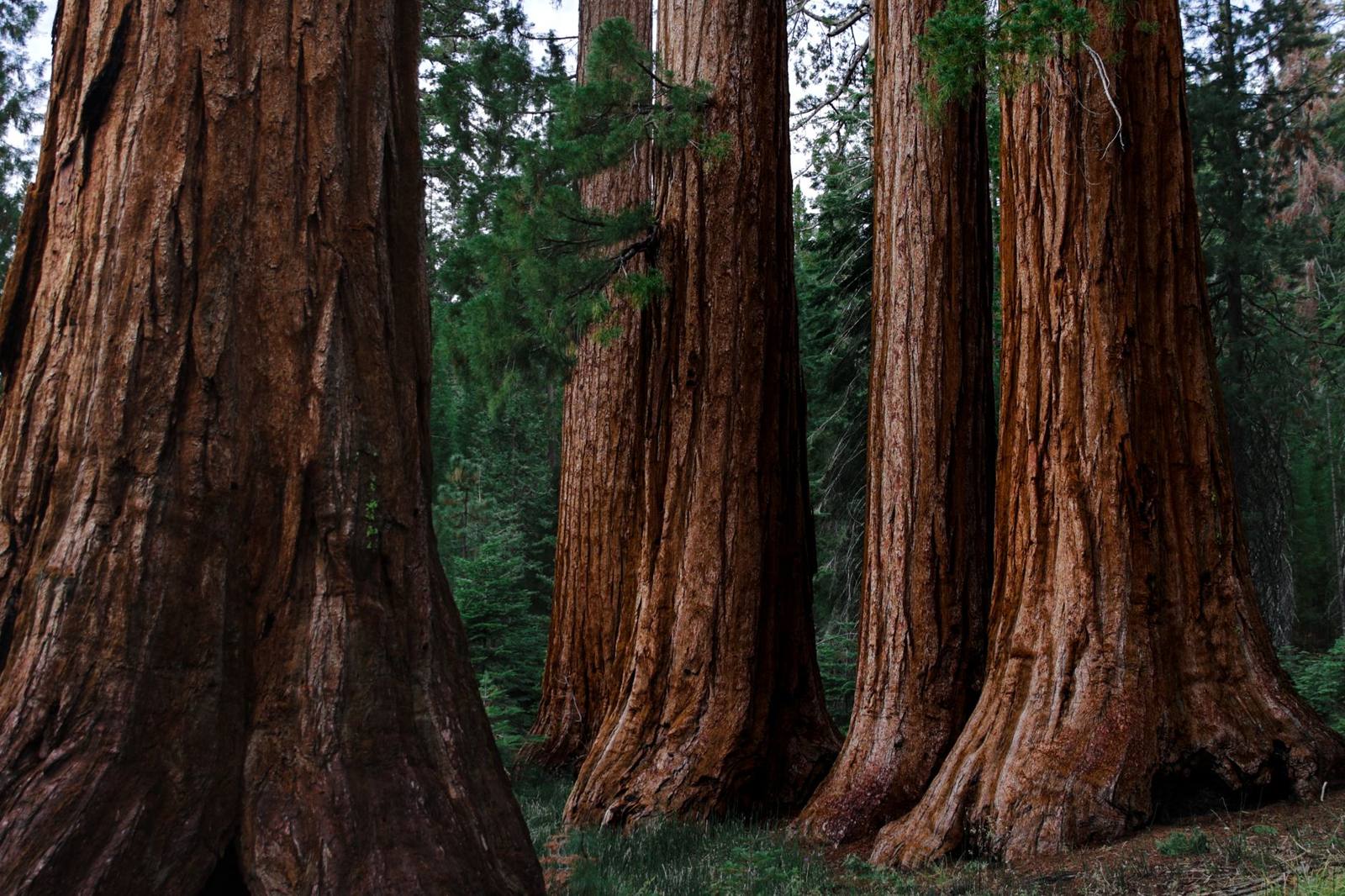
In 1854, a crew led by speculator George Gale stripped 116 feet of bark from a giant sequoia at what is now Calaveras Big Trees State Park, a job that took four workers 21 days1. California State Parks materials put the weight of bark removed at nearly 60 tons2. The bark was reassembled into a walk-through shell, toured through the eastern United States, and shipped to England for display in a glass case at London’s Crystal Palace, where a fire destroyed the exhibit in 18661. The tree survived the stripping. It still stands today, a blackened snag in the park’s North Grove13. This page covers what happened to the tree, why it drew crowds on two continents, and how to see it now.
- Bark stripped: 1854, to a height of 116 ft, by four men working 21 days1
- Weight of bark removed: nearly 60 tons2
- Purpose: a traveling commercial exhibit of a “curiosity of nature”1
- Exhibited: across the eastern United States, then in a glass case at London’s Crystal Palace1
- Fire: destroyed the Crystal Palace exhibit in 18661
- Fate of the tree: survived the stripping and still stands as a snag in the North Grove13
- Grove discovered: 1852, by hunter Augustus T. Dowd4
- Park established: 1931, protecting the North and South Groves5
The Mother of the Forest was never the largest tree at Calaveras. It became the most famous one because of what was done to it, two years after the grove itself became a national sensation. Its story is one of the odder episodes in the history of Sequoia National Park and the wider big-tree country, even though the tree itself stood 150 miles north of the park, in the Sierra foothills near Arnold.
The grove that made Big Trees famous
Hunter Augustus T. Dowd, working for the Union Water Company, brought outside attention to the Calaveras grove in 1852 when he publicized what became known as the Discovery Tree45. Emigrant parties had actually passed through the North Grove as early as 1849, but it was Dowd’s account that reached newspapers and turned the site into a destination4. The Discovery Tree itself was felled the following year, on June 27, 1853, after a crew spent weeks working it with pump augers and chisels because no saw was long enough to reach through its trunk4. Its 27-foot stump was leveled off and used for dances, concerts, and Fourth of July celebrations, and a hotel went up nearby within the year4. For more on how the discovery unfolded and who actually gets credit for it, see who discovered the giant sequoias.
The grove that resulted is now Calaveras Big Trees State Park, established in 1931 to protect the North and South Groves along Highway 4, about four miles northeast of Arnold5. It remains the only California state park with giant sequoias5.
Stripping the Mother of the Forest
The felling of the Discovery Tree was destructive but crude. What happened next to a second, still-living tree nearby was more calculated. In 1854, a man named George Gale organized a crew of four workers who spent 21 days stripping bark from a tree that came to be called the Mother of the Forest, working their way up the trunk to a height of 116 feet1. State park materials describe the job as removing nearly 60 tons of bark2.
The goal was not lumber. It was spectacle. The bark sections were numbered and shipped east so they could be reassembled into a free-standing shell that visitors could walk into and study, a way of bringing the scale of a California giant sequoia to people who would never travel to see one growing1. It worked as a business plan for a while, if not without controversy.
A traveling sideshow, coast to coast and then to England
The reassembled bark toured venues in the eastern United States before it was shipped abroad, ending up on display in England1. There it was set up in a glass case inside the Crystal Palace, the vast iron-and-glass exhibition hall that had already made a name for itself displaying industrial and natural marvels to Victorian crowds1. For a tree that had never left California, the Mother of the Forest’s bark traveled further than most 19th-century Californians ever would.
The exhibit’s run ended in 1866, when a fire tore through the Crystal Palace and destroyed the display along with it1. It was not the only Calaveras exhibit to meet that fate. Sections of the Discovery Tree itself had been shipped to New York for a similar show, where skeptics dismissed the whole thing as a hoax; that exhibit, too, was destroyed by fire, while the sections were still awaiting further shipment to Paris2. Big-tree exhibits in the 19th century seem to have had a habit of burning.
What became of the tree itself
Losing 116 feet of bark should have killed the tree outright, and for years many visitors assumed it eventually did. It did not fall. Deprived of the living tissue that once carried water and nutrients up its trunk, the Mother of the Forest slowly died standing, and it remains standing today: a tall, blackened, hollow snag in the North Grove, still recognizable by its scale even without a scrap of bark left on it13. State park fact-sheet materials describe the tree as having survived the stripping and continuing to stand as a snag rather than collapsing outright3. It is a monument to a specific kind of 19th-century enthusiasm: proof that discovering something remarkable and immediately trying to sell tickets to see pieces of it were, for a certain kind of entrepreneur, the same impulse.
The episode also set a pattern. Big-tree country would see more of this same commercial instinct in the following decades, from cut cross-sections shipped to world’s fairs to the tunnel cut through the Wawona Tree in Yosemite. None of the later exhibits, though, involved skinning a living tree while it was still standing.
Visiting the Mother of the Forest today
The snag stands in the North Grove at Calaveras Big Trees State Park, reachable on the North Grove Trail, a roughly 1.8-mile loop that also passes the Discovery Tree stump5. As of September 2026, the park charges day-use fees on the state parks website and keeps the North Grove Trail open year-round, weather permitting; check current conditions before a winter visit, since the road to the South Grove closes with the first significant snowfall5. For trip planning, fees, and the difference between the North and South Groves, see the full Calaveras Big Trees State Park guide.
Frequently Asked Questions
What is the Mother of the Forest?
Did the Mother of the Forest tree die?
Where was the bark exhibited?
The bark was reassembled and shown at venues across the eastern United States before being shipped to England, where it went on display in a glass case at the Crystal Palace in London. A fire destroyed that exhibit in 18661.
Who cut the bark off the Mother of the Forest?
State-park-adjacent historical accounts credit George Gale with organizing the work, which took four men 21 days to strip bark up to a height of 116 feet1.
Is the Mother of the Forest the same tree as the Discovery Tree?
No. The Discovery Tree was a separate giant sequoia at Calaveras that was felled entirely in June 1853, the year before the Mother of the Forest was stripped of its bark. Both episodes happened in the same North Grove4.
Can you still see the Mother of the Forest?
Yes. The snag still stands in the North Grove at Calaveras Big Trees State Park and is reachable on the North Grove Trail5.
Is Calaveras Big Trees State Park the same as Sequoia National Park?
No. Calaveras Big Trees State Park is a separate state park roughly 150 miles north of Sequoia National Park, in the central Sierra foothills near Arnold. It protects two groves of giant sequoias but is administered by California State Parks, not the National Park Service5.
Related Articles
Sources
- Big Tree Trail — Journal of Sierra Nevada History & Biography, Sierra College. Accessed 2026-09-15.
- Park History — California State Parks. Accessed 2026-09-15.
- Calaveras Big Trees Fact Sheet (PDF) — California State Parks. Accessed 2026-09-15.
- Big Trees, Early Years — Calaveras Heritage Council. Accessed 2026-09-15.
- Calaveras Big Trees State Park — California State Parks. Accessed 2026-09-15.