
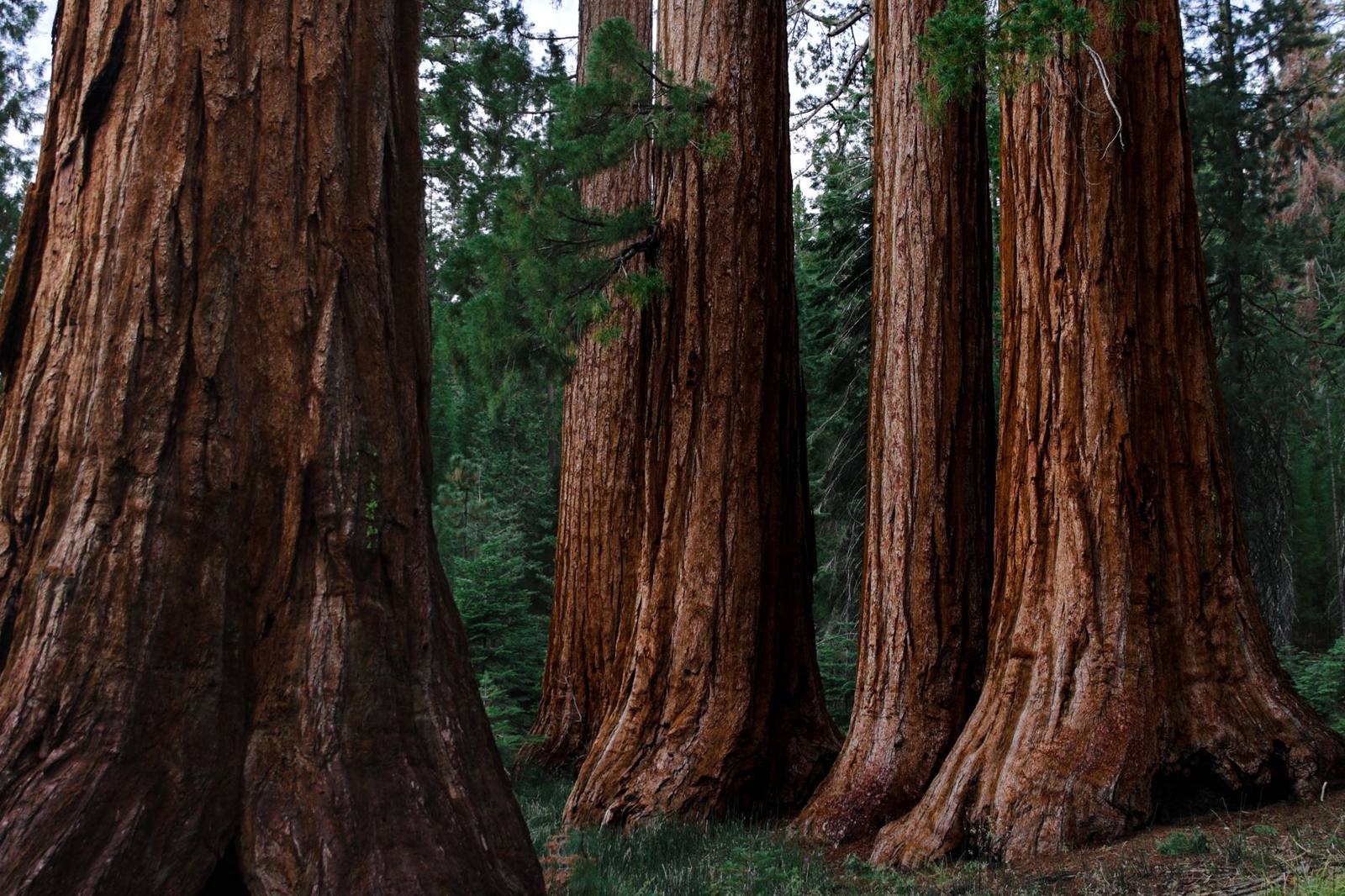
Sequoiadendron giganteum is the current scientific name for the giant sequoia, placed in its own genus by botanist John T. Buchholz in 19391. Before that, the tree carried two earlier names: Wellingtonia gigantea, given by John Lindley in 1853 in honor of the Duke of Wellington, and Sequoia gigantea, applied by Joseph Decaisne in 1854 when he grouped the tree with coast redwood12. Buchholz split the two apart because they differ enough in cone and seed structure to warrant separate genera, leaving the genus Sequoia with a single living species, the coast redwood1. That reclassification means the word “sequoia” in strict botanical usage now names only the coast redwood, even though “giant sequoia” remains the tree’s universal common name13. Sequoiadendron sits in the cypress family, Cupressaceae, alongside Sequoia and the dawn redwood genus Metasequoia4.
- Current name: Sequoiadendron giganteum (Lindl.) Buchholz1
- Genus created: 1939, by John T. Buchholz1
- Earlier names: Wellingtonia gigantea (Lindley, 1853); Sequoia gigantea (Decaisne, 1854)12
- Family: Cupressaceae (cypress family)45
- Common names: giant sequoia, “bigtree,” Sierra redwood, and (in Britain) Wellingtonia1
- Subspecies: none recognized1
- Genus name origin: “Sequoia” plus the Greek word for tree; whether “Sequoia” itself honors the Cherokee scholar Sequoyah is disputed16
- Closest living relatives: coast redwood (Sequoia sempervirens) and dawn redwood (Metasequoia glyptostroboides), the other two Cupressaceae genera called “redwood”47
Giant sequoia has carried three different scientific names since Western botanists first described it in 1853, and the genus it lives in today, Sequoiadendron, has exactly one species in it. This page traces that naming history, explains why it means “sequoia” is not, strictly speaking, the giant sequoia’s genus, and places the tree within the wider family of conifers it belongs to. For the species’ size, age, and range, see the giant sequoia trees guide.
Classification at a glance
| Rank | Name |
|---|---|
| Kingdom | Plantae |
| Division | Pinophyta (conifers) |
| Family | Cupressaceae |
| Genus | Sequoiadendron |
| Species | S. giganteum |
| Author citation | (Lindl.) Buchholz |
| Recognized subspecies or varieties | None |
Source: The Gymnosperm Database and the U.S. Forest Service’s fire-effects database13.
A name that changed twice before it was settled
In 1853, the English plant collector William Lobb rushed giant sequoia seed and foliage samples to England, where John Lindley of the Horticultural Society of London rushed out a formal description. Lindley named the tree Wellingtonia gigantea, honoring the Duke of Wellington, who had died the previous year2. American botanist Albert Kellogg had already been preparing to name the same tree Washingtonia, after George Washington, and the near-simultaneous naming attempts on opposite sides of the Atlantic set off a dispute over which name should stand2.
Neither name survived. In 1854, French botanist Joseph Decaisne concluded that the tree belonged in the same genus as coast redwood, which had been named Sequoia in 1847, and renamed it Sequoia gigantea1. That classification held for 85 years. In 1939, American botanist John T. Buchholz examined the cone and seed anatomy of both trees closely enough to conclude they did not belong in the same genus after all, and created Sequoiadendron, “tree of the sequoias,” to hold giant sequoia alone1. The modern name, Sequoiadendron giganteum, has been standard ever since, though old signage, older books, and outdated online references still sometimes use Sequoia gigantea, and California’s own state government code has never been updated to match, a quirk covered on the California state tree page8.
Why "Sequoia" technically means coast redwood
Buchholz’s 1939 split had a side effect that trips up casual research: once giant sequoia moved into its own genus, the genus Sequoia was left with a single living species, the coast redwood1. In strict taxonomic terms, “a sequoia” is a coast redwood, and the tree everyone calls a giant sequoia is technically a Sequoiadendron, not a Sequoia. Common usage never caught up with the split. “Giant sequoia” remains the name used by the National Park Service, the U.S. Forest Service, and every field guide, and this site follows that convention throughout, as instructed by the writing guide’s own house style.
The origin of the word “Sequoia” itself is a separate and older argument. It is commonly said to honor Sequoyah, the Cherokee scholar who created a writing system for the Cherokee language, but the botanist who coined the genus name, Stephen Endlicher, left no explanation, and some botanical historians argue the name instead derives from the Latin sequor (“I follow”), a reference to the genus following Taxodium in Endlicher’s classification scheme. The full case for each side is worked out on the page why is it called sequoia.
Where giant sequoia sits among the "redwoods"
Three unrelated-sounding common names — coast redwood, giant sequoia, and dawn redwood — all belong to the same family, Cupressaceae, and are often grouped loosely as “the redwoods” even though each is in its own genus47. The table below places them side by side.
| Genus | Species | Common name | Native range |
|---|---|---|---|
| Sequoia | S. sempervirens | Coast redwood | Coastal fog belt, central California to southern Oregon |
| Sequoiadendron | S. giganteum | Giant sequoia | About 94 Sierra Nevada groves, 4,000–8,000 ft |
| Metasequoia | M. glyptostroboides | Dawn redwood | Small valleys in Hubei, Hunan, and Chongqing, China |
Sources: Save the Redwoods League on coast redwood and dawn redwood ranges, and the U.S. Forest Service on giant sequoia’s range479. A full comparison of all three is at the three redwoods: dawn redwood vs. giant sequoia vs. coast redwood, and the story of Metasequoia’s own rediscovery is told on the dawn redwood discovery page.
What sets Sequoiadendron apart physically
Giant sequoia foliage is bluish-green and scale-like, with short, thick, sharp-pointed needles arranged in a spiral around the twig, unlike coast redwood’s flatter, two-ranked needles10. Its cones are small for the size of the tree, typically 2 to 3.5 inches long, egg-shaped, and woody, staying green and sealed on the tree for twenty years or more before opening19. Bark is reddish-brown, deeply furrowed, and fibrous, commonly a foot or more thick at the base, among the thickest bark of any tree species9. Details on cone structure and seed release are on the giant sequoia cones and seeds page.
A genus with a shrinking family tree
Sequoiadendron is what botanists call a monotypic genus: one genus, one living species, with no close relatives left standing beside it. That was not always the case. Save the Redwoods League notes that giant sequoia, coast redwood, and dawn redwood descend from a shared lineage that once grew across much of the Northern Hemisphere, before a cooling, drying climate over millions of years left only isolated refuges: the Sierra Nevada for giant sequoia, the coastal fog belt for coast redwood, and a handful of valleys in central China for dawn redwood47. Each of the three genera in that lineage that survived to the present day is now represented by exactly one species, which is part of why the three trees invite comparison despite looking and growing so differently.
Frequently Asked Questions
What is the scientific name for giant sequoia?
Sequoiadendron giganteum (Lindl.) Buchholz. The species has no recognized subspecies or varieties1.
Why isn't giant sequoia classified as a Sequoia?
Botanist John T. Buchholz separated it into its own genus, Sequoiadendron, in 1939, based on differences in cone and seed anatomy from coast redwood, the only species that remained in the genus Sequoia1.
What did people call giant sequoia before 1939?
Is "Sequoia" named after Sequoyah?
It is commonly believed to be, but the connection is disputed by botanical historians, since the botanist who coined the name left no written explanation for it. Some researchers argue for a Latin origin instead6.
What plant family is giant sequoia in?
Cupressaceae, the cypress family, along with coast redwood and dawn redwood4.
Are giant sequoia and coast redwood the same genus?
No, not since 1939. Giant sequoia is Sequoiadendron; coast redwood is Sequoia. They are closely related but classified separately1.
Does giant sequoia have any subspecies or varieties?
No. Sequoiadendron giganteum is recognized as a single species with no subspecies, though cultivated varieties for landscaping exist, such as ‘Pendulum’ and ‘Glaucum’1.
Related Articles
Sources
- Sequoiadendron giganteum — The Gymnosperm Database. Accessed 2026-09-15.
- How the giant sequoia came to England — National Trust. Accessed 2026-09-15.
- FEIS: Sequoiadendron giganteum — U.S. Forest Service. Accessed 2026-09-15.
- Giant Sequoias — Save the Redwoods League. Accessed 2026-09-15.
- Metasequoia glyptostroboides — Yale Nature Walk. Accessed 2026-09-15.
- Naming Sequoia — Yore Sequoia. Accessed 2026-09-15.
- Coast Redwoods — Save the Redwoods League. Accessed 2026-09-15.
- California Code, Government Code – GOV § 422 — California Legislative Information. Accessed 2026-09-15.
- Sequoiadendron giganteum, Silvics of North America — U.S. Forest Service. Accessed 2026-09-15.
- Giant Sequoia (Sequoiadendron giganteum) — UC Agriculture and Natural Resources. Accessed 2026-09-15.