
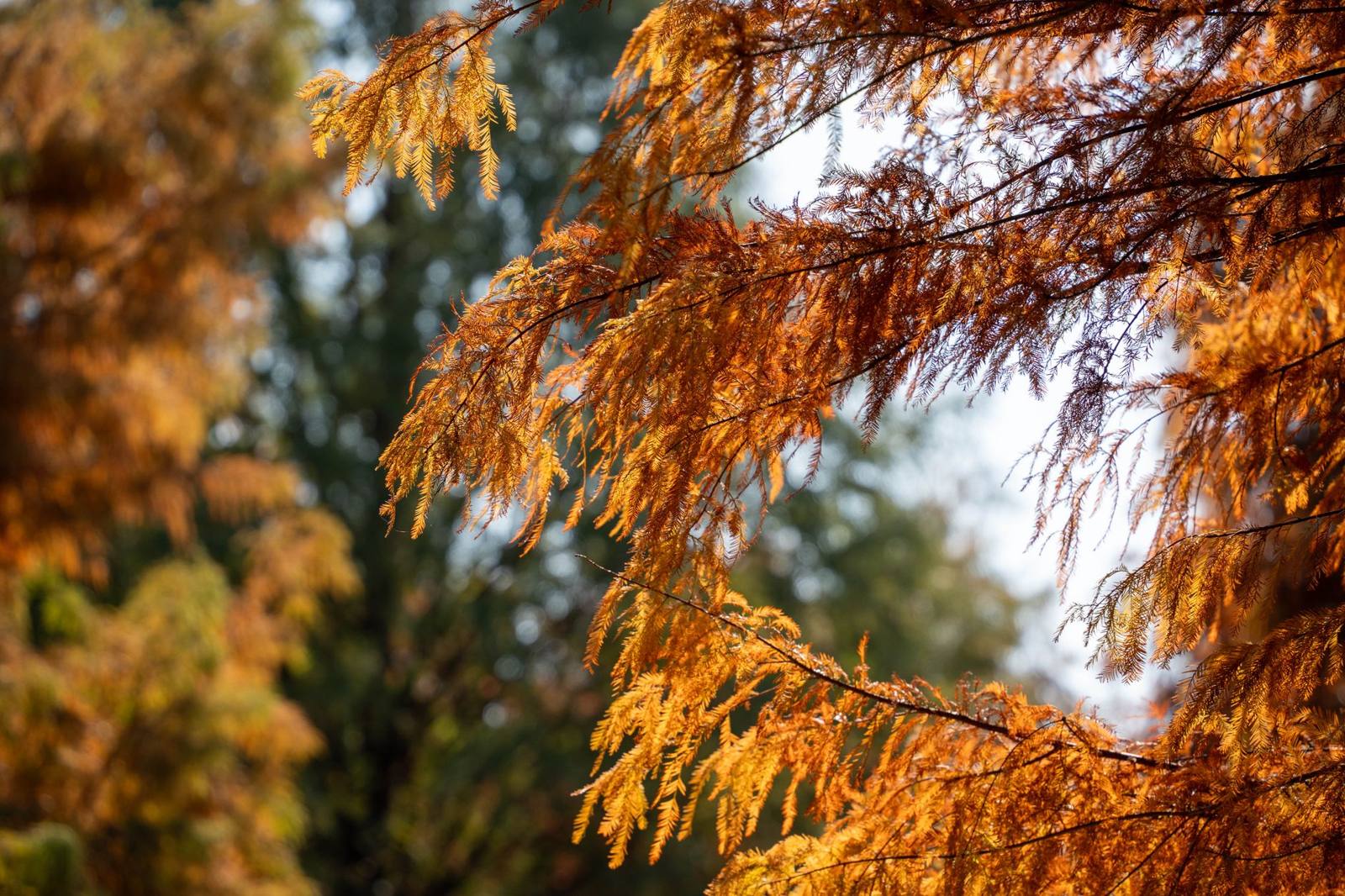
Dawn redwood, Metasequoia glyptostroboides, is known as a “living fossil” because it was described from fossil remains before anyone confirmed a living population existed12. In 1941, Japanese paleobotanist Shigeru Miki named the fossil genus Metasequoia from deposits roughly five million years old1. That same year, unaware of Miki’s paper, a Chinese forestry official noticed a large deciduous conifer locally called shui-sa, or “water fir,” growing near Mo-tao-chi in what is now Hubei province1. Specimens collected over the following years let botanists Wan-Chun Cheng and Hsen-Hsu Hu confirm in 1946 that the living tree and Miki’s fossil genus were the same plant, a species alive that science had known only as extinct1. In 1947 and 1948, Arnold Arboretum director Elmer D. Merrill funded seed collection in China, and two shipments of seed reached the Arboretum in January and February 1948; the Arboretum went on to distribute at least 600 seed packets to gardens and institutions worldwide before China closed to Western botanists in 19491.
- Fossil genus named: 1941, by Shigeru Miki, from deposits about 5 million years old1
- Living tree first noticed: 1941, near Mo-tao-chi (Modaoxi), Hubei province, China, called shui-sa (“water fir”) locally1
- Species confirmed alive and named: 1946, by Wan-Chun Cheng and Hsen-Hsu Hu, as Metasequoia glyptostroboides1
- Seed collection funded: July 1947, with $250 from Arnold Arboretum director Elmer D. Merrill1
- Seed reached the US: January and February 1948, two shipments to Arnold Arboretum1
- Seed redistributed: at least 600 packets sent to gardens and universities worldwide1
- Estimated wild population at discovery: about 1,000 trees; roughly 5,400 documented today3
- Family: Cupressaceae, the cypress family, along with coast redwood and giant sequoia14
Dawn redwood is the only one of the three “redwood” trees whose modern discovery happened within living memory, and its story runs backward from how most species are found: paleontologists described it from fossils first, then botanists found it alive years later. This page traces that timeline from the 1941 fossil description through the seed shipments that put dawn redwoods in gardens around the world by 1948. For the tree’s place alongside its two better-known relatives, see the where to see giant sequoias guide.
Named from fossils in 1941, before anyone knew it survived
In 1941, Japanese paleobotanist Shigeru Miki examined fossil conifer remains and concluded they represented a genus distinct from the living genus Sequoia, which he named Metasequoia, meaning “like a sequoia”1. At the time, every known Metasequoia specimen was fossilized, dated to roughly five million years old, and the genus was treated as extinct1. Miki had no way of knowing that, in the same year, a living relative of the tree he had just named was standing in a valley in central China.
A tree noticed by chance, then studied for five years
Also in 1941, a Chinese forestry professor named T. Kan came across a large deciduous conifer while traveling through Wan Hsien, near Mo-tao-chi (Modaoxi) in what is now Hubei province1. Local people called it shui-sa, or “water fir.” Because it was winter and the tree had already dropped its needles, Kan could not collect a usable specimen and the encounter went no further at the time1.
The tree was not properly documented for several more years. In 1942, Kan asked a colleague, Lung-hsin Yang, to collect herbarium material, but those early specimens went unidentified1. In the summer of 1944, forester T. Wang collected leafy branches and fruit from the same tree, at first misidentifying it as a species of water pine1. It took two more botanists, Chung-lun Wu and Wan-Chun Cheng, working from Wang’s 1944 specimens, to recognize in 1944–1946 that the fruiting scales’ distinctive opposite arrangement meant this was not a known genus at all1. Cheng’s assistant, C.Y. Hsieh, made two further expeditions, in February and May 1946, specifically to collect flowers and young fruit needed to complete the description1.
In 1946, Cheng, working with Hsen-Hsu Hu, the first Chinese national to earn a Harvard doctorate in botany, formally connected the living Hubei tree to Miki’s 1941 fossil genus and published it as a new species, Metasequoia glyptostroboides1. A conifer known only from fossils, believed extinct for millions of years, was alive in a river valley in Hubei.
The 1947–1948 seed rescue
Word of the discovery reached the United States, and Elmer D. Merrill, director of Harvard’s Arnold Arboretum, moved to secure seed before China’s political situation made that impossible. In July 1947, Merrill funded a seed-collecting expedition with $250, with additional support from Ralph Chaney of the University of California, Berkeley1. Two shipments of dawn redwood seed reached the Arnold Arboretum in January and February of 19481. The Arboretum redistributed the seed widely, sending at least 600 packets, more than a kilogram of seed in total, to botanical gardens, arboreta, and universities around the world1. That distribution effort finished just before China closed to Western botanists after the 1949 revolution, a door that would not reopen until 19801.
The rescue produced a footnote dispute rather than a clean ending. In March 1948, Ralph Chaney and a science journalist published articles crediting Chaney with the seed collection and discovery, which Merrill, who had organized and funded the effort from Harvard, considered a misrepresentation and documented his objection to at the time1. Both men had real roles: Chaney contributed funding and later conducted his own field studies of the Hubei population, but the seed-collection effort that stocked the world’s gardens was organized and financed through Merrill’s office at the Arnold Arboretum1.
One of the many recipient institutions, Tyler Arboretum in Pennsylvania, received two Metasequoia seeds from the Arnold shipment in 1948, planted them that same year, and has since grown its collection to 19 dawn redwoods, an example of how a single seed shipment multiplied into permanent plantings across the world5.
What the tree turned out to be
Dawn redwood is a deciduous conifer, unusual among cone-bearing trees for dropping its needles every winter after they turn a copper-orange color36. It commonly reaches 100 to 130 feet tall in cultivation today, with some individual ancient trees having exceeded 160 feet, and its trunk often develops a buttressed, flared base more than 10 feet across6. Unlike its California relatives, dawn redwood evolved in wet, seasonally flooded lowland habitat and has no particular adaptation to fire6. At the time of its scientific discovery, an estimated 1,000 native trees existed in the wild; roughly 5,400 have been documented in China today, and the original tree studied in 1943 is thought to still be alive, at an estimated age of about 400 years3.
All three “redwoods” — dawn redwood, coast redwood, and giant sequoia — belong to the cypress family, Cupressaceae, and share a common ancestry that once spread across much of the Northern Hemisphere before retreating to isolated refuges as the climate cooled over millions of years14. A full comparison of the three trees side by side is at the three redwoods: dawn redwood vs. giant sequoia vs. coast redwood.
Frequently Asked Questions
When was the dawn redwood discovered?
It depends on which discovery is meant. The fossil genus Metasequoia was named in 1941, and the living tree, first noticed by a Chinese forestry professor that same year, was not confirmed as the living version of that fossil genus until 19461.
Where was the living dawn redwood found?
Who discovered the dawn redwood?
Several people were involved over five years: T. Kan first noticed the tree in 1941; T. Wang collected identifiable specimens in 1944; and Wan-Chun Cheng and Hsen-Hsu Hu formally described it as a living species in 1946, connecting it to Shigeru Miki’s 1941 fossil genus1.
Why is the dawn redwood called a "living fossil"?
How did dawn redwood seed reach the rest of the world?
Arnold Arboretum director Elmer D. Merrill funded a 1947 seed-collecting expedition, and two shipments of seed reached the Arboretum in January and February 1948. At least 600 seed packets were then distributed to gardens and universities worldwide1.
How many dawn redwoods exist in the wild today?
An estimated 1,000 native trees existed when the species was discovered; roughly 5,400 have been documented in China today3.
Is the original dawn redwood tree still alive?
The tree studied in 1943 near Modaoxi is thought to still be living, at an estimated age of about 400 years3.
How is dawn redwood different from giant sequoia and coast redwood?
Dawn redwood is deciduous, dropping its needles each winter, unlike its two evergreen California relatives, and it evolved in a wet, seasonally flooded habitat rather than one shaped by wildfire6.
Related Articles
Sources
- The Living Fossil — Arnold Arboretum, Harvard University. Accessed 2026-09-15.
- Metasequoia glyptostroboides — Yale Nature Walk. Accessed 2026-09-15.
- Dawn Redwood: A Living Fossil — University of Illinois Extension. Accessed 2026-09-15.
- Giant Sequoias — Save the Redwoods League. Accessed 2026-09-15.
- Tyler’s Dawn Redwoods — Tyler Arboretum. Accessed 2026-09-15.
- Dawn Redwoods — Save the Redwoods League. Accessed 2026-09-15.