
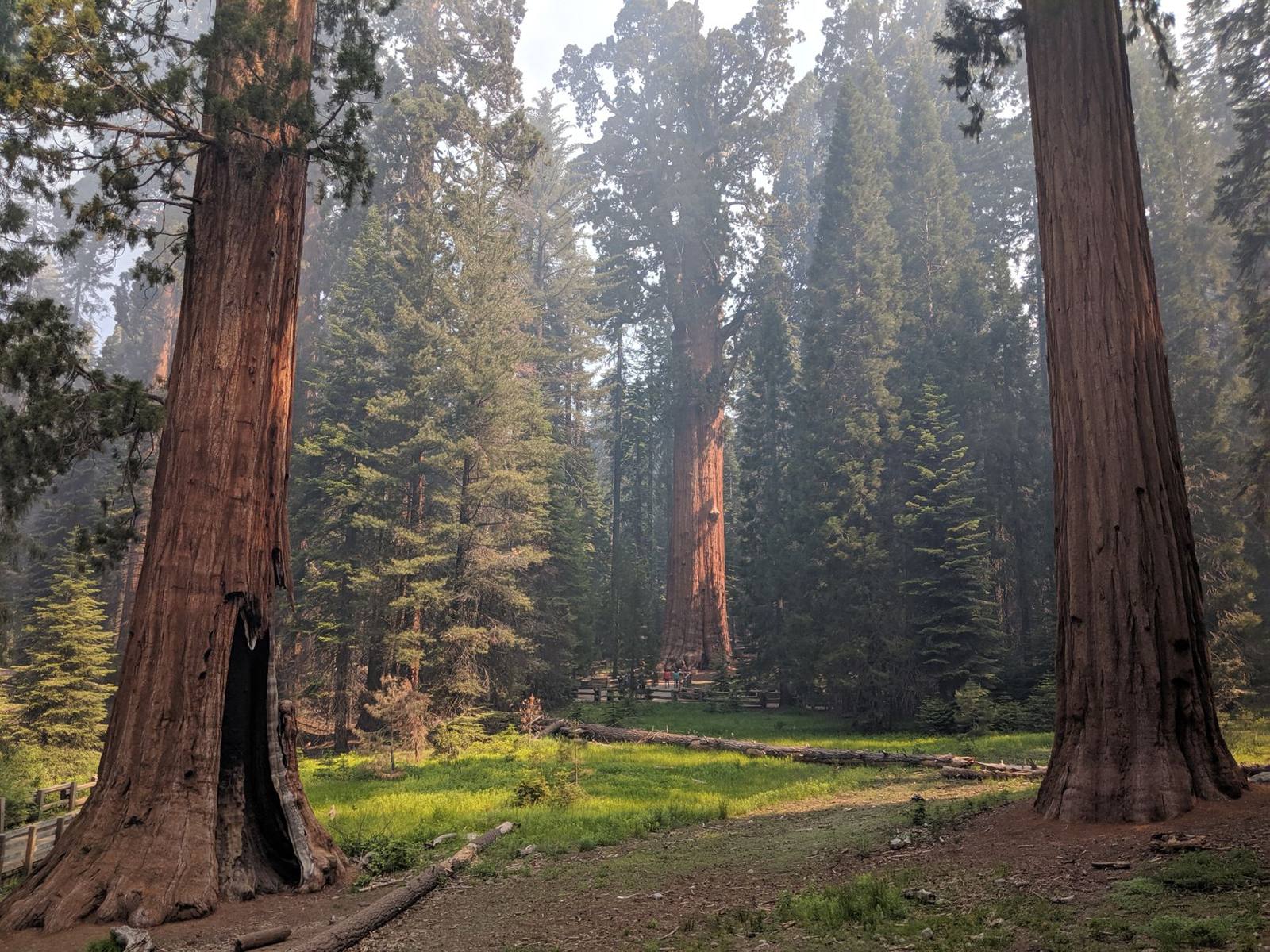
Freeman Creek Grove covers 4,192 acres in Sequoia National Forest and is the largest unlogged giant sequoia grove outside a national park, as well as the easternmost grove in the species’ range1. In 1992, President George H.W. Bush stood beside a large sequoia at the base of the grove and signed a proclamation protecting giant sequoia groves on National Forest System land; that tree is now known as the President George H.W. Bush Tree1. The grove holds roughly 800 sequoias over 10 feet in diameter, but they are notably young for the species, mostly under 1,000 years old, with no fallen giants recorded1. The Freeman Creek Trail runs about four miles one way, descending from 7,100 feet to 5,200 feet through the grove and beyond it1. As of September 2026, portions of the trail and grove are closed for repairs, with reopening expected in 20271.
- Size: 4,192 acres, the largest unlogged sequoia grove outside a national park1
- Location: the easternmost giant sequoia grove in California1
- Named tree: the President George H.W. Bush Tree, site of a 1992 proclamation1
- Grove composition: about 800 trees 10+ ft in diameter; ages mostly under 1,000 years; no fallen giants1
- Trail: Freeman Creek Trail, about 4 miles one way, 7,100 ft down to 5,200 ft1
- Season: May 15 to November 151
- Current status (as of September 2026): portions closed for repairs, expected to reopen in 20271
Freeman Creek Grove does not get the crowds that Sequoia and Kings Canyon National Parks do, and its own managing agency currently has part of it closed. That combination makes it one of the more overlooked stops in where to see giant sequoias, despite holding a claim that larger, better-known groves cannot make.
The largest unlogged grove outside a national park
Freeman Creek Grove sits within Sequoia National Forest, part of the patchwork of federal land that also includes the Giant Sequoia National Monument. At 4,192 acres, the Forest Service describes it as the largest unlogged giant sequoia grove that lies outside the boundaries of a national park, and also the easternmost grove in the species’ native range1. That combination is unusual. Most of the largest surviving old-growth groves, including Redwood Mountain and Giant Forest, sit inside Sequoia and Kings Canyon National Parks, protected from the logging era that gutted places like Converse Basin. Freeman Creek escaped that fate while remaining national forest land the entire time.
The grove is one of 33 that the Sequoia National Forest manages across its northern and southern districts, split between the Hume Lake Ranger District in the north and the Western Divide Ranger District in the south, where Freeman Creek is located2. The broader designation protecting groves like this one, the Giant Sequoia National Monument, was proclaimed by President Bill Clinton on April 15, 2000, from beneath what is now called the Proclamation Tree at the Trail of 100 Giants, not far from Freeman Creek34.
The trees inside the grove
What sets Freeman Creek apart is not just its size but the age of its trees. The Forest Service counts roughly 800 sequoias in the grove measuring 10 feet or more in diameter, with a few reaching 20 feet across and more than 100 trees at 15 feet in diameter1. Despite those numbers, the sequoias here are relatively young by the species’ standards, mostly less than 1,000 years old, and the grove has no fallen giants on the ground, a detail the Forest Service specifically notes1. That combination, a young, still-growing population with no dead giants littering the forest floor, is part of what makes Freeman Creek feel different from older, more storied groves like Giant Forest or Redwood Mountain, where ancient snags and downed trunks are part of the scenery.
The President George H.W. Bush Tree and the 1992 proclamation
The grove’s most famous tree earned its name from a single event. In 1992, President George H.W. Bush traveled to the base of Freeman Creek Grove and, standing beside one of its large sequoias, signed a proclamation protecting giant sequoia groves across National Forest System lands1. The tree has been known as the President George H.W. Bush Tree since, and it remains reachable via Forest Road 20S781. It is one of a small number of named sequoias with a direct connection to federal conservation policy rather than to a Gold Rush-era logging story or a Victorian exhibition, the more common origin for a big tree’s name in this part of California.
Hiking the Freeman Creek Trail
The Freeman Creek Trail runs about four miles one way, dropping from roughly 7,100 feet in elevation to about 5,200 feet as it follows Freeman Creek before crossing a ridge through a mixed forest of sugar pine and black oak1. It is a descending hike out and a climbing one back, the reverse of the usual approach to a sequoia grove trail, since most groves in the national parks are reached by walking downhill to a named tree and then climbing back to the car. Mountain bikes are permitted on designated sections of trail here, which is unusual for a grove of this size and age; bikes are prohibited on nearly every sequoia grove trail inside the national parks1.
Getting there
Access to Freeman Creek Grove is roundabout by design, reflecting its position in national forest land rather than a developed park corridor. From the San Joaquin Valley, the route runs via Highway 99 or State Highway 190 to Lloyd Meadow Road, also signed as Forest Road 22S82, which leads into the grove area from the community of Johnsondale1. The grove’s season runs May 15 through November 15, reflecting a high-elevation approach that is not maintained for winter travel1. For the broader Monument that surrounds groves like this one, along with nearby Trail of 100 Giants, see the Giant Sequoia National Monument guide and the Trail of 100 Giants guide, the most accessible and heavily visited grove nearby.
Current access, as of September 2026
As of September 2026, the Forest Service’s Freeman Creek Grove page states that portions of the trail and grove are closed for repairs, with reopening expected in 20271. Anyone planning a visit should check the current Sequoia National Forest recreation page before making the drive, since a grove this remote is not a place to discover a closure on arrival, and repair timelines on national forest land can shift.
There is no visitor center or paved trailhead here, which is part of why Freeman Creek stays quiet even in peak summer months. Anyone weighing whether the detour is worth it should compare it against the more developed options nearby: Trail of 100 Giants has a paved, largely accessible loop and a campground directly across the road, while Freeman Creek trades that convenience for a longer approach, a young but extensive stand of sequoias, and, currently, a partial closure. Travelers coming from the Trail of 100 Giants or planning a longer loop through the Giant Sequoia National Monument can treat Freeman Creek as an optional add-on once the closed sections reopen, rather than a primary destination on its own.
Frequently Asked Questions
What is Freeman Creek Grove known for?
It is the largest unlogged giant sequoia grove outside any national park and the easternmost grove in the species’ range, and it is home to the President George H.W. Bush Tree, where Bush signed a 1992 proclamation protecting giant sequoia groves on national forest land1.
How big is Freeman Creek Grove?
The grove covers 4,192 acres and contains roughly 800 sequoias measuring 10 feet or more in diameter, with a few reaching 20 feet across1.
How long is the Freeman Creek Trail?
About four miles one way, descending from roughly 7,100 feet to 5,200 feet in elevation as it follows Freeman Creek1.
Are mountain bikes allowed at Freeman Creek Grove?
Yes, on designated sections of the trail, which is unusual for a sequoia grove; most grove trails inside Sequoia and Kings Canyon National Parks prohibit bikes entirely1.
Is Freeman Creek Grove open right now?
As of September 2026, the Forest Service reports that portions of the trail and grove are closed for repairs, with reopening expected in 2027. Check the current Sequoia National Forest recreation page before visiting1.
How do you get to Freeman Creek Grove?
Access runs via Lloyd Meadow Road (Forest Road 22S82) from the community of Johnsondale, reached from the San Joaquin Valley by Highway 99 or State Highway 190. The season runs May 15 through November 151.
Is Freeman Creek Grove part of Sequoia National Park?
Related Articles
Sources
- Freeman Creek Grove — U.S. Forest Service, Sequoia National Forest. Accessed 2026-09-15.
- Explore the Forest — U.S. Forest Service, Sequoia National Forest. Accessed 2026-09-15.
- Giant Sequoia National Monument – North — U.S. Forest Service, Sequoia National Forest. Accessed 2026-09-15.
- Trail of 100 Giants (Long Meadow Grove) — U.S. Forest Service, Sequoia National Forest. Accessed 2026-09-15.