
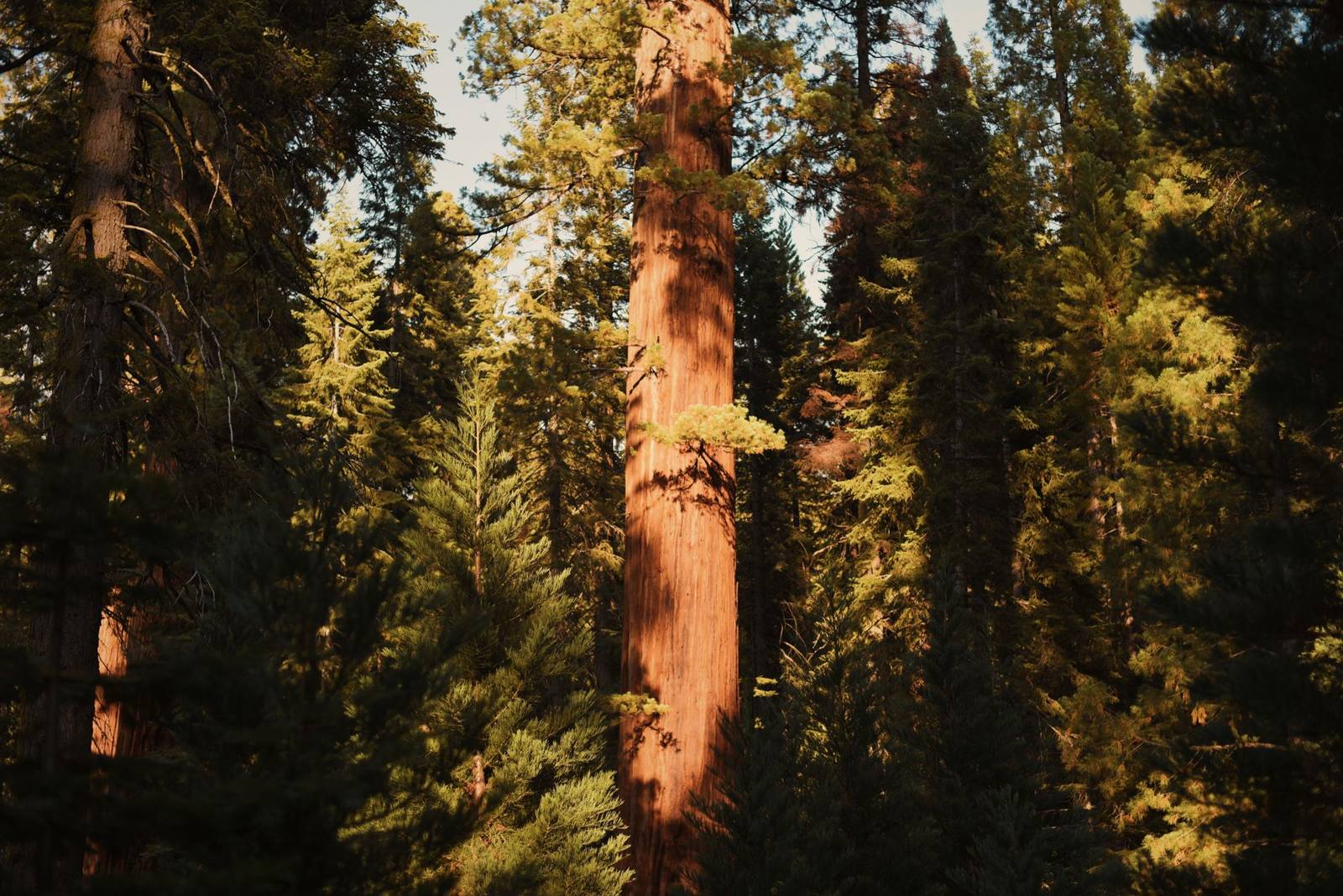
No single, verified figure exists for how much carbon an individual old-growth giant sequoia stores in its native Sierra Nevada groves; none of the official or peer-reviewed sources checked for this article publish one12. What is documented is a ranking: old-growth coast redwood forest stores more carbon per acre than any other forest type studied, and giant sequoia forest, coast redwood’s closest relative, comes in second, according to 2020 research from Save the Redwoods League and Humboldt State University1. The best individual-tree measurements come from a 2024 study of giant sequoias planted in the United Kingdom, which recorded carbon accumulation rates from about 30 to 156 kilograms of carbon per tree per year, averaging around 85 kilograms per year across the sites studied, in trees decades old, not millennia old2. Scientists estimate a tree’s stored carbon from three inputs: trunk volume, wood density, and the fraction of dry wood that is carbon, typically applied using a carbon fraction of about 0.5 to 0.5423. Applied to General Sherman’s measured trunk volume of about 52,500 cubic feet (1,487 cubic meters), that method could in principle produce a number, but doing so responsibly requires an old-growth wood-density figure this article could not verify from an official source, so no total is given for that specific tree here.
- Verified per-acre ranking: coast redwood forest stores the most carbon per acre of any forest type studied; giant sequoia forest ranks second1
- Coast redwood benchmark: up to about 890 metric tons of carbon per acre in old-growth stands1
- Measured per-tree rate, cultivated UK giant sequoias: about 30 to 156 kg of carbon per tree per year, averaging roughly 85 kg/year2
- How estimates are built: trunk volume × wood density × carbon fraction (commonly ~0.5–0.54)23
- Worked-example input: General Sherman’s trunk volume, about 52,500 cu ft (1,487 m³)4
- What is missing: a published, sourced wood-density figure for old-growth giant sequoia trunk wood, needed to convert volume into a defensible carbon total23
- Research context: the study behind the UK figures is the first to measure actual carbon accumulation in giant sequoia outside its native range2
Giant sequoia is often described as a powerful carbon sink because it is the most massive tree species on Earth, but a precise, sourced number for how much carbon one mature tree stores is harder to find than the claim suggests. This page lays out what has actually been measured, what has only been ranked, and how the estimate would be built if better data existed. For the tree’s basic biology, see the giant sequoia trees guide.
What is actually known: a ranking, not a number
In April 2020, Save the Redwoods League and Humboldt State University published research, based on eleven years of measurement under the League’s Redwoods and Climate Change Initiative, concluding that old-growth coast redwood forests store more carbon per acre than any other forest type that has been studied, with figures reaching up to about 890 metric tons of carbon per acre1. The same research places giant sequoia forest, described as coast redwood’s closest relative, in second place for carbon storage per acre among forest types studied1. That comparison is a per-acre forest-level figure, not a per-tree number, and the announcement does not break out a specific carbon total for giant sequoia forests the way it does for coast redwood1.
Because it does not measure individual sequoia trees directly, this figure cannot answer “how much carbon does one giant sequoia store.” It does establish, with a citable source, that giant sequoia forest is among the most carbon-dense forest types anywhere, trailing only its closest living relative.
The best individual-tree measurements: cultivated trees in Britain
The most specific per-tree carbon figures available come from a 2024 study of giant sequoias planted in the United Kingdom, published as “Giant sequoia (Sequoiadendron giganteum) in the UK: carbon storage potential and growth rates”2. Researchers measured trees at several UK sites and recorded average annual carbon accumulation ranging from about 30 kilograms per tree per year at the lowest-performing site to roughly 85 kilograms per tree per year on average across sites, with individual fast-growing trees reaching as high as 156 kilograms of carbon in a single year2. Those figures used a carbon fraction of 0.54, meaning 54 percent of a tree’s dry wood mass was treated as carbon2.
Two caveats limit how far this data can travel. First, the UK trees studied are cultivated, open-grown specimens planted starting in 1853, not wild trees competing in a Sierra Nevada grove, and researchers found their growth rates comparable to same-age trees in the species’ native range, which suggests the figures are a reasonable proxy for young and middle-aged trees generally, not a claim about mature Sierra Nevada groves specifically2. Second, none of the UK trees are old-growth giants on the scale of General Sherman; the study’s oldest and largest specimens are still well short of the 2,000-plus-year individuals found in California2. A young, fast-growing tree can post an impressive annual rate simply because it is adding wood quickly, while an ancient tree adds wood more slowly per year in linear terms even as it holds vastly more total carbon in its accumulated trunk2.
How scientists actually estimate a tree's carbon
The general method scientists use to estimate a tree’s stored carbon has three components: the volume of wood in the tree, the density of that wood, and the fraction of the wood’s dry mass that is carbon23. Multiplying trunk volume by wood density gives the dry mass of the wood; multiplying that mass by the carbon fraction, commonly around 0.5 to 0.54, gives an estimate of stored carbon2. The UK study applied exactly this approach, using a carbon fraction of 0.54 for its calculations2.
Applying this method to a specific named tree requires a reliable wood-density figure for that species and age class. This is where a responsible estimate for a Sierra Nevada giant sequoia runs into a gap: the U.S. Forest Service’s Silvics manual, the most detailed official source on giant sequoia biology reviewed for this article, describes old-growth wood as brittle with low tensile strength but does not publish a specific dry-wood density or specific-gravity figure usable in this formula3. Without that number from an official source, this article will not manufacture one.
Using General Sherman as the worked example, honestly
The task of estimating one very large tree’s carbon is a useful way to see the method even where the final number is out of reach. General Sherman’s trunk volume is documented by the National Park Service at about 52,500 cubic feet, or roughly 1,487 cubic meters, with an estimated trunk weight near 1,400 tons4. That volume figure is the correct starting input for the trunk-volume step of the carbon calculation described above.
What is missing is the middle step: a sourced wood-density figure specific to old-growth giant sequoia trunk wood, which would convert that volume into a dry-wood mass, and from there, using a carbon fraction near 0.5, into an estimate of stored carbon. The NPS trunk-weight estimate of about 1,400 tons is not clearly specified as green (wet) or dry weight in the source, and green wood carries substantial water weight that is not carbon, so using that figure directly as a stand-in for dry wood mass would overstate the result4. Rather than combine an unverified density assumption with an ambiguous weight figure to produce a specific number for General Sherman, this article states the honest limit: the volume is well documented, the method is well documented, and the missing input is a wood-density figure this research could not verify from an official or peer-reviewed source, so no total-carbon figure for General Sherman appears here. Readers who want it can watch for updated research from Save the Redwoods League, which led the 2020 forest-carbon study, or from the team behind the 2024 UK study, both of which are positioned to publish exactly this kind of figure12.
Why the size still matters for climate purposes
Even without a precise per-tree number, the underlying logic holds: a tree that adds cubic feet of wood every year for thousands of years, and that can hold more total wood in a single trunk than any other tree species, is removing and holding carbon on a scale few living things match, which is consistent with giant sequoia forest ranking second only to coast redwood in the 2020 per-acre study1. Because old sequoias continue adding wood volume at a roughly steady or even increasing rate rather than slowing down as they age, an old, large tree is not a spent asset for carbon storage; it is closer to the opposite.
Frequently Asked Questions
How much carbon does a giant sequoia store?
There is no verified, sourced figure for an individual old-growth giant sequoia. What is documented is a ranking: giant sequoia forest stores the second-most carbon per acre of any forest type studied, after coast redwood forest1.
Is there any measured carbon figure for a giant sequoia tree?
Yes, for cultivated trees. A 2024 study of giant sequoias planted in the UK measured carbon accumulation rates from about 30 to 156 kilograms per tree per year, averaging around 85 kilograms per year, though those are young to middle-aged cultivated trees, not ancient Sierra Nevada specimens2.
How is a tree's carbon storage calculated?
By multiplying trunk volume by wood density to get dry wood mass, then multiplying that by a carbon fraction, typically around 0.5 to 0.54, since roughly half of dry wood mass is carbon2.
Why can't you calculate General Sherman's total stored carbon?
Do giant sequoias store more carbon than coast redwoods?
No, based on the sources checked. The 2020 Save the Redwoods League and Humboldt State University research found old-growth coast redwood forest stores the most carbon per acre of any forest type studied, with giant sequoia forest ranking second1.
Does an old giant sequoia keep adding carbon as it ages?
Yes, in terms of wood volume. Giant sequoias continue adding wood at a roughly steady or even increasing annual rate as they age, rather than slowing down, which is documented for the tree’s growth generally, though a specific per-year carbon figure for old-growth trees was not found in sources checked for this article3.
Are UK-grown giant sequoias a good stand-in for California trees when estimating carbon?
Partially. Researchers found the UK trees’ growth rates comparable to same-age native-range trees, which supports using the UK figures as a rough proxy for young and middle-aged trees. The UK’s oldest specimens are still far younger than ancient Sierra Nevada giants, so the comparison does not extend to old growth2.
Related Articles
Sources
- Research From Save the Redwoods League and Humboldt State University Confirms Significant Role of Redwood Forests in California’s Climate Fight — Save the Redwoods League. Accessed 2026-09-15.
- Giant sequoia (Sequoiadendron giganteum) in the UK: carbon storage potential and growth rates — Holland et al., Royal Society Open Science, 2024, via PubMed Central. Accessed 2026-09-15.
- Sequoiadendron giganteum, Silvics of North America — U.S. Forest Service. Accessed 2026-09-15.
- The General Sherman Tree — National Park Service, Sequoia & Kings Canyon. Accessed 2026-09-15.