
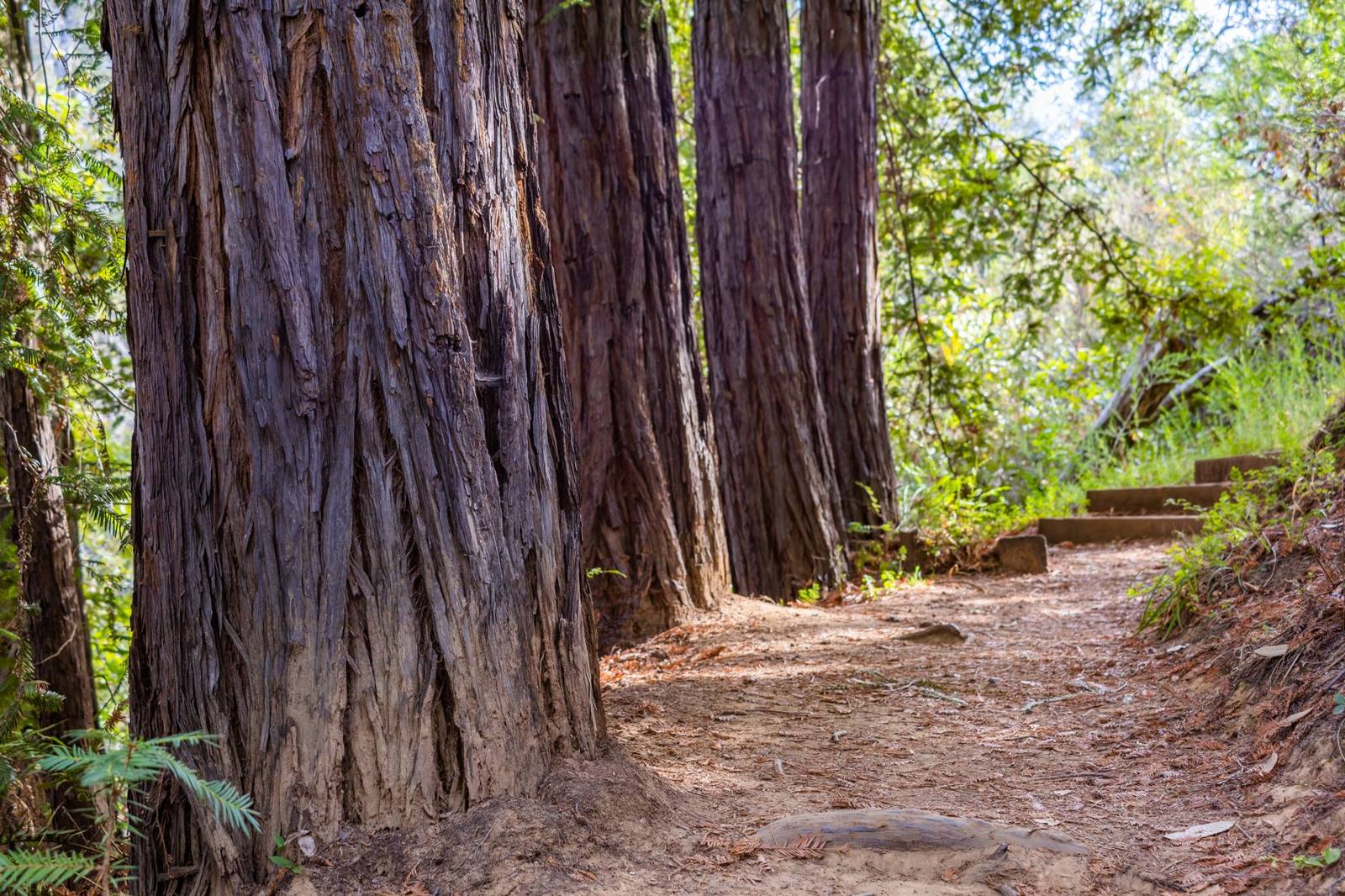
California has two state trees, not one. Government Code Section 422 reads “the California redwood” and then, in parentheses, lists two Latin names: Sequoia sempervirens and Sequoia gigantea, an older synonym for what botanists now call Sequoiadendron giganteum, the giant sequoia1. The section was part of the Government Code when it was enacted in 1943 and was amended in 1953, under Statutes Chapter 1140, to spell out both species rather than leave “California redwood” open to one reading, according to the California State Capitol Museum2. The two trees named in that one law could hardly be less alike day to day: coast redwood is the tallest tree species alive, and giant sequoia is the most massive by trunk volume, led by the General Sherman Tree at roughly 52,500 cubic feet of trunk wood34. The statute has never been updated to use the current genus name Sequoiadendron, so California’s law books still carry a scientific name that taxonomists retired in 19395.
- Law: California Government Code, Section 4221
- Text of the law: “The California redwood (Sequoia sempervirens, Sequoia gigantea) is the official state tree”1
- Codified: as part of the Government Code, added by Statutes of 1943, Chapter 1342
- Amended: 1953, Statutes Chapter 1140, to cover both species by name12
- Species named: coast redwood (Sequoia sempervirens) and giant sequoia, listed under its old name Sequoia gigantea, now Sequoiadendron giganteum15
- Tallest of the two: coast redwood; Save the Redwoods League cites the Hyperion tree in Redwood National Park at 380 ft3
- Largest of the two: giant sequoia; General Sherman in Sequoia National Park holds about 52,500 cubic feet of trunk wood, more than any other living tree4
- Where each grows wild: coast redwood in a coastal fog belt from central California into southern Oregon; giant sequoia in roughly 94 groves confined to the western slope of the Sierra Nevada36
Search for “California’s state tree” and most results give a single answer. The correct one is two trees at once. California’s Government Code names both the coast redwood and the giant sequoia as the official state tree, and the two species have almost nothing in common except being large, long-lived, and native to California. This page walks through what the law actually says, how it ended up naming two different trees, and where each one grows. For the full picture of giant sequoias specifically, see the giant sequoia trees guide.
What the law actually says
California Government Code Section 422, part of Title 1’s chapter on the state flag and emblems, reads in full: “The California redwood (Sequoia sempervirens, Sequoia gigantea) is the official state tree”1. The scientific names in parentheses are doing the real work. Sequoia sempervirens is the coast redwood. Sequoia gigantea is an old scientific name for the giant sequoia, a name that was standard before 1939 and has not been botanically correct since, a point covered in detail on the page about Sequoiadendron giganteum’s taxonomy.
The California State Capitol Museum’s official page on the state symbols confirms the two-part history: the section was added to the Government Code in 1943 and amended in 1953, under Statutes Chapter 1140, to recognize “two related native species of redwood trees, the Coast Redwood and giant Sequoia,” as joint holders of the title2. The museum’s page does not give a legislative explanation for why the amendment was needed, only that it happened. What the text shows is straightforward: lawmakers took a law that already named both species in parentheses and used the 1953 amendment to make that dual designation explicit rather than ambiguous.
Because the statute has not been updated since 1953, it still carries “Sequoia gigantea,” a name Swedish-American botanist John T. Buchholz replaced in 1939 when he created the separate genus Sequoiadendron for the giant sequoia5. State law and current botanical nomenclature disagree, and nobody has moved to reconcile them.
Two different trees, one title
Pairing these two species as a single state symbol groups together the tallest tree species on Earth and the most massive one, and little else about them matches. The table below lines up the basics.
| Coast redwood | Giant sequoia | |
|---|---|---|
| Scientific name | Sequoia sempervirens | Sequoiadendron giganteum |
| Claim to fame | Tallest tree species alive | Largest tree by trunk volume |
| Record individual | Hyperion, 380 ft, Redwood National Park | General Sherman, 274.9 ft tall, ~52,500 cu ft trunk, Sequoia National Park |
| Native range | Narrow coastal fog belt, central California to southern Oregon | About 94 scattered groves on the western Sierra Nevada slope, 4,000–8,000 ft elevation |
| Water source | Coastal fog, absorbed partly through foliage | Sierra Nevada snowpack |
| How it reproduces | Resprouts from stumps and burls as well as by seed | Almost entirely by seed; stump sprouts only before about age 20 |
| Oldest known age | More than 2,200 years | More than 3,200 years |
Sources: Save the Redwoods League on coast redwoods3; the National Park Service on General Sherman4; the U.S. Forest Service’s Silvics manual on both species’ biology and range67.
The two are close relatives, both in the cypress family, Cupressaceae, along with the dawn redwood, but they are different genera that split apart long before either was named5. A companion page works through the differences point by point: sequoia vs. redwood, side by side, and a field-identification guide covers how to tell a giant sequoia from a coast redwood by bark, needles, and cones.
Why the wording still causes confusion
Search engines and casual references often shorten “California’s state tree” to just “the redwood,” and readers reasonably assume that means the coast redwood, the species usually meant by “redwood” outside California. The statute’s own wording, with two scientific names sitting side by side in one sentence, is the reason both species share the title rather than either one alone1. It also means state literature can legitimately call either the coast redwood or the giant sequoia “California’s state tree” without being wrong, since the law names both.
This is not the only naming tangle around these trees. The genus name “Sequoia” itself is commonly assumed to honor the Cherokee scholar Sequoyah, though the origin is disputed among botanical historians, a question worked out in full on the page why is it called sequoia. And because giant sequoia was reclassified out of the genus Sequoia in 1939, the word “sequoia” in a strict taxonomic sense now refers only to the coast redwood, even though “giant sequoia” remains the universal common name for the Sierra Nevada tree, a point explained further on the Sequoiadendron giganteum taxonomy page.
Where to see each state tree
Because the two species occupy entirely different parts of California, seeing both usually means two separate trips. Giant sequoias grow only in the Sierra Nevada, most accessibly in Sequoia and Kings Canyon National Parks, Yosemite’s three groves, and the various groves of Giant Sequoia National Monument; the where to see giant sequoias guide ranks every option. Coast redwoods grow in a coastal strip from Big Sur to just over the Oregon border, most famously in Redwood National and State Parks and Muir Woods. A side-by-side comparison of the two kinds of parks is at Redwood National Park vs. Sequoia National Park.
For visitors who want the largest example of each species in one reference, General Sherman’s full statistics, including how it got its name and how to walk to it, are on the General Sherman Tree page, and thirty additional verified figures about the species are collected in 30 giant sequoia facts.
Frequently Asked Questions
Is the giant sequoia California's state tree?
Yes, jointly with the coast redwood. California Government Code Section 422 names “the California redwood,” with both Sequoia sempervirens (coast redwood) and Sequoia gigantea, the old name for giant sequoia, listed in parentheses as the species covered1.
When did California name a state tree?
The state-tree provision was part of the Government Code when that code was enacted in 1943, and it was amended in 1953 to make clear it covered both coast redwood and giant sequoia2.
Why does California have two state trees instead of one?
Are coast redwood and giant sequoia the same tree?
Does California's law use the correct scientific name for giant sequoia?
Which is bigger, the state's coast redwood or its giant sequoia?
Where can I see California's state tree in person?
Related Articles
Sources
- California Code, Government Code – GOV § 422 — California Legislative Information. Accessed 2026-09-15.
- Tree – Coast Redwood and Giant Sequoia — California State Capitol Museum. Accessed 2026-09-15.
- Coast Redwoods — Save the Redwoods League. Accessed 2026-09-15.
- The General Sherman Tree — National Park Service, Sequoia & Kings Canyon. Accessed 2026-09-15.
- Sequoiadendron giganteum — The Gymnosperm Database. Accessed 2026-09-15.
- Giant Sequoias — Save the Redwoods League. Accessed 2026-09-15.
- Sequoiadendron giganteum, Silvics of North America — U.S. Forest Service. Accessed 2026-09-15.