
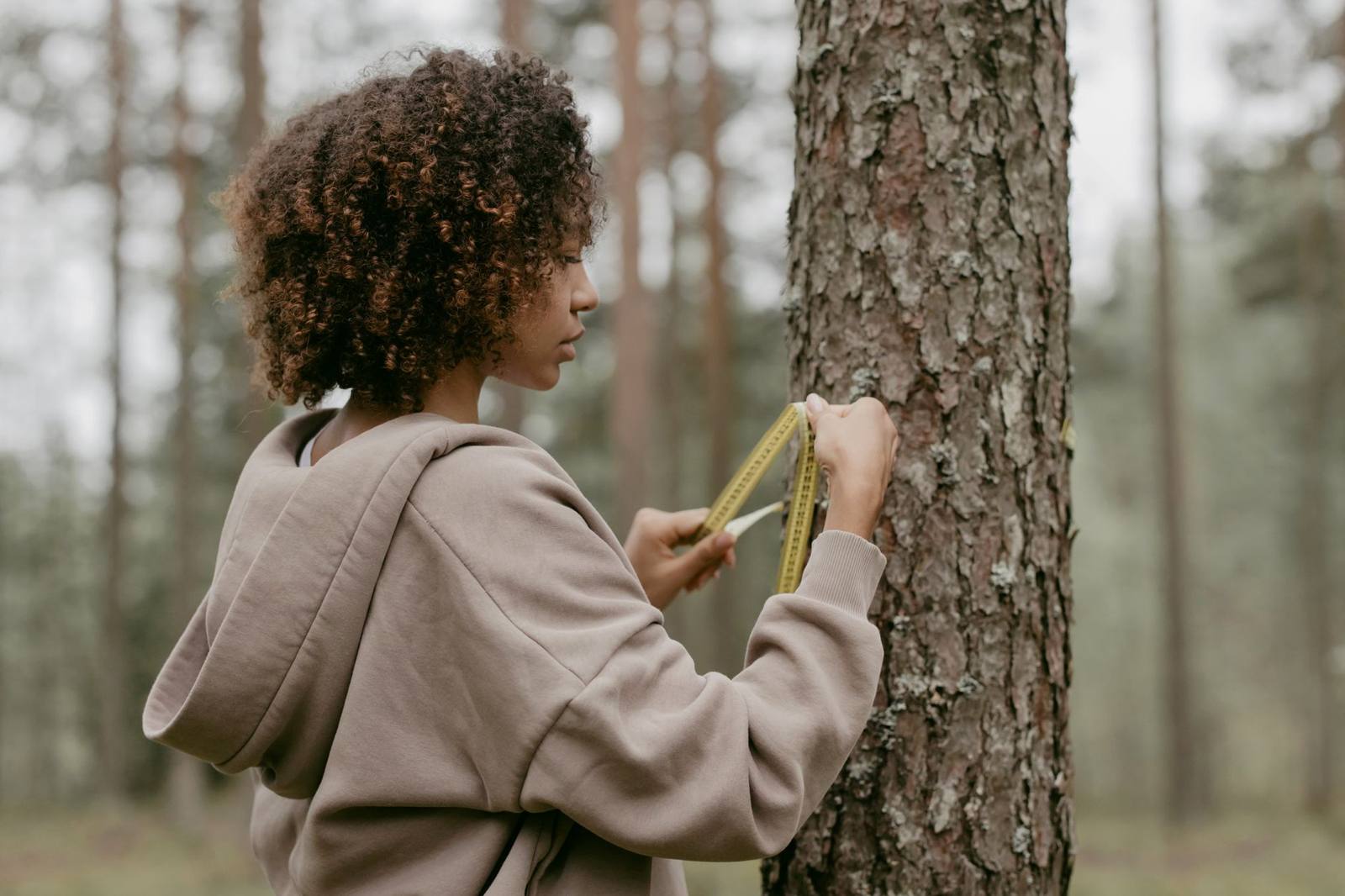
This lesson plan fits a single 45-minute class period and needs only string, a tape measure, and simple counting materials such as dried beans. The core activity has students lay out a 36.5-foot length of string to match the base diameter of the General Sherman Tree, the tree with the most wood of any living thing on Earth1. A second activity uses about 200 small objects to model the seeds packed into one sequoia cone, which is only 2 to 3.5 inches long2. A third activity has students count rings on a stump cross-section, the same method researchers used when a Sierra Nevada sequoia stump was ring-counted at more than 3,200 years old23. The plan closes with discussion questions on fire ecology and links to the National Park Service’s own classroom, field-trip, and virtual-learning programs6.
- General Sherman’s base diameter is 36.5 feet, the number the string activity is built around1
- A sequoia cone is 2 to 3.5 inches long and holds about 200 seeds2
- It takes roughly 91,000 sequoia seeds to weigh one pound4
- A documented sequoia stump was ring-counted at more than 3,200 years old23
- Giant sequoias are a pioneer species that need the sunlit, bare-soil gaps fire creates in order to reproduce5
- A single large sequoia can carry 10,000 to 30,000 cones at once2
- The National Park Service offers free ranger classroom visits, field trips, and virtual programs for schools6
This lesson plan is built for a teacher or homeschool parent who needs something usable today: an objective, a script for 45 minutes, three activities with materials most schools already have on hand, and a source for every number a sharp student might ask about. It draws on the same National Park Service and U.S. Forest Service data behind the site’s main page on giant sequoia trees, scaled down to classroom time and classroom supplies. Nothing here requires a field trip, though the closing section links to the real thing in case one is possible.
Learning objectives
By the end of the lesson, students should be able to:
- State at least three verified facts about giant sequoia size, reproduction, or fire ecology, each traceable to a source
- Explain why sequoia cones stay closed for years and what makes them open
- Explain why fire helps sequoias reproduce instead of only destroying them
- Use direct measurement — string, seed counts, ring counts — to build a physical sense of numbers that are otherwise abstract
Grade level, time, and materials
This works for grades 3 through 8 with light adaptation; younger students can skip the multiplication step in Activity 2. It takes one 45-minute period. You will need:
- A ball of string or twine, at least 37 feet, plus scissors or a tape measure to mark 36.5 feet of it
- Sidewalk chalk or masking tape, and an open space such as a gym floor, hallway, or blacktop
- Dried beans, lentils, or rice (about 200 per small group) and small cups
- A printed cross-section of a tree trunk with growth rings, or a real cut branch or “tree cookie” if one is available
- Colored pencils and a blank number line for the ring-counting step
A 45-minute sequence
| Time | Segment |
|---|---|
| 0–5 min | Hook: show General Sherman’s stats and ask students to guess its width |
| 5–15 min | Activity 1: measure the tree’s base with string |
| 15–25 min | Activity 2: count the seeds in a cone |
| 25–35 min | Activity 3: count the rings, find the age |
| 35–45 min | Discussion questions and wrap-up |
Opening hook
Tell students that the General Sherman Tree in Sequoia National Park is 274.9 feet tall and that its trunk weighs almost 1,400 tons1. Ask them to guess how wide the base is before revealing the answer in Activity 1.
Activity 1: How wide is the biggest tree on Earth?
General Sherman is called the biggest tree on Earth because it holds more wood in its trunk than any other living tree, not because it is the tallest or the oldest1.
- Measure and cut, or mark with tape, 36.5 feet of string — the exact base diameter of General Sherman’s trunk1.
- Lay the string in a straight line on the floor and have two students hold the ends.
- Ask the class to guess how many students, lying end to end with arms outstretched, it would take to span that distance. Test the guess.
- For a circle version, cut string to about 115 feet (36.5 feet × π) and lay it in a loop on the floor to model the trunk’s footprint. The National Park Service also gives a directly measured circumference of 102.6 feet at the ground, which is close but not identical, since a tree trunk is not a perfect circle1.
- Point out that this activity measures width on purpose. General Sherman’s height of 274.9 feet is taller than most schools can measure indoors1.
Activity 2: Count the seeds in a cone
- Show students the size comparison: a sequoia cone is only 2 to 3.5 inches long, about the size of a chicken egg2.
- Each small group counts out 200 seed-sized objects — beans, lentils, or rice — into a cup. That is roughly how many actual seeds sit inside one real cone2.
- Explain that real sequoia seeds are far smaller than a bean or a grain of rice; it takes about 91,000 of them to weigh one pound4.
- Extend the math for older students: a single large sequoia can carry 10,000 to 30,000 cones at once2. Multiplying 200 seeds by 10,000 cones shows that one tree can hold roughly two million seeds in reserve, waiting for the right conditions.
Activity 3: Count the rings, find the age
- Explain that scientists date very old sequoias by counting growth rings in a cross-section, most often from a stump rather than a living tree2.
- In 1914, USGS researcher Ellsworth Huntington ring-counted 458 giant sequoia stumps in the Sierra Nevada as part of an early study of the species’ ages3.
- One stump examined by U.S. Forest Service researchers came out to more than 3,200 years old2.
- Have students count the rings on their printed sample or tree cookie, then mark that many years back on a number line. A tree that reached 3,200 years old was already growing before the founding of ancient Rome.
Discussion questions
- General Sherman is called the biggest tree, not the tallest or the oldest. What is the difference between big, tall, and old for a tree, and why might a tree be one but not the others1?
- Why might a tree benefit from keeping its cones closed for up to 20 years instead of releasing seeds right away4?
- Giant sequoia roots rarely reach more than a few feet deep, yet the trees can stand for thousands of years. What does that suggest about how the roots are shaped instead2?
- Giant sequoia reproduction failed across much of the 1900s. What changed once land managers began setting fires on purpose5?
- If you were a park ranger planning a controlled fire in a sequoia grove, what would you want to check beforehand?
- Why do you think a stump, rather than a living tree, is the usual source for ring-counting an old sequoia2?
Send students to the kids' pages next
For independent reading or a follow-up assignment, point students to giant sequoia facts for kids, Sequoia National Park facts for kids, and how big is the General Sherman Tree. Students curious about fire specifically can read why do sequoias need fire, a kid-friendly explanation, and a class that wants to grow its own sequoia from seed can follow grow a giant sequoia in the classroom.
NPS education resources
The National Park Service runs its own classroom programs for Sequoia and Kings Canyon, including free ranger visits to a classroom, organized field trips into the parks, and virtual learning sessions that bring a ranger in remotely6. The same page also links to Every Kid Outdoors, the federal program that gives fourth graders and their families a free annual pass to national parks and other federal lands6. A teacher planning ahead should start with the National Park Service’s education programs for Sequoia and Kings Canyon6 to check current scheduling and availability before the school year fills up.
Frequently Asked Questions
How long does this lesson take?
The full sequence, including all three activities and discussion, fits a standard 45-minute class period.
What grade levels is this lesson plan for?
It is written for grades 3 through 8. Younger students can do the measuring and counting activities without the multiplication extension in Activity 2.
Do I need a real sequoia cone for the activities?
No. A picture or description of the size is enough; the seed-counting activity uses dried beans, lentils, or rice as stand-ins2.
How wide is the General Sherman Tree really?
Its base diameter is 36.5 feet and its circumference at the ground is 102.6 feet1.
Why do giant sequoias need fire?
Fire dries out their cones so seeds are released, clears dead needles so seeds reach bare soil, and opens sunny gaps where seedlings can grow; without it, sequoia reproduction largely failed through the 1900s5.
Can a class do a virtual visit with a park ranger?
Yes. The National Park Service offers virtual learning sessions for Sequoia and Kings Canyon that bring a ranger into a classroom remotely6.
How do scientists know a sequoia's age?
Related Articles
Sources
- The General Sherman Tree — National Park Service, Sequoia & Kings Canyon. Accessed 2026-09-15.
- Sequoiadendron giganteum, Silvics of North America — U.S. Forest Service. Accessed 2026-09-15.
- Ellsworth Huntington’s 1914 Giant Sequoia Ages and Tree-Ring Measurements of 458 Stumps, Sequoia — U.S. Geological Survey. Accessed 2026-09-15.
- Giant Sequoias — National Park Service, Sequoia & Kings Canyon. Accessed 2026-09-15.
- Giant Sequoias and Fire — National Park Service, Sequoia & Kings Canyon. Accessed 2026-09-15.
- Education Programs — National Park Service, Sequoia & Kings Canyon. Accessed 2026-09-15.